Best Cervical Pillow for Side Sleepers: How Contour Pillows Work and Who They Suit
The best cervical pillow for side sleepers is the one whose neck roll matches the height of your shoulder, and for most average frames that points to the Royal Therapy Memory Foam Contour Pillow, with its removable layer and 6.5-inch Extra size. Smaller frames do better on the lower UTTU or VYLEE. The shape matters less than the height: the trials on contour pillows are mixed, and this page shows both sides. It also explains how the neck roll works and who should skip contour pillows altogether.

What a cervical pillow actually is
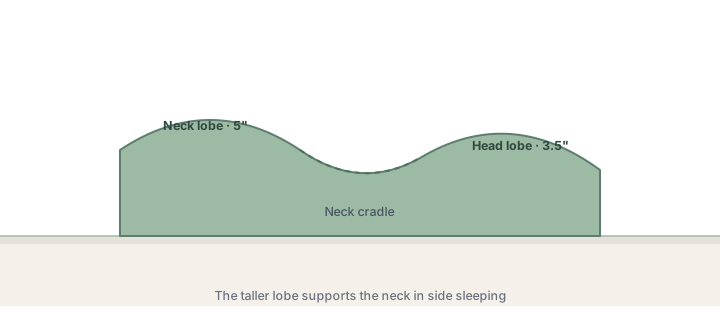
A cervical pillow, also sold as a contour or orthopedic pillow, is a molded foam block with a raised roll along one or both long edges and a lower dip in the middle. Cervical refers to the neck, the part of the spine the pillow is shaped to hold. The roll sits under your neck and the dip holds your head.
The idea matches a piece of standard advice. Harvard Health tells side sleepers to keep the spine straight using a pillow that is higher under your neck than your head. A regular pillow is the same height all the way across, so your head presses it down while the neck may hang over a gap. A contour pillow builds that difference in.
Sleep Foundation's medically reviewed side-sleeping page describes it the same way: you may prefer a cervical pillow, which has a higher part to support the neck and a lower loft under the head. It also says the most important factors are the pillow's shape and height, which is the theme of this whole page. All four picks here are memory foam, the most common material for this shape. If you want to compare other memory foam designs, see our memory foam pillow guide.
Cervical pillows: our 4 picks
#1 · Best cervical pillow overall
Royal Therapy Memory Foam Contour Pillow
It reaches the tallest setting of the contour pillows in our catalogue: the Queen is listed at 5 inches, a removable middle layer gives a second height, and the Extra size is 6.5 inches for broad shoulders. The foam is CertiPUR-US and the cover OEKO-TEX. Amazon's summary of buyer reviews highlights the neck support and two height levels.
- Type
- Contour cervical (memory foam, layered)
- Height
- 5 in (Queen); 6.5 in Extra size
- Fill
- Memory foam
- Price band
- Mid-range
#2 · Best for small frames
UTTU Sandwich Cervical Pillow
With its middle layer removed the UTTU drops to 4.0/3.2 inches, one of the lowest contour settings we list, and it goes up to 5.2/4.5 inches with the layer in. That makes it a good match for narrow shoulders or a soft mattress. It will be too low for broad shoulders.
- Type
- Contour cervical (removable layer)
- Height
- 5.2/4.5 in; 4.0/3.2 in with layer removed
- Fill
- Memory foam
- Price band
- Mid-range
#3 · Best two-edge contour
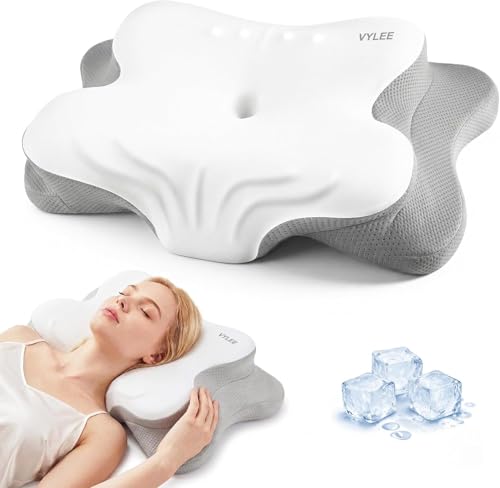
VYLEE Cervical Neck Pillow
Instead of a removable layer, the VYLEE has two neck-roll edges, 3.9 and 4.9 inches, so you turn it to pick the side that fits. The listing calls it soft but supportive, which may suit someone who finds most contour foam too hard. It lists a 12-month warranty; some buyers mention lumpiness.
- Type
- Contour cervical (dual height)
- Height
- 3.9 in / 4.9 in (two edges)
- Fill
- Memory foam
- Price band
- Mid-range
#4 · Best budget cervical pillow
Cozyplayer Ultra Pain Relief Cooling Cervical Pillow
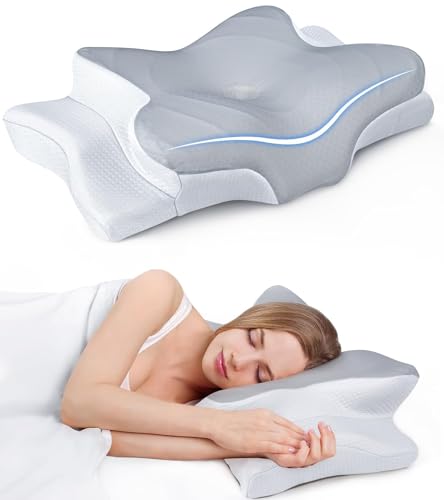
A budget-band contour pillow at 5.1 inches whose height changes when you rotate it 180 degrees. The listing states a 100-night trial, which is useful when you are testing whether the contour shape suits you at all. It is smaller than a standard pillow, about 23 by 13 inches.
- Type
- Contour cervical (memory foam)
- Height
- 5.1 in; height changes by rotating it
- Fill
- Memory foam
- Price band
- Budget


We earn a commission if you buy through these links, at no extra cost to you. As an Amazon Associate we earn from qualifying purchases. Prices and availability are shown on Amazon and can change.
The neck roll, the head dip and your shoulder
On your side, three heights have to agree. Your shoulder sets how far your ear sits above the mattress. The neck roll has to fill the space under the side of your neck. The head dip has to be low enough that your head isn't pushed toward the ceiling, but high enough that it doesn't drop toward the bed.
When the roll is too low, your neck sags into the gap and bends down. When it's too high, it pushes your neck up and the head tilts away from the mattress. Cleveland Clinic chiropractor Andrew Bang's rule of thumb applies to either fault: a proper pillow should keep your neck parallel to the mattress, rather than bent down or up.
That is why a contour pillow can't be a one-size product, even though it is often sold as one. A 2025 biomechanics study of side sleepers found that shoulder width, combined with pillow height, predicted the neck curve well. Two people with different shoulders need different roll heights from the same shape. Most contour pillows deal with this in one of three ways, and the picks above cover all three: a removable foam layer (Royal Therapy, UTTU), two edges of different height (VYLEE), or a pillow you rotate to change the height (Cozyplayer).
Notice how much you have to turn your head around to fit the shape. A contour pillow rewards someone who stays in one spot. If you shift a lot, the roll may end up under your cheek.
Who does well on a contour pillow?
From the research and clinician guidance above, a contour pillow tends to suit you if you mostly stay on your side or move between side and back, because the design supports the neck in both positions. Amazon's summary of buyer reviews for the Royal Therapy, for example, singles out its neck support in both positions.
It also suits people who already know roughly what height feels right. A molded block gives you one or two fixed heights, so it works best when one of those heights is yours. And it suits anyone who prefers a pillow that holds the same shape every night without plumping, since solid foam doesn't shift the way shredded fill does.
People with a sore neck often start here. If neck pain is your main reason for shopping, our neck pain page compares contour pillows against adjustable ones and explains when no pillow will help. Johns Hopkins puts the choice of soft versus hard down to preference, as long as the pillow is supportive.
If you move a lot through the night, sleep partly on your stomach, or simply dislike a firm molded shape, read the warning section below before buying.
Picking the right height: start from your shoulders
There is no clinically set correct height. A 2021 review of pillow-height research says the evidence cannot yet identify an optimal range for the lateral position. So use the practical guidance, and say where it comes from.
Sleep Foundation's side-sleeper guide says side sleepers usually need a pillow at least 4 inches thick, and that broad shoulders may need more than 6 inches. Its neck pain guide gives a different range, 3 to 5 inches for side and back sleepers. The two pages don't agree, so treat each as a separate starting point and let your frame decide where you land.
Roughly, the four picks line up like this: narrow shoulders or a soft, sinking mattress point toward the UTTU with its layer out (3.2 to 4.0 inches) or the VYLEE's 3.9-inch edge. Average frames sit around the 5-inch models, which are the Royal Therapy Queen, the Cozyplayer and the UTTU with its layer in. Broad shoulders, or a firm mattress where your shoulder barely sinks, point toward the Royal Therapy Extra at 6.5 inches.
Cleveland Clinic's pillow article explains the mattress effect: on a firmer mattress the pillow has to fill a larger gap, while a pillow-top or memory foam topper lets your shoulder sink, so you need a thinner pillow. If you are unsure, our broad shoulders guide walks through measuring the gap.
Contour foam vs a regular foam pillow
If the trials found contour and regular foam pillows similar for spinal slope, why buy a contour at all? Mostly for how it handles the neck-to-head difference without any setup. A regular pillow can reach the same alignment if its height is right, but it's flat across, so your neck relies on the pillow compressing under your head. A contour builds the difference in.
The costs are real too. Solid memory foam is often described as warmer than shredded fill, though no source in our register measures the difference. The shape takes getting used to, and in one lab study 70.8% of participants' necks had stabilised on a pillow within 15 minutes, so judge comfort after you have settled rather than in the first minute. And contour pillows run smaller than a standard pillow, so they can look odd in a standard case.
What both types share is the material question. In one side-sleeper trial, the fill change that mattered was feather: switching to or from a feather pillow, from foam, latex or polyester, changed spinal slope significantly. None of the four contour picks here uses feathers.
If you'd rather see every shape side by side, our side sleeper pillow shop lists contour, curved and adjustable pillows together, and our main guide to the best pillow for side sleepers explains how to choose between them.
Sukie's take
The research doesn't back contour pillows clearly: the trials found contour foam no better than regular foam, while height and feather-versus-foam fill did make a difference. I'd still consider a contour for someone who stays put on their side and knows their height, but I'd buy it with a trial or a removable layer, never as a fixed block I couldn't change.
Cervical: common questions
Are cervical pillows good for side sleepers?
They can be, if the neck roll matches your shoulder height. Harvard Health advises side sleepers to use a pillow higher under the neck than the head, which is what a contour shape does. But a trial in 106 side sleepers found no advantage for a foam contour pillow over regular shapes, so it is an option, not a must.
Which side of a cervical pillow do I use when sleeping on my side?
Most contour pillows have a higher and a lower edge. Put the edge that fills the space under your neck without tilting your head up toward the ceiling. Broader shoulders usually need the higher edge.
How high should a cervical pillow be for a side sleeper?
Sleep Foundation suggests at least 4 inches for most side sleepers and over 6 inches for broad shoulders; its neck pain page gives 3 to 5 inches. Our picks run from 3.2 inches (UTTU, layer out) to 6.5 inches (Royal Therapy Extra).
Is the best cervical pillow for side sleepers also good for back sleepers?
Often, yes. Contour pillows are usually shaped for both positions, and Amazon's summary of buyer reviews for the Royal Therapy singles out its neck support for back and side sleeping. Back sleepers typically need the lower edge or a lower setting.
Can a cervical pillow make neck pain worse?
Yes, if the height is wrong. Harvard Health warns that a pillow that is too high or stiff can keep the neck flexed and cause morning stiffness. If pain gets worse, try a lower setting, or return it if the seller's policy allows.
How long does it take to get used to a contour pillow?
The shape usually feels unusual at first. One lab study found 70.8% of participants' necks had stabilised on a pillow within 15 minutes. No source we found says how many nights it takes to get used to a new shape.
Do doctors recommend cervical pillows?
Opinions differ. A Cleveland Clinic chiropractor says contour pillows work best for most people, and Johns Hopkins says a pillow designed to cradle the neck could help with neck or shoulder pain. Trials have not shown contour pillows to be superior. No source here endorses a brand.
Are cervical pillows good for stomach sleepers?
Generally no. The raised roll lifts the head, while stomach sleepers need a low pillow. Sleep Foundation suggests 3 inches or less for stomach sleepers.
What is the difference between a cervical pillow and a curved side-sleeper pillow?
A cervical pillow has a raised neck roll along its long edge. A curved side-sleeper pillow, such as the Sidney Sleep, has a cut-in curve that wraps around the shoulder and usually uses adjustable shredded fill rather than a molded block.
Can I put a cervical pillow in a normal pillowcase?
Usually, but it will fit loosely. Contour pillows are smaller than standard pillows; the Royal Therapy Queen is listed at 24 x 14 inches and the Cozyplayer at about 23 x 13 inches. Each of the four picks here is sold with its own cover.
Is memory foam the only option for a cervical pillow?
It is the most common, and all four picks here are memory foam. Latex contour pillows exist, and one side-sleeper field trial found a latex pillow performed best for waking symptoms, though a 2025 review found no pillow type clearly superior for chronic neck pain.
How often should I replace a cervical pillow?
Sleep Foundation guidance says memory foam pillows should be replaced every 2 to 3 years. Replace it sooner if the neck roll has flattened or no longer springs back.
Sources
- Harvard Health — Say 'good night' to neck pain (read October 2026)
- Harvard Health — Is your pillow hurting your health? (read October 2026)
- Sleep Foundation — Side Sleeping: Which Side Should You Sleep On? (read October 2026)
- Sleep Foundation — Best Pillows for Side Sleepers in 2026 (read October 2026)
- Sleep Foundation — Best Pillows for Neck Pain in 2026 (read October 2026)
- Sleep Foundation — How Often Should You Replace Your Pillows? (read October 2026)
- Cleveland Clinic — Is Your Pillow Giving You a Stiff Neck While You Sleep? (read October 2026)
- Johns Hopkins Medicine — Choosing the Best Sleep Position (read October 2026)
- Gordon et al. — Pillow use in side sleepers (Man Ther 2009, abstract) (read October 2026)
- Gordon et al. — Does pillow type alter cervico-thoracic spinal posture when side lying? (J Multidiscip Healthc 2011) (read October 2026)
- Gordon et al. — Pillow use: cervical stiffness, headache and scapular/arm pain (J Pain Res 2010) (read October 2026)
- Chun-Yiu et al. — Pillow designs and neck pain: meta-analysis (Clin Biomech 2021, abstract) (read October 2026)
- Ghosh et al. — Pillows in chronic neck pain: systematic review (Rehabilitación 2025, abstract) (read October 2026)
- Lei et al. — Pillow height determinants and evaluation (Healthcare 2021) (read October 2026)
- Tian et al. — Individualized optimal pillow height for side sleepers (Med Biol Eng Comput 2025, abstract) (read October 2026)
- Hodkinson et al. — Time to stabilisation of the cervical spine in side lying (Ergonomics 2013, abstract) (read October 2026)
- Royal Therapy Memory Foam Contour Pillow — Amazon listing (read October 2026)
- UTTU Sandwich Cervical Pillow — Amazon listing (read October 2026)
- VYLEE Cervical Neck Pillow — Amazon listing (read October 2026)
- Cozyplayer Ultra Pain Relief Cooling Cervical Pillow — Amazon listing (read October 2026)