Guides & Answers
What Is the Best Pillow for Side Sleepers?
What is the best pillow for side sleepers? I'll answer the question honestly, even though it isn't the answer most articles will give you: there isn't one best pillow. There's a best pillow FOR YOU, and figuring out what that is takes about ten minutes of thinking through five variables: your shoulder width, your weight, your temperature, your neck condition, and your budget. I spent over a year going down this rabbit hole for my own family — my husband sleeps hot and on his side, my mom is a lifelong down-pillow person, and I'm somewhere in the middle — and the more I read, the more clear it became that the "best pillow" question is a category trap.

Why there isn't one best pillow for all side sleepers
Side sleepers are not a homogeneous group. A 6'2" linebacker who sleeps hot has completely different pillow needs than a 5'1" senior with arthritic neck pain. Yet most "best pillow" articles treat them as the same audience. Here's what actually varies across side sleepers:
- Shoulder width: determines how much space exists between your ear and the mattress when you're on your side. Wider shoulders need higher-loft pillows. Narrower shoulders need lower-loft pillows. A pillow that's perfect for a 14-inch shoulder-to-ear gap is too high for an 11-inch gap.
- Body weight: heavier sleepers sink more into the mattress, which slightly reduces the loft needed. Lighter sleepers don't compress the mattress as much, so they need higher pillow loft.
- Mattress firmness: a firm mattress doesn't sink under your shoulder, leaving a bigger gap to fill. A soft mattress lets your shoulder sink in, closing that gap. So a firm-mattress side sleeper needs MORE loft than a soft-mattress side sleeper.
- Temperature preference: hot sleepers need breathable fills (latex, shredded foam, down) and cooling covers. Cold sleepers can use anything.
- Neck/shoulder conditions: existing neck pain or shoulder issues change the firmness and shape that will help vs. hurt.
- Budget: a $40 pillow and a $200 pillow are different products entirely.
None of these variables are optional. Skipping them is how people end up with five returned pillows in their closet.
The five variables that define YOUR best pillow
Walk through these in order. Each narrows the field.
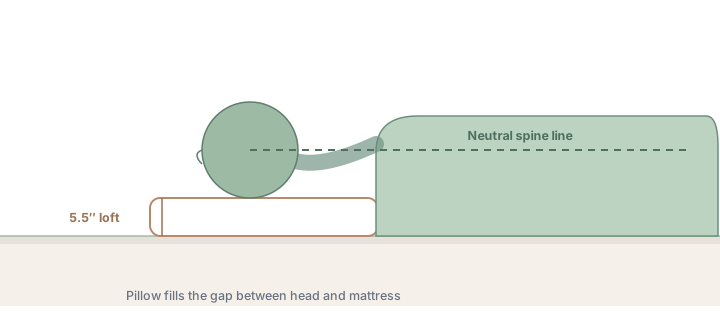
1. Shoulder-to-ear gap. Lie on your side on your actual mattress. Have someone measure (or measure yourself with a yardstick) the distance from your ear to the mattress surface. That number, give or take an inch for the squish of the pillow, is your target loft. Most adults land in the 4-7 inch range. Broad-shouldered adults can need up to 8 inches. Petite adults sometimes need only 4.
2. Temperature. Do you wake up sweating? Flip the pillow looking for cool spots? Then you need a breathable fill (latex, shredded foam, down) AND a breathable cover (Tencel, bamboo, phase-change). If you're a cold sleeper, you can use any material.
3. Neck condition. Healthy neck = any supportive pillow works. Neck pain, arthritis, cervical spondylosis, or a herniated disc = you need a firmer, more structured pillow, possibly a cervical-shaped contour pillow. The Cleveland Clinic has detailed guidance on neck-friendly pillows that I'd point anyone with chronic neck issues toward.
4. Maintenance tolerance. Down requires fluffing, dryer cycles, and professional cleaning. Latex and foam are largely set-and-forget. Honestly assess how much pillow care you'll actually do.
5. Budget. Set your range BEFORE shopping. Reasonable bands: $40-$80 (entry decent), $80-$150 (sweet spot for most), $150-$300 (premium materials like high-fill-power down or thick natural latex). Above $300 you're paying for luxury branding more than performance.
Frameworks for matching variables to materials
Once you know your five variables, the material picks itself. Here's the framework I use when friends ask:
- Side sleeper + neck pain + average temperature: medium-firm Talalay latex, OR memory foam cervical contour pillow with the right loft.
- Side sleeper + hot sleeper + healthy neck: shredded latex or shredded open-cell foam with a phase-change cover.
- Side sleeper + cold sleeper + plush preference: 700+ fill power goose down with at least 25 oz of fill weight.
- Side sleeper + broad shoulders + firm mattress: high-loft (7-8 in) firm latex OR adjustable-fill shredded foam tuned to high loft.
- Side sleeper + petite frame + soft mattress: low-loft (4-5 in) medium-firm latex or memory foam.
- Side sleeper + back pain (sleeps on side AND back): shredded foam or down-alternative that compresses for back position but holds shape for side.
- Side sleeper + tight budget: medium-firm shredded memory foam or microfiber down-alternative at the $40-60 range, plan to replace every 18 months.
The pattern: the material follows from the constraints, not from someone else's "best of" list.
What the research and sleep specialists actually agree on
I've watched dozens of hours of long-form sleep coach, PT, and chiropractor YouTube content while researching pillows. Across very different sources, there's actually broad agreement on a few principles:
- Spinal alignment is the goal. Your pillow exists to fill the gap between your ear and the mattress so your spine stays in a neutral line from your skull to your tailbone. That's it. That's the function.
- Loft matters more than material. A perfectly-sized cheap pillow beats a luxury pillow at the wrong height for almost every side sleeper.
- Firmness should be medium-firm. Too soft = your head sinks in and breaks alignment. Too firm = pressure points on your ear and cheek.
- Replace pillows every 1-3 years. All pillows lose loft over time. The Sleep Foundation recommends 1-2 years for most pillows, longer for premium latex or down.
- Pillow geometry matters for some people. Cervical contour pillows (with a curved neck-roll shape) can help people with chronic neck issues, but they're not necessary for healthy sleepers.
- Try before you commit. A 100-night sleep trial is the single most useful feature a pillow can have.
The loud disagreements are mostly about specific brands. The principles are remarkably consistent.
Common mistakes side sleepers make picking a pillow
After reading hundreds of negative reviews of "best for side sleepers" pillows, the same mistakes show up over and over:
- Buying the most popular pillow without checking loft. Popular doesn't equal right-for-you. A pillow can be #1 best-seller and be the wrong height for your shoulders.
- Buying based on the look or feel in the store. A pillow that feels great when you press it with your hand is a different experience than one you've slept on for eight hours.
- Ignoring the return policy. Some pillows ship with no returns at all. Side-sleeper pillows are a guess-and-check purchase — you need the option to return.
- Choosing softer than medium-firm. Soft pillows compress to almost nothing under side-sleeper head weight, leaving your neck unsupported.
- Not adjusting for mattress firmness. People upgrade to a softer mattress, keep their old pillow, and wonder why their neck hurts now. The pillow + mattress combo has to work together.
- Replacing too late. Pillows over 2-3 years old that you've never replaced are almost certainly contributing to whatever sleep issue you're trying to solve.
If I had to recommend something to a friend tomorrow
Someone asks me "what pillow should I buy?" — here's my actual flowchart:
- Do you have any neck or shoulder pain right now? Yes → start with a cervical contour memory foam pillow or a medium-firm Talalay latex pillow with a low loft. Try that first.
- No pain, but you sleep hot? Get a shredded latex or shredded open-cell foam pillow with a phase-change cover, adjustable fill, 100-night trial.
- No pain, normal temperature, average build? Get a medium-firm Talalay latex or shredded latex pillow at 5-7 inch loft. Long-term reliable choice.
- No pain, normal temperature, prefer plush soft feel? Get a 700+ fill power goose down pillow with at least 25 oz fill and chambered construction.
- Tight budget? Shredded memory foam adjustable pillow, $40-60 range, plan to replace in 18 months.
- Side AND back sleeper? Get a shredded fill pillow you can adjust low when back, fluff up when side.
That decision tree covers maybe 90% of the people asking. The remaining 10% are special cases — pregnancy, post-surgery, severe arthritis — and those people should ask a doctor or PT, not a pillow website. But for the typical side sleeper trying to make a normal purchase decision, the answer is a medium-firm latex or shredded foam pillow with an adjustable fill and a sleep trial, period.
Independent video reviews worth watching
We don't test pillows in a lab. Instead, here are independent, hands-on video reviews from sleep and mattress channels that pair well with this guide — useful for seeing loft, fill, and feel before you buy. These are third-party reviews, not ours.
 ▶
▶Mattress Clarity
Best Pillows For Side Sleepers 2026 — My Top 5 Of The YearEditor's takeaway
I've come to think of the "what is the best pillow" question the same way I think about "what is the best running shoe" — there isn't one. There's a shoe for your foot shape, your gait, your distance, your terrain, and the answer is different for everyone. Same with pillows. The best pillow for my husband is not the best pillow for my mom is not the best pillow for me. What ALL of them have in common is fit. If your pillow fits your shoulder-to-ear gap, supports your spine in a neutral line, and breathes enough for your temperature, the brand and the price almost don't matter. The framework is what matters. The brand is downstream of the framework.
Frequently asked questions
How often should I replace my pillow if I sleep on my side?
Every 1-2 years for most pillows, 2-3 years for premium latex, and 3-5 years for high-fill-power goose down with good care. Side sleepers wear pillows out faster than back sleepers because the head presses into the fill from above with the full weight of a tilted skull. Signs your pillow is done: it doesn't fluff back up after compression, you wake up with neck stiffness you didn't have before, it has visible discoloration or smells musty after washing, or you can fold it in half and it stays folded. Trust the symptoms, not the calendar.
Does the pillowcase material matter as much as the pillow?
It matters more than people realize, but less than the pillow itself. The pillowcase is the first thing your face touches, so cool-to-the-touch materials (Tencel, bamboo, silk, cotton percale) make a noticeable difference in how comfortable the pillow feels in the first 10-15 minutes of going to bed. After that, the underlying pillow fill takes over. A great pillowcase on a bad pillow is still a bad sleep experience. A mediocre pillowcase on a great pillow is fine. Spend your money on the pillow first, then upgrade the case if you sleep hot or have skin/hair concerns.
Can the wrong pillow really cause neck pain?
Yes, absolutely — and it's the #1 modifiable cause of morning neck pain in healthy adults. When your pillow is the wrong loft for your shoulder width, your neck bends sideways all night while you sleep, putting strain on the cervical spine, ligaments, and surrounding muscles. Hours of that compounds into stiffness, headaches, and chronic neck pain. The American Chiropractic Association consistently identifies pillow misfit as a top contributor to morning neck pain. The fix is usually trying a different loft or firmness, not seeing a doctor — though if pain persists after a proper pillow fit, do see a doctor.
Should side sleepers use a pillow between their knees?
Most side sleepers benefit from a knee pillow — yes. When you sleep on your side, the top leg drops forward and pulls your pelvis with it, rotating your spine and putting strain on the lower back and hips. A pillow between the knees (or a body pillow that runs the length of your legs) keeps the knees stacked and the pelvis neutral, which keeps the spine in a straight line. Even a $15 contour memory foam knee pillow makes a real difference. People with hip pain, lower back pain, or pregnancy especially benefit. People with no pain who just want better sleep posture still benefit, even if more subtly.
Is a thicker pillow always better for side sleepers?
No — thicker than your shoulder-to-ear gap is just as bad as thinner. If your pillow is too thick, your neck bends UP toward the ceiling instead of DOWN toward the mattress; either way, it's not neutral. The correct loft is the one that exactly fills the gap between your ear and the mattress when you're lying on your side. For most adults, that's somewhere in the 4-7 inch range. Broader shoulders need more loft; narrower shoulders need less. Measure your gap or have someone measure it for you — guessing leads to expensive pillow purchases that don't fit.
Do expensive pillows actually sleep better than cheap ones?
Above a certain quality floor, no — the gains plateau quickly. A $40 medium-firm shredded foam pillow that fits your loft is significantly better than a $20 bag of polyester fluff. Going from $40 to $100 buys you better materials (latex vs. foam, breathable covers, better construction), longer lifespan, and a sleep trial — all real value. Going from $100 to $300 buys you premium materials (high-fill-power goose down, natural Talalay latex) and luxury branding, but the sleep quality difference is smaller than the price gap. Above $300, you're paying for branding more than performance. Sweet spot is $80-150 for most side sleepers.
What's the best pillow shape for side sleepers — flat or contoured?
It depends on whether you have neck issues. Healthy necks do fine with a flat (rectangular) pillow as long as the loft is right. Contoured (cervical) pillows with a curved neck-roll shape can help people with chronic neck pain, cervical spondylosis, or after a whiplash injury — the contour provides extra support to the cervical spine. But contour pillows can be polarizing: some people love the structured support, others find the geometry uncomfortable. If you have neck issues, try a contour pillow with a return policy. If you don't, a flat pillow at the right loft is simpler and works for most people.
Can I use two pillows stacked instead of buying one tall pillow?
Technically yes, in a pinch, but it's not a great long-term solution. Two stacked pillows tend to shift and slide during the night, so the loft isn't stable. They also typically have a soft top pillow that compresses fully under your head, leaving a sagging shape that doesn't actually give the spinal alignment you want. If you need more loft than a single pillow provides, the right answer is to buy a higher-loft pillow (or an adjustable-fill shredded pillow you can tune up), not stack. The exception is using a thin pillow under a thicker pillow for very broad-shouldered sleepers — but even then, a single 8-inch-loft adjustable pillow is more stable.
Does mattress type affect what pillow I should buy?
Yes, significantly. Side sleepers on a soft mattress sink their shoulder INTO the mattress, which reduces the shoulder-to-ear gap and means they need a LOWER pillow loft than they'd need on a firm mattress. Side sleepers on a firm mattress don't get any shoulder sinkage, leaving a bigger gap, so they need a HIGHER pillow loft. This is why people who upgrade to a softer mattress often suddenly start having neck pain — their old pillow that worked on the firm mattress is now too tall. If you switch mattresses, expect to also re-evaluate your pillow.
Is memory foam or latex better for side sleepers?
Both work well; the choice comes down to preferences. Memory foam contours to your head shape and feels enveloping — supportive but with a slow, sinking sensation. Latex is more responsive and springy — supportive but doesn't sink in. Memory foam tends to run hotter unless it's specifically open-cell or has cooling tech. Latex runs cooler by default. Memory foam is usually less expensive. Latex usually lasts longer (5+ years vs. 2-4 years). For a side sleeper who wants set-and-forget durability and runs warm, latex is my default recommendation. For someone who wants contouring pressure relief on a budget, memory foam wins. Both can be excellent.
Keep reading
Related guides
← Back to our main Best Pillow for Side Sleepers guide