Part of Pillows by Sleep Position — Combination Side Sleeper Guide
Best Pillow for Side and Back Sleepers with Neck Pain
The best pillow for side and back sleepers with neck pain is the one that maintains a neutral cervical spine in BOTH positions, not the one with the most aggressive contour or the highest cervical curve. I want to make that distinction up front, because there's an entire category of orthopedic-looking pillows that work well for pure back sleepers with neck pain and then become a nightmare when the same person rolls onto their side. If you're dealing with morning neck stiffness, headaches that start at the base of your skull, or that 'crick' you can't quite shake during the day, your pillow choice matters more than for almost any other condition — and the dual-position requirement makes the choice harder, not easier. Below is what I've learned from reading hundreds of reviews from neck-pain combo sleepers and watching too many sleep coach videos.

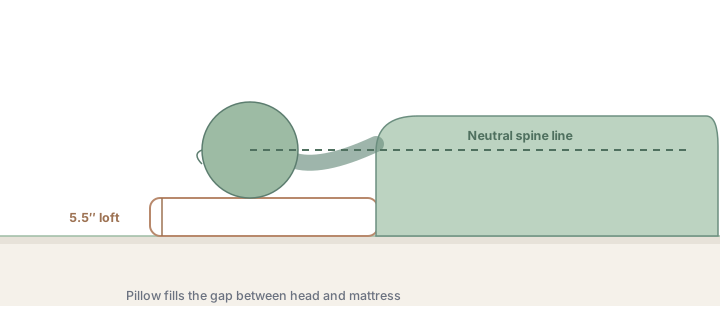
Why combo sleepers with neck pain need a different pillow
Most 'neck pain pillows' are designed assuming you stay in one position all night. The classic cervical contour pillow — a foam pillow with a raised neck-support bump and a recessed area for your head — is engineered around back sleeping. The bump cradles the natural curve of your cervical spine when you're flat on your back. It's a genuinely good design for that use.
The problem is that when you roll to your side on the same pillow, the cervical bump is no longer under your neck — it's under the side of your jaw or ear. The geometry that supported you on your back now actively pushes your head into a bad angle on your side. Many people with neck pain buy these pillows, get good first-night relief on their back, then wake up worse on the second night because they shifted to their side without realizing it.
For combo back-and-side sleepers with existing neck pain, the pillow needs to do three things at once: (1) keep your cervical spine in neutral alignment on your back without pushing your chin down, (2) fill the shoulder-mattress gap on your side so your neck doesn't sag, and (3) handle the transition between positions without forcing your head into bad geometry mid-roll. This is genuinely hard.
The two designs that solve it best, in my reading: adjustable shredded memory foam (where you tune the loft to a compromise position) and dual-zone contour pillows specifically marketed for combo sleepers (with a raised back-sleep zone in the center and lower side-sleep zones on the wings).
What 'neutral cervical alignment' actually means
Neutral cervical alignment is a phrase you'll see in every neck-pain article, and it's worth defining precisely. Your cervical spine has a natural forward curve when viewed from the side — the inward dip just above your shoulders. A neutral pillow position preserves that curve without flattening it or exaggerating it.
On your back, neutral means: your chin and forehead are roughly level, your gaze (if your eyes were open) would point straight up at the ceiling, and the back of your neck has gentle contact with whatever's supporting it. If your chin is tucked down toward your chest, the pillow is too tall. If your head is tipped back so you're looking past your eyebrows, the pillow is too short.
On your side, neutral means: your nose, chin, and breastbone form a straight vertical line when viewed from the front. Your head should not tilt toward either shoulder.
The American Chiropractic Association's recommendations consistently emphasize neutral alignment as the single most important pillow-related factor for people with neck pain. Loft, fill, brand, and shape are all in service of that one goal.
The practical test: have your partner take a phone photo of you on the pillow in each position. Don't trust how it feels — feels-fine is not the same as is-neutral. After years of bad pillow habits, many people's 'comfortable' is actually their cervical spine in a stressed position because their muscles have adapted around the misalignment.
The pillow types that work for combo neck-pain sleepers
After reading thousands of reviews from people specifically buying for neck pain, here's the realistic ranking of pillow types for combo back-and-side sleepers:
Adjustable shredded memory foam: My top recommendation. You can tune the loft precisely to a level that gives neutral alignment in both positions. The shredded foam structure also flexes around your head when you change positions, partially conforming to the new shape. Look for models that ship with extra fill bags so you can add as well as remove.
Dual-zone contour pillows for combo sleepers: Pillows specifically designed with a back-sleep zone (medium height, gentle cervical bump) in the center and lower side-sleep zones on the outer edges. Work well if you can train yourself to land in the right zone. Less forgiving than adjustable foam if you're a heavy roller.
High-fill-power down (650+): Soft enough to compress for back sleep but lofted enough to support the side position. Less precise than adjustable foam but more naturally accommodating to position changes.
Cervical roll pillows used WITH a regular pillow: Some people get good results from placing a small cervical roll inside the pillowcase of a regular pillow, positioned at the neck. The roll adds back-sleep neck support without raising the loft for side sleep. Unconventional but effective for some.
Solid cervical contour pillows: Skip these if you're a combo sleeper. They're designed around one position and create problems in the other.
Loft targeting for combo sleepers with neck pain
Loft matters more for neck-pain combo sleepers than for healthy combo sleepers, because a mistake compounds into worse pain rather than just mild stiffness.
The sweet spot for an average-build adult with neck pain who sleeps roughly 60/40 back/side or 50/50: about 4 to 4.5 inches compressed loft. That's a touch shorter than the loft I'd recommend for a healthy combo sleeper, because a slightly lower pillow gives the back-sleep portion more comfort (the most critical position for the cervical spine) at the cost of a small amount of side-sleep support.
If you're side-dominant (70%+ side, 30% back), nudge loft up to 4.5-5 inches.
If you're back-dominant (70%+ back, 30% side), drop to 3.5-4 inches.
For broader-shouldered adults, add half an inch to all of the above. For petite frames, subtract half an inch.
Get this fitted with an adjustable pillow if you can. Removing or adding a handful of shredded foam at a time, sleeping on it, and adjusting again over a week is the most reliable way to land on the right loft. Trying to guess the right loft and buying a fixed-loft pillow is how most neck-pain sufferers end up with three pillows in their closet that didn't work.
Cooling and breathability for sensitive necks
People with neck pain often have associated muscle tension, and overheated necks tense up more than cool ones. A pillow that traps heat against your neck and head can make morning stiffness worse independent of alignment issues.
Look for: a breathable cover (Tencel, lyocell, cotton), a fill that allows airflow (shredded foam beats solid foam by a lot), and ideally a removable washable cover so sweat and oils don't build up.
Avoid: solid memory foam under a synthetic cover (worst-case heat trapping), pillows with no removable cover (impossible to clean once they get sweaty), and 'cooling gel' marketing that doesn't have actual breathable cover materials backing it up. Gel is a 10-minute illusion. Fabric and fill structure are what actually keep you cool.
If you tend to sweat at night, the pillow may also be aggravating your neck because of stiff fabric — a cotton or lyocell cover that drapes softly is easier on a sore neck than a tight polyester one.
Independent video reviews worth watching
We don't test pillows in a lab. Instead, here are independent, hands-on video reviews from sleep and mattress channels that pair well with this guide — useful for seeing loft, fill, and feel before you buy. These are third-party reviews, not ours.
 ▶
▶Dr. Dave Candy (Physical Therapist)
How to Choose the Best Pillow for Neck Pain Relief ▶
▶PROPEL Active
Chiropractor Tests 3 Popular Amazon Neck PillowsEditor's takeaway
I'd treat this purchase the way I treat anything related to chronic pain in our family — slowly and with a return window. For a combo back-and-side sleeper dealing with morning neck stiffness, I'd start with an adjustable shredded memory foam pillow set initially at about 4.5 inches of loft, then tune down by handfuls of fill over the first ten nights based on which position seems to be causing more issues. If after three weeks the pain hasn't improved, I'd return it and try a high-fill-power down pillow as my plan B. What I would NOT do is buy a single-bump cervical contour pillow for a combo sleeper, even though they're heavily marketed to neck-pain sufferers — they work for back-only sleepers and create new problems for everyone else. And the moment my husband had radiating pain into his arm, I'd skip the pillow shopping entirely and book a doctor visit. Pillows fix alignment, not nerves.
Frequently asked questions
Is a cervical contour pillow good for combo back and side sleepers?
Standard cervical contour pillows — the ones with a raised neck-support bump in the center — are designed around back sleeping. They work well for that. The problem for combo sleepers is that when you roll to your side, the bump that supported your neck is now under your jaw or ear, in an awkward position. Some brands now make dual-zone contour pillows specifically for combo sleepers, with a back-sleep zone in the center and lower side-sleep zones on the wings. Those can work. The single-bump traditional cervical pillow usually doesn't.
What loft works for a side-and-back sleeper with neck pain?
For an average-build adult, around 4 to 4.5 inches of compressed loft. That's slightly lower than what a healthy combo sleeper would use, because a marginally lower pillow gives better back-sleep alignment (the position most important for healing neck pain). Side-dominant combo sleepers can go 4.5-5 inches; back-dominant can drop to 3.5-4. Use an adjustable shredded foam pillow if possible so you can tune this over a week of sleeping on it.
Can a pillow actually fix neck pain?
It can fix neck pain caused by sleep alignment issues — pain that's worst in the morning and improves during the day, that comes and goes with pillow changes, and that's not associated with numbness or tingling. It cannot fix pain from a herniated disc, pinched nerve, arthritis, or injury — those need medical evaluation. Most morning-stiffness type neck pain in adults is pillow-fixable, but if you have radiating pain, numbness in your arms, or persistent pain unchanged by sleep changes, see a doctor first.
What's the best fill type for combo sleepers with neck pain?
Adjustable shredded memory foam, by a wide margin. The ability to tune loft precisely matters more for neck-pain sufferers than for healthy sleepers because a mistake compounds into worse pain. High fill power down (650+) is a second option that handles position changes naturally. Solid memory foam is risky because the loft is fixed — if it's wrong for you, there's nothing to adjust. Latex is the same. Polyester fiberfill doesn't have the durability or support needed for ongoing neck issues.
Should I sleep with my arm under my head when I'm on my side?
No, especially if you have neck pain. The arm-under-head position raises your shoulder height by 4-5 inches and forces the pillow loft you need to be much taller — which then ruins your back-sleep alignment. Sleep coaches consistently recommend arm-down side sleeping with a correctly-tall pillow instead. If you can't break the habit, try hugging a body pillow, which keeps your arms forward and down rather than tucked up.
How long should it take a new pillow to help with neck pain?
If a pillow is right for you, you should notice some morning improvement within 5-7 nights. Significant improvement should be present by 14 nights. If you're past 21 nights with no improvement, the pillow is not solving your problem and you should return it. Don't 'give it more time' beyond the trial window — that's how people end up stuck with bad pillows. Note that pillows can also temporarily worsen pain for the first 2-3 nights as your body adapts to new alignment; symptoms that worsen for 1-3 nights then improve are a normal adjustment, but pain getting worse over a full week is a sign the pillow is wrong.
Should I see a doctor before buying a new pillow?
Not necessarily for ordinary morning stiffness — pillow shopping is reasonable as a first step. But you should see a doctor first if you have any of these: numbness or tingling in your arms or hands, pain following an injury or whiplash event, pain that wakes you up at night, headaches with visual disturbances, or pain that hasn't responded to multiple pillow changes. A pillow won't fix nerve compression, disc issues, or structural problems.
Are memory foam pillows or down pillows better for neck pain?
Adjustable shredded memory foam edges out down for most neck-pain combo sleepers because the loft can be tuned precisely. Down is a close second — its natural compressibility makes it forgiving across position changes — but you can't dial in a specific height the way you can with adjustable foam. Solid memory foam is usually worse than either, because the loft is fixed. If you're choosing between shredded foam (adjustable) and high-fill-power down, both can work; pick whichever feels and smells better to you after the first three nights.
Do I need a special pillow case or just any pillowcase?
For pure neck-pain purposes, the pillowcase doesn't matter much — what matters is the pillow underneath. But: a smooth, breathable pillowcase (cotton, silk, lyocell) is gentler on a sore neck than a stiff polyester case, and you'll sweat less in it, which reduces overnight muscle tension. Wash your pillowcase weekly — accumulated oil and skin cells aren't just unhygienic, they also degrade the fill underneath over time.
When should I replace my pillow if I have neck pain?
Faster than you would otherwise. The earliest warning sign that your pillow is wearing out is the return of morning neck pain that had previously resolved. For shredded memory foam used by a neck-pain combo sleeper, expect 2-3 years. For down, 2-3 years with regular fluffing. Polyester fiberfill is too short-lived (under 18 months) to recommend for neck pain sufferers. If you've recently switched to a new pillow that worked great for six months and now your pain is creeping back, swap to a fresh one even if the old one looks fine.
More in this section
Pillows by Sleep Position — Combination Side Sleeper Guide
View all guides in this section →
Keep reading
Related guides
← Back to our main Best Pillow for Side Sleepers guide