Part of Pillow Materials and Fill Types — A Side Sleeper Guide
Best Cooling Body Pillow for Side Sleepers
Best cooling body pillow for side sleepers solves a problem most regular pillows don't have to deal with — you wrap your whole body around 50+ inches of fabric and foam, and suddenly a lot more of you is touching pillow surface than when you just had a head pillow. That extra contact area is where heat lives. I started researching cooling body pillows after my husband — a side sleeper who runs hot — tried a regular body pillow during a back-pain stretch and ended up shoving it onto the floor by 2 a.m. because it felt like sleeping next to a furnace. After several months of looking at materials, covers, and shapes, here's what I learned about how to pick one that actually stays cool through the night.

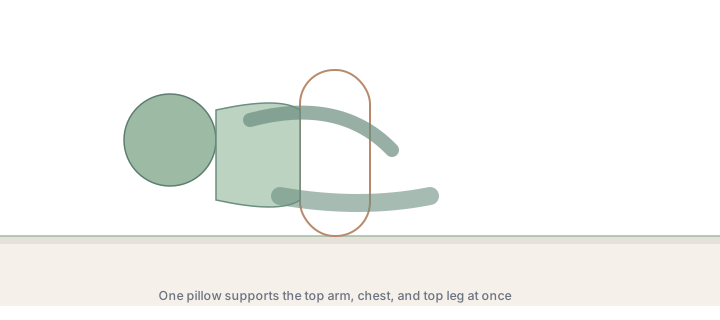
Why body pillows trap more heat than regular pillows
A standard pillow has maybe 200 square inches of surface area touching you. A body pillow is more like 1,000+ square inches running the length of your torso, hugged by an arm, with a leg draped over it. That's five times the heat-trapping surface, and almost all of it is touching parts of your body that sweat (chest, inner thighs, underarms).
When you add a non-breathable cover or a solid foam fill on top of all that contact area, you've basically built a heat blanket and pressed it against yourself for eight hours. This is why "cooling" matters in a body pillow more than in a regular pillow — the stakes are higher.
There's also a thermodynamics issue people don't think about: heat doesn't just stay where it's generated; it builds up in materials with low conductivity. A polyester body pillow is essentially a heat reservoir — it absorbs your body heat all night and only releases it slowly. By 3 a.m., the pillow itself is warm even on the side you're NOT touching. Flipping it doesn't help because both sides have heated up. A breathable fill (latex, shredded foam, down) lets heat pass through and dissipate into the surrounding air instead of pooling in the pillow.
The good news is that the same cooling technologies that work in regular pillows also work in body pillows, just scaled up. The bad news is that the price scales up too. A premium cooling body pillow is usually $80-$160, and the cheap ones almost never have the technology you need.
Fill types ranked for cooling in a body pillow
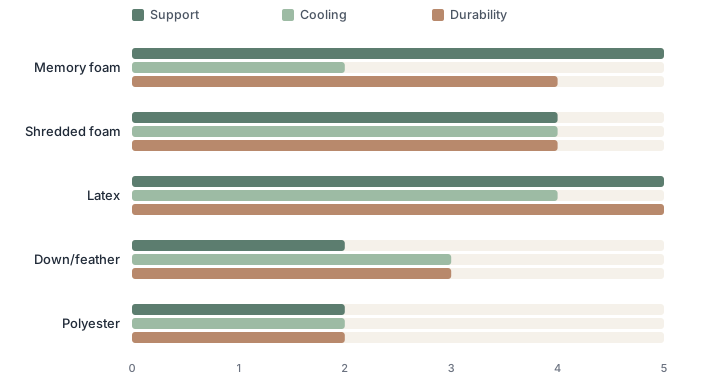
After reading several hundred reviews and comparing manufacturer specs across the major cooling body pillow brands, here's how the fills stack up from coolest to warmest:
- Shredded latex — the gold standard. Naturally breathable, holds shape well over a long body pillow, doesn't compress into a hot lump.
- Shredded memory foam (open-cell) — close second. Make sure the spec sheet says "open-cell" or "ventilated," not just "gel-infused."
- Down or down-alternative — breathes well, but flattens fast under the weight of a side sleeper's leg or arm. Frequent fluffing required.
- Polyester fiberfill — cheap, runs warm, compresses. Skip for cooling purposes.
- Solid memory foam (one-piece body pillows) — supportive but the warmest option by a wide margin. Avoid if you sleep hot.
- Microbead — surprisingly cool because of all the airflow between beads, but very soft and not supportive enough for most side sleepers.
The cover material on a body pillow matters even more than on a regular pillow, because there's so much of it. Tencel, bamboo viscose, and phase-change covers are all good picks. Avoid pillows with polyester covers that aren't specifically engineered for cooling.
What I'd buy and what I'd skip for a hot-sleeping side sleeper
After all this research, here's where I've landed for someone who wants a body pillow that won't cook them at night:
Worth it: - Straight shape, 48-54 inches long - Shredded latex or shredded open-cell memory foam fill - Removable, machine-washable phase-change or Tencel cover - 100-night sleep trial — cooling claims are subjective and you need a return option
Skip: - Solid memory foam body pillows ("contoured" or "orthopedic" shapes are often solid foam) - Anything labeled "plush" or "cloud-like" — usually polyester fiberfill that runs warm and compresses - Body pillows under $50 that claim cooling tech — the math doesn't work - U-shape pregnancy pillows if you sleep hot AND aren't pregnant — too much surface contact
A detail people overlook: a body pillow with a separately removable cover is way easier to wash than one with the cover sewn on, and washing the cover regularly is the #1 thing that keeps the cooling effect alive over time. Harvard Health has a good piece on bedroom hygiene and sleep quality that touches on why fresh bedding makes a real difference in how cool a bed feels.
One more thing on covers — look for a TWO-LAYER cover system if your budget allows. The outer cooling layer (phase-change knit or Tencel) is what your skin contacts; the inner liner (usually a finer mesh) keeps the shredded fill in place and breathes well. Pillows with this construction stay cooler longer because the cooling cover doesn't get directly soiled by sweat and oils as quickly. The cleveland clinic and most sleep hygiene resources agree that frequent washing is the unglamorous truth of cool bedding — fancy materials are wasted if the cover is dirty.
The last thing worth mentioning: storage matters. If you only use a body pillow seasonally (or you have one for guests), don't store it compressed in a closet for months. Compression deforms the fill and can permanently kill the breathability. Store body pillows loosely on a shelf or hung over a closet rod. The shape of the pillow when stored is the shape it tries to return to when you sleep on it.
Independent video reviews worth watching
We don't test pillows in a lab. Instead, here are independent, hands-on video reviews from sleep and mattress channels that pair well with this guide — useful for seeing loft, fill, and feel before you buy. These are third-party reviews, not ours.
 ▶
▶Sleepopolis
Coop Body Pillow — Most Comfortable for Side Sleepers? ▶
▶Sleepopolis
Best Pillows for Side Sleepers of 2026 — Our 8 Favorites!Editor's takeaway
If my husband would let me buy him exactly one thing for sleep, it'd be a straight shredded-latex body pillow with a phase-change cover. He's a side sleeper, he runs hot, and the body pillow gives his arm somewhere to go that isn't pinned under his torso. The cooling part is what makes it sustainable through summer — without it, the body pillow becomes a furnace by month two and gets retired to the closet. I learned that the hard way with a cheap polyester body pillow we tried first.
Frequently asked questions
Are cooling body pillows just regular body pillows with a fancy cover?
Sometimes, honestly, yes — the budget end of the cooling body pillow market is mostly regular polyester fiberfill body pillows with a cool-to-the-touch cover slapped on top. Those help for the first 10 minutes, then warm up like any other pillow. The pillows that genuinely sleep cool over the full night have a breathable INTERNAL fill (shredded latex, open-cell foam, or down) PLUS a cooling cover. The cover alone is not enough surface area, given how big a body pillow is, to keep the whole thing cool. Always check the spec sheet for the fill description, not just the cover.
What's the best fill for a cooling body pillow if I sleep on my side?
Shredded latex or shredded open-cell memory foam, with a phase-change or Tencel cover. Shredded fills win because (a) they let air circulate inside the pillow, not just around it, and (b) you can adjust the firmness/support by adding or removing fill, which matters for side sleepers because everyone's hip-to-shoulder geometry is different. Down-alternative is fine for cooling but flattens fast under a side sleeper's draped leg, leaving you with a sad, unsupportive noodle by morning. Solid memory foam — even with gel infusion — is the worst pick for a hot sleeper.
How long should a cooling body pillow be for a side sleeper?
48-54 inches is the standard length and works for most adults under 5'10". If you're taller than 5'10" or you like the pillow to support from neck to ankle in one piece, look for 60-inch "king" length body pillows. For cooling specifically, shorter is slightly better — less surface area touching you — but you don't want to give up the support either, so don't go below 48 inches just for marginal cooling gains. The shape (straight vs. U vs. C) matters more for heat than the length does.
Can I machine wash a cooling body pillow?
Almost always you can wash the cover; the pillow itself depends on the fill. Shredded foam and down-alternative body pillows can usually go in a large washer on gentle, then air dry (heat damages the foam). Solid foam and latex should be spot-cleaned only — submerging them breaks down the material. The single biggest thing for keeping the cooling effect alive is washing the COVER frequently — every 2-3 weeks, more if you sweat heavily. Sweat and skin oils clog the breathable cover knit and reduce its cooling effectiveness over time. Buy a pillow with a removable, machine-washable cover, full stop.
Is a cooling body pillow worth it during pregnancy?
Yes, especially in the third trimester when body temperature runs higher anyway and a U-shape or C-shape body pillow becomes useful for supporting a growing belly. The trade-off is that those wrap-around shapes have more contact area and trap more heat than a straight body pillow. The fix is to prioritize cover material (phase-change or Tencel) and fill (shredded latex or open-cell foam). [The Sleep Foundation has guidance on pregnancy sleep positioning](https://www.sleepfoundation.org/pregnancy/pregnancy-and-sleep) that explains why left-side sleeping with body pillow support is generally recommended. If you're not pregnant and just want cooling, skip the U-shape — straight is much cooler.
Do phase-change cooling body pillows really work or is it marketing?
Real phase-change material (PCM) genuinely absorbs heat above skin temperature and releases it when you move — the technology was originally developed by NASA for spacesuits. In a body pillow context, where you're contacting the pillow over a large area, PCM has plenty of heat to absorb and works noticeably. The catch is that not every "phase-change" claim is using real PCM. Look for named PCM technology (Outlast is one of the most common) on the spec sheet, not just the marketing phrase "phase-change." Real PCM body pillows are usually $100+. If you see a $40 body pillow claiming phase-change cooling, it's probably just a polyester knit with a cool-to-the-touch finish.
Will a cooling body pillow help if my bedroom is hot?
It helps but it can't fully compensate for a hot room. Cooling pillows work by transferring heat from your body to the surrounding air; if the room itself is 78°F, there's not much temperature gradient to work with. The Sleep Foundation recommends 60-68°F for the bedroom, and within that range, a cooling body pillow makes a clear difference. Outside that range, you'll get diminishing returns. If your bedroom runs hot and you can't change that, layer the solutions: cooling mattress topper, moisture-wicking sheets, AND a cooling body pillow. Doing all three together is more effective than spending $200 on the best body pillow and skipping the rest. A cheap fan pointed at the bed (not at you directly — at the bed) also helps more than people expect, because it creates the air circulation that lets the pillow actually release the heat it's absorbed. Without airflow, every cooling material on the market eventually saturates and stays warm.
More in this section
Pillow Materials and Fill Types — A Side Sleeper Guide
View all guides in this section →
Keep reading
Related guides
← Back to our main Best Pillow for Side Sleepers guide