Part of Pillows for Pain Relief — A Side Sleeper Pillar Guide
Best Body Pillow for Side Sleepers with Back Pain
The best body pillow for side sleepers with back pain is one that fills the entire length from chest to knees, keeps your top knee from dropping forward, and keeps your top arm from rotating in. I'm Sukie, and this is a topic I went deep on after my mom started waking up with lower back pain almost every morning. After weeks of research — verified-buyer reviews, physical therapist videos on YouTube, manufacturer spec sheets — the conclusion was clear: a good body pillow is one of the cheapest, fastest interventions for sleep-related lower back pain in side sleepers.

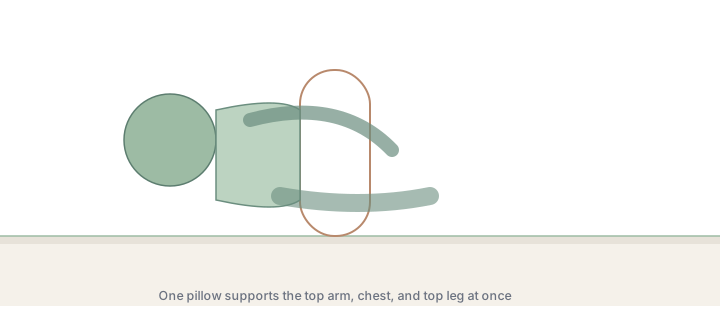
Why a body pillow helps side sleepers with back pain
When you side sleep without anything between your knees, your top leg drops forward and inward, twisting your pelvis. That twist travels up through your lumbar spine and over hours of sleep creates exactly the lower back pain you wake up with. The fix is mechanical: put something between your knees that holds the top knee in the same plane as your hip. The pelvis stays neutral, the lumbar spine stays neutral, and the small stabilizing muscles get a real night off.
A full body pillow does this AND addresses the dangling-top-arm problem (which contributes to shoulder pain) AND can be tucked behind your back to stop you from rolling onto a painful side. One pillow, three jobs.
Harvard Health has written about sleep posture and back pain, and the recommendation to use a pillow between the knees is one of the most consistent pieces of guidance across reputable sleep medicine sources.
The right fill and firmness for back pain
For body pillows, firmness matters more than for head pillows. A soft body pillow compresses between your knees and stops holding them apart — exactly the problem you bought it to solve. A firm body pillow holds its loft and keeps the legs separated through the night.
Fill options:
- Memory foam (solid or shredded): Firmest, most supportive, but heaviest and warmest. Excellent for back pain because the support is consistent.
- Latex (especially shredded): Firm, supportive, cooler than foam, but pricey for body-pillow sizes.
- Polyfill (microfiber clusters): Cheap, lightweight, cooler. Compresses faster — you'll be replacing it more often.
- Down or down-alternative: Soft and luxurious-feeling. Generally too soft for back pain. Skip.
- Kapok or buckwheat blends: Less common but supportive and breathable. Good if you sleep hot.
If your body pillow is also doubling as a between-the-knees support, lean firmer. The knee gap is where compression happens fastest, and a soft pillow loses effectiveness here within an hour. According to the Cleveland Clinic guidance on back pain and sleep, placing a firm pillow between the knees is among the most effective non-medical interventions for sleep-related lower back pain in side sleepers.
How to actually use a body pillow for back pain
Buying the pillow is half the battle. Positioning it correctly is the other half.
For a J-shape or straight rectangle:
- Lie on your side, knees bent slightly toward your chest.
- The pillow runs vertically — bottom end between your ankles or shins, top end against your chest or under your top arm.
- Your top knee should rest on the pillow at the same height as your hip. If your knee drops forward off the pillow, push the pillow further under it.
- Your top arm rests on the upper portion of the pillow, NOT dangling forward.
- If you have lower back pain specifically, the most important part is the knee-to-hip alignment. Get that right first; everything else is bonus.
For a U-shape:
- Sleep inside the U with the curve under your neck.
- One arm of the U runs down your front, between your knees, past your feet.
- The other arm runs down your back, keeping you from rolling onto your back during the night.
- This setup is locked-in supportive but takes up a LOT of bed space.
Give any new body pillow setup at least a week before judging it. The first few nights you'll wake up to find the pillow has migrated halfway off the bed. By night 5 to 7, your sleeping body learns to keep it in place.
Independent video reviews worth watching
We don't test pillows in a lab. Instead, here are independent, hands-on video reviews from sleep and mattress channels that pair well with this guide — useful for seeing loft, fill, and feel before you buy. These are third-party reviews, not ours.
 ▶
▶Tina's Nook
Coop Body Pillow ReviewEditor's takeaway
When my mom finally added a J-shape body pillow to her setup, the change was almost immediate. Three nights in, she said her lower back wasn't waking her up at 4 a.m. anymore. She'd been spending money on lumbar support cushions, heating pads, and even a new mattress topper before she tried the body pillow — which cost less than any of them and worked better than all of them combined. The lesson I keep coming back to: for side sleepers, alignment isn't only about the head pillow. The hips and knees matter just as much, and a $50 to $90 body pillow is the most underrated purchase in this whole category.
Frequently asked questions
Does a body pillow really help with back pain or is it just a fad?
It genuinely helps when the back pain comes from sleep position — which is a huge share of morning back pain in side sleepers. The mechanism is simple and well-documented: a pillow between the knees keeps your pelvis neutral, which keeps your lumbar spine neutral, which lets the small stabilizing back muscles relax for the night. It's not a fad. It's one of the most consistent recommendations from physical therapists for anyone who side sleeps and wakes up with lower back pain.
Do I need a full-length body pillow or is a knee pillow enough?
A knee pillow is enough if back pain is your only concern and the rest of your sleep position is already comfortable. A full-length body pillow is better if you also have shoulder pain (because it addresses the dangling top arm), if you tend to roll onto a painful side during the night, or if your partner moves a lot and you want a buffer. Full body pillows take up significantly more bed space — that's the trade-off. For pure back-pain solutions, a smaller dedicated knee pillow is more practical for most people.
What firmness should a body pillow be if I have back pain?
Medium-firm to firm. A soft body pillow compresses to nothing between your knees within an hour, and then it's not doing its job. Firm pillows hold their loft through the night, which keeps your knees apart, your pelvis neutral, and your lower back unloaded. This is the one area where I'd specifically avoid soft, plush, or 'cloud-like' body pillows — they feel nice but don't work for the back-pain use case.
U-shape vs J-shape body pillow — which is better for back pain?
J-shape for most people. It addresses the knee-to-hip alignment, supports the top arm, and supports the head if positioned right — all in a more manageable footprint than a U. U-shape is more supportive overall because it also stops you from rolling onto your back during the night, but it takes up so much bed space that it's awkward for couples. If you sleep alone, prefer the U. If you share a bed, prefer the J.
Will a body pillow help if my back pain is from a herniated disc?
It can reduce daily aggravation but won't fix the herniation itself. A body pillow keeps your lumbar spine in neutral alignment during sleep, which prevents you from worsening the disc by sleeping in a twisted position for hours. That's real value. But the underlying disc issue requires medical treatment — physical therapy, sometimes injections, occasionally surgery. The pillow is a meaningful daily quality-of-life improvement, not a cure for the structural problem.
How long is a body pillow supposed to last?
Memory foam and latex body pillows hold up for 2 to 3 years before they start losing firmness. Polyfill body pillows compress faster — often within 12 to 18 months. The squeeze test works well here: grab the middle of the pillow with one hand. If it springs back to full thickness when you let go, it's still healthy. If it stays compressed, the fill is exhausted and it's time to replace it. A dead body pillow is worse than no pillow because you'll keep relying on it even though it's no longer supporting your knees apart.
Is it worth buying a body pillow if I also need a regular head pillow?
Yes, treat them as separate purchases. Your head pillow handles cervical alignment; your body pillow handles hip, knee, and pelvic alignment. They do different jobs, and trying to make one pillow do both usually fails at both. Budget for two purchases. Together they typically run $90 to $200 — meaningful but not extreme — and they outperform a single $200 'do-everything' pillow in almost every case I've researched.
Can I use a body pillow if I share the bed with a partner?
Yes, with a slight trade-off in bed real estate. A J-shape or straight rectangle body pillow takes up the space of about half a person — manageable on a queen, easy on a king, tight on a full. U-shape body pillows are bulkier and harder to share a bed with. If space is tight, a smaller knee-and-thigh wedge pillow does most of the back-pain work in a fraction of the footprint. Partners sometimes resent body pillows at first, then come around once they see the morning back pain stop. It's a brief negotiation.
What's the difference between a pregnancy pillow and a body pillow for back pain?
Pregnancy pillows are designed for a specific use case — supporting a growing belly, easing lumbar pressure as posture changes, and accommodating a side-only sleep requirement in later trimesters. Body pillows for back pain prioritize knee separation and pelvic alignment. There's significant overlap: a good C-shape or U-shape pregnancy pillow works well for non-pregnancy back pain too. But a basic straight-rectangle body pillow may not provide enough support for late-pregnancy needs. If you're choosing between the two and not pregnant, a J-shape is usually the most cost-effective fit.
How do I keep a body pillow from sliding around all night?
A few practical tricks. First, a body pillow with a removable cover that has some grip texture (cotton jersey or microfiber sometimes does this better than smooth satin or silk). Second, the J-shape's curve naturally hooks against your body in a way that keeps it from migrating. Third, if you sleep with a top sheet, tucking the top sheet over the pillow's bottom end on the mattress anchors it. After about a week of consistent use, most people stop noticing the pillow shifting because their sleeping body learns to keep contact with it.
Will a body pillow work for sciatica-related back pain?
It can ease some of the daily aggravation that sciatica causes, especially when the pain travels from the lower back into the hip. Keeping your top knee on the pillow at hip height stops the pelvic rotation that often inflames sciatic-nerve irritation overnight. That said, sciatica is a nerve issue that often needs medical care, not just sleep adjustments. The body pillow is a meaningful comfort layer for people managing sciatica, but it's part of a treatment plan rather than the whole plan. Talk to your doctor or physical therapist about positioning that suits your specific case — the right side or left side may matter depending on which leg the sciatic nerve is irritating, and that's a question a professional can answer better than a pillow guide.
More in this section
Pillows for Pain Relief — A Side Sleeper Pillar Guide
View all guides in this section →
Keep reading
Related guides
← Back to our main Best Pillow for Side Sleepers guide