Part of Pillows for Pain Relief — A Side Sleeper Pillar Guide
Best Pillows for Side Sleepers with Neck and Shoulder Pain
Best pillows for side sleepers with neck and shoulder pain don't have to cost $200. I want to lead with that, because the most common mistake I see in this category is people either (a) buying the cheapest possible pillow and getting nothing that holds up, or (b) spending $180+ assuming premium price means premium relief — when the actual sweet spot for most pain sufferers is the $60-100 range. This page is about what each price tier actually delivers for someone with neck or shoulder pain, where the budget options surprise me, and where the splurge is genuinely worth it. My goal is to help you spend the right amount, not the most amount.

What price tier actually buys for pain sufferers
Pillow pricing has a fairly predictable structure once you start reading enough listings. At each tier you're getting more durability, more adjustability, better cover materials, and better return windows — but the rate of improvement flattens after a certain point.
Under $25: Polyester fiberfill, no return window, no adjustability, no removable cover. These pillows mat down within 2-4 months and stop giving meaningful support. For someone with neck or shoulder pain, this tier is actively counterproductive — you're starting with insufficient support and it gets worse from there. The exception: if you need a temporary travel pillow or a guest room pillow that won't be used often, this tier is fine.
$25-50: Better polyester fiberfill, some down-alternative options, occasionally a low-quality solid memory foam pillow. Some have removable covers, some don't. Return windows are limited (often 30 days, sometimes none). For neck and shoulder pain sufferers, this is the entry point where a pillow can actually help — but the durability is still limited to 12-18 months, and adjustability is rare.
$50-100: This is the value sweet spot. Shredded memory foam pillows with adjustable fill, good-quality down-alternative, sometimes real down at the lower end of fill power. Removable washable covers are standard. Return windows expand to 60-100 nights. Durability moves to 2-3 years. Most people with neck and shoulder pain will find their best pillow somewhere in this tier.
$100-200: Premium materials — high fill power down (650+), high-density shredded memory foam, lyocell or Tencel covers, multi-zone designs. Trial windows extend to 100-365 nights. Durability 3-4+ years. The upgrades are real but the relief improvement over a $75 adjustable foam pillow is incremental for most people.
Over $200: Boutique brands, specialty cervical designs, hand-finished down. Usually not worth it unless you've tried mid-range pillows and need a specific feature only the premium ones offer.
Price-tier comparison: what to expect at each level
The table below breaks down what each budget actually gets you for the neck-and-shoulder-pain use case. The middle row — $50-100 — is the tier I keep recommending for most family members and friends. It hits 90% of what the premium pillows offer at half the price.
The rule of thumb: if you've never bought a quality pillow before, start in the $50-100 tier. If you've already tried two pillows in that range and neither worked, then it's worth stepping up to $100-150 for the more specialized features. Going below $50 is almost always a false economy for pain sufferers — you'll buy two or three of them in the time a $75 pillow would have lasted, and your pain will be worse the whole time.
According to the Sleep Foundation's pillow buying guide, durability and adjustability are the two features most correlated with long-term satisfaction for pain sufferers. Both of those features start appearing reliably at the $50-100 tier.
Where to spend, where to save
If your budget is tight, here's how I'd allocate dollars within a pillow purchase for neck and shoulder pain:
Spend on: - Adjustability. A pillow you can tune to your exact loft is dramatically better for pain than a fixed-loft pillow at a similar price. Adjustable shredded memory foam adds maybe $10-20 over its non-adjustable equivalent and is almost always worth it. - Return window. A pillow with a 100-night trial is worth $15-20 more than the same pillow with no returns. Pain sufferers have a higher misfit rate and you need the ability to send it back if it doesn't work. - Cover quality. A removable, washable cover saves the pillow from sweat and skin oil buildup and effectively extends its life by a year or more. Worth the $5-10 premium.
Save on: - Brand prestige. A $50 adjustable shredded foam pillow from a well-reviewed direct-to-consumer brand often outperforms a $130 pillow from a department store name brand. Read the reviews, not the logo. - 'Cooling gel' marketing. Cooling gel beads are mostly a 10-minute illusion. Cooling comes from breathable fabric and airflow, not from gel. Don't pay extra for cooling gel. - Decorative cover designs. You'll put a regular pillowcase over it anyway. Pay for the cover material (breathability matters), not the print or color. - Extra-large or king sizes unless you actually need them. Standard size pillows are usually fine for one head and don't shift around the bed at night.
Budget pillows for pain sufferers — what actually works under $75
Realistically, under $75 you have two viable categories for neck and shoulder pain:
Adjustable shredded memory foam (the budget hero): Several direct-to-consumer brands offer adjustable shredded foam pillows in the $45-70 range that perform within 10% of pillows costing twice as much. The key features to look for: removable extra fill so you can tune loft, washable cover, and at least a 30-day return window. The biggest tradeoff vs. premium versions is foam density — budget foam compresses slightly faster over the years, so expect 2 years of useful life rather than 3+.
Down-alternative microfiber (the soft option): Decent down-alt pillows are available in the $30-60 range. They mimic down's compressibility at a fraction of the price. The tradeoffs vs. real down: they flatten faster (12-24 months vs. 2-3 years for down), they hold less heat, and they're less responsive to fluffing. For a side sleeper with pain who finds memory foam too dense, these are worth trying.
What to actively avoid under $75:
- Cheap solid memory foam pillows that aren't adjustable. The loft is locked in, the foam degrades fast, and most don't have removable covers.
- 'Cooling' pillows in the budget range. The cooling features at this price are usually marketing-only.
- No-name 'orthopedic' or 'cervical' pillows with no reviews. These almost always have rigid foam shapes that work for one sleep position and create problems for the rest of the night.
A $60 adjustable shredded foam pillow with a 60-night return window and a removable cotton cover beats most $130 'orthopedic' pillows for the neck-and-shoulder-pain use case. That's the honest read on this category.
When premium ($100+) is actually worth it
I don't want to dismiss premium pillows entirely. They are sometimes worth the extra spend. Here's when:
- You've tried two or three mid-range pillows and none of them worked. At that point, the specialized features of a premium pillow — multi-zone construction, ultra-high fill power down, custom-tuned firmness — start to matter.
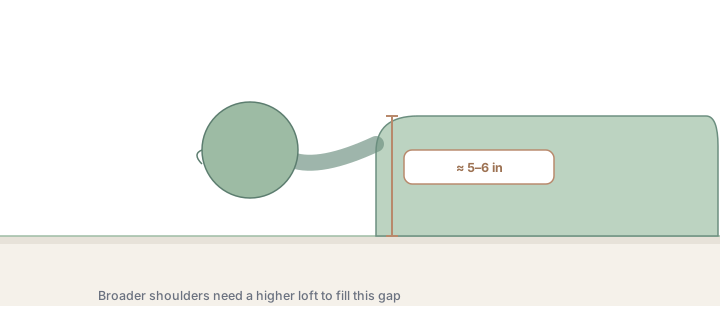
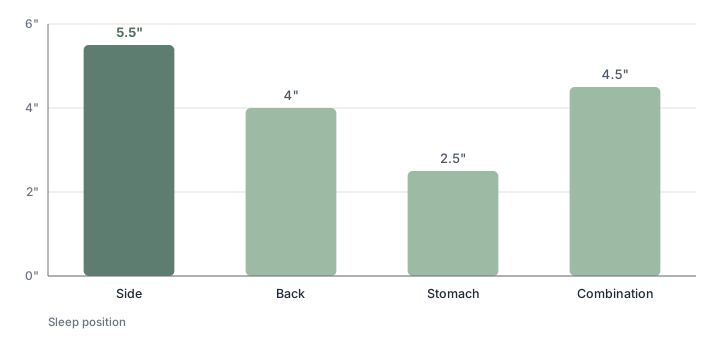
- You're a large-frame or broad-shouldered side sleeper. Premium pillows often go up to 6-7 inches of supportable loft without bottoming out, while mid-range pillows struggle past 5 inches. If you need significant loft and you're heavy enough to compress lesser pillows, premium becomes worth it.
- You want a 100-365 night trial window. The longer trials almost exclusively come with premium pricing. If you want a year to decide, that's a feature with real value.
- You have a specific cooling need (chronic night sweats, hot sleeper status, hot climate). Premium pillows with real phase-change material covers, Tencel fabric, and proper airflow design actually do sleep cooler. Budget 'cooling' pillows mostly don't.
- You want durability beyond 3 years. Premium foam densities and high fill power down both outlast budget materials by 1-3 years. If you really hate pillow shopping, the longer-life premium pillow saves you a future purchase.
The one thing premium pillows do NOT reliably do better: relieve neck and shoulder pain. A correctly-fitted $70 adjustable foam pillow performs about the same as a correctly-fitted $170 one for most pain sufferers. The premium pillow lasts longer and has nicer fabric, but it doesn't relieve more pain. For pain specifically, the American Academy of Orthopaedic Surgeons consistently emphasizes proper alignment over premium materials as the dominant factor.
Pillow price tiers for side sleepers with neck and shoulder pain
| Price tier | What you get | Trial / returns | Expected lifespan |
|---|---|---|---|
| Under $25 | Basic polyester fiberfill, fixed loft, no cover removal | Usually none | 2-6 months of useful support |
| $25-50 (entry) | Better polyester or budget down-alt, sometimes removable cover | Often 30 days | 12-18 months |
| $50-100 (value sweet spot) | Adjustable shredded memory foam, removable washable cover, real adjustability | 60-100 nights typical | 2-3 years |
| $100-200 (premium) | High fill power down or high-density foam, Tencel/lyocell cover, multi-zone designs | 100-365 nights | 3-4+ years |
| Over $200 (boutique) | Hand-finished construction, specialty cervical or custom designs | 100-365 nights | 4-5+ years |
Independent video reviews worth watching
We don't test pillows in a lab. Instead, here are independent, hands-on video reviews from sleep and mattress channels that pair well with this guide — useful for seeing loft, fill, and feel before you buy. These are third-party reviews, not ours.
 ▶
▶Dr. Matthew Posa, DC
The Best Pillow For Neck and Shoulder Pain (Avoid This Common Mistake)Editor's takeaway
What I'd actually buy if I were starting from scratch with neck and shoulder pain on a tight budget: a $55-70 adjustable shredded memory foam pillow with a 60-100 night return window. Not the cheapest, not premium — the boring middle. That's where the value actually lives. The mistake I've watched friends make over and over is either (a) spending $20 and being disappointed within months, or (b) jumping straight to a $180 premium pillow assuming it'll fix everything. The premium pillow is fine; it's just not 3x better than the $60 one for pain relief. If your budget genuinely caps at $40, get the best $40 adjustable foam you can find and accept that it'll need replacing in 18 months. If you can stretch to $70, you'll save money across two years and your pain will be better the whole time.
Frequently asked questions
What's the cheapest pillow that actually works for side sleepers with neck and shoulder pain?
Realistically, around $45-60 for an adjustable shredded memory foam pillow from a direct-to-consumer brand. Below that, you're typically getting non-adjustable polyester or low-density foam that won't last and won't tune to your specific loft needs. The $45-60 range is the lowest price where you can find a pillow with adjustable fill, a removable washable cover, and at least a 30-day return window — three features that together cover most of the bases for pain sufferers.
Are expensive pillows really better for pain than mid-range pillows?
For pain specifically, not by much. The features that actually relieve pain — correct loft, supportive fill, neutral cervical alignment — are available reliably starting at $50-70. What expensive pillows add (3-4+ year durability, premium cover materials, longer trial windows, ultra-high fill power down) are real upgrades but they don't relieve more pain. If you've never bought a quality pillow, start at $60-90. Going to $150+ before trying mid-range is usually overspending.
Why is my $20 pillow making my neck and shoulder worse?
Cheap polyester pillows mat down within months, so the pillow you bought six weeks ago at full loft is now half its original height. You're essentially side-sleeping with insufficient support, which compresses the bottom side of your neck and shoulder for hours every night. Pain caused by inadequate pillow loft compounds over weeks. The fix is replacing the pillow with something that holds its shape — at minimum an adjustable shredded foam in the $50-70 range.
How long should a budget pillow last for someone with pain?
An adjustable shredded foam pillow in the $50-75 range should give you 2-3 years of useful support if you fluff and rotate it regularly. Down-alternative in that range: 12-24 months. Below $50: usually 6-18 months. For pain sufferers specifically, the earliest sign that a pillow is wearing out is the return of morning pain that had previously resolved — replace at that point, not when the pillow looks visibly damaged.
Is it worth paying extra for a 'cooling' pillow?
Sometimes yes, sometimes no. Real cooling features — Tencel or lyocell fabric covers, phase-change material, shredded fill that allows airflow — do help hot sleepers sleep cooler. These typically start at $80-100. Below that price, 'cooling' usually means gel beads infused into foam, which is a 10-15 minute illusion before the gel equalizes with body temperature. If you genuinely sleep hot, pay for fabric and airflow, not for gel.
Should I buy a fancy pillow if I'm on a tight budget?
Tight budget means more reason to be careful about what you buy, not less. The single biggest budget mistake is buying three $20 pillows over the course of a year that don't work, when one $60 pillow would have lasted two years and actually helped your pain. If you can stretch to $60-70 for an adjustable shredded foam pillow with a return window, you'll come out ahead financially within 6-12 months and your pain will be better the whole time.
Where should I buy a budget pain pillow — Amazon, big-box, or direct-to-consumer?
Direct-to-consumer brands generally have the best return windows (often 100 nights or more) and the most transparent product specs. Amazon offers convenience and reviews but return windows are usually 30 days. Big-box stores allow in-person feel but rarely the longest trials. For pain sufferers, the longer trial window is the most important purchase factor — being able to return a pillow that doesn't work is worth more than saving $5-10 at checkout. Whichever channel you choose, verify the actual return policy before buying.
More in this section
Pillows for Pain Relief — A Side Sleeper Pillar Guide
View all guides in this section →
Keep reading
Related guides
← Back to our main Best Pillow for Side Sleepers guide