Part of Pillows for Pain Relief — A Side Sleeper Pillar Guide
Best Body Pillow for Side Sleepers with Shoulder Pain
The best body pillow for side sleepers with shoulder pain is not the prettiest one on Amazon, the longest one on the shelf, or the one with the trendiest cooling fabric. It is the one that holds the top arm at chest height all night so it stops dropping forward and dragging the underside shoulder out of alignment. That is the entire mechanism most shopping pages skip. Side-sleep shoulder pain is overwhelmingly a top-arm problem first and an underside-shoulder compression problem second, and a properly chosen body pillow addresses both at once. This guide is written for readers who already own a decent head pillow and still wake with an aching shoulder, a popping rotator cuff, or numb fingers that take twenty minutes to fade.

Why a head pillow alone cannot solve shoulder pain
A head pillow controls the cervical spine. It controls almost nothing below the neck. Side sleepers who wake with shoulder pain often spend months — sometimes years — swapping head pillows, raising and lowering loft, switching between memory foam and shredded latex, and seeing only marginal improvement. The reason is mechanical. When a side sleeper settles onto a mattress, the top arm has no fixed support. Gravity pulls it forward and down across the front of the body. Within about thirty to ninety minutes the entire upper torso rotates with the arm: the shoulder rolls toward the bed, the chest closes inward, and the underside shoulder bears the full thoracic weight at an unnatural angle.
The consequences are predictable. The underside rotator cuff is compressed against the mattress. The brachial plexus — the nerve trunk that crosses the shoulder and feeds the arm — is partially impinged. The top shoulder, meanwhile, sits in an internally rotated, protracted position for hours, irritating the supraspinatus tendon and the subacromial bursa. According to the American Academy of Orthopaedic Surgeons, repetitive sleeping postures that compress or impinge the shoulder are a routinely cited contributor to chronic shoulder complaints in adults over forty. A head pillow cannot interrupt this geometry. A body pillow can.
The two mechanisms a body pillow uses to reduce shoulder pain
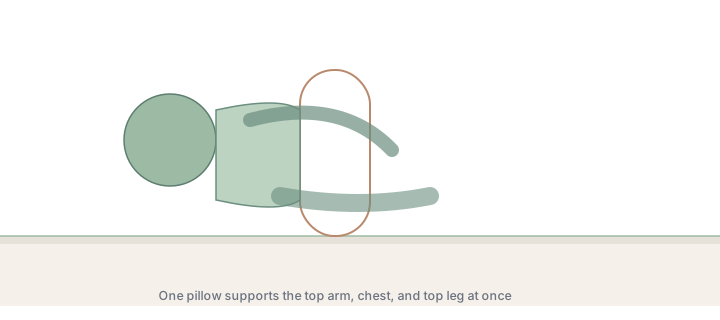
The first mechanism is offloading. When a side sleeper hugs a body pillow, the top arm rests on the pillow at roughly chest height instead of dropping forward. The shoulder stays externally rotated rather than internally collapsed. The supraspinatus is unloaded. The chest stays open. Verified-buyer review patterns on the largest body pillow listings consistently mention this as the change buyers feel within the first one to three nights — a noticeably looser shoulder on waking, and a chest that feels less constricted in the morning.
The second mechanism is anti-rotation. A body pillow hugged against the front of the torso physically prevents the upper body from rolling forward toward the mattress. Without that block, even sleepers who fall asleep on a clean side position drift toward a three-quarter prone position by 3 a.m., which is when the underside shoulder takes the most punishment. With a body pillow, the torso stays vertical relative to the mattress, and the underside shoulder keeps its native joint angle.
Both mechanisms compound. A sleeper who solves only one — say, by hugging a thin pillow that offloads the arm but does not block torso rotation — sees roughly half the benefit. The right body pillow does both.
Length, firmness, and fill — the specs that matter for shoulder pain
Length is the most-skipped spec. A body pillow shorter than the torso lets the top arm dangle past the end, which reintroduces the forward drop the pillow was supposed to prevent. The working rule for shoulder pain is simple: the pillow should run from at least the top of the head to the top of the knee when hugged. For most adults that means a 54-inch pillow; sleepers over six feet should look at 60 inches; sleepers under 5'4" can use 48 inches without losing support.
Firmness matters more than the marketing suggests. A body pillow that collapses under the weight of the top arm by midnight is the same as having no body pillow at all. We recommend a medium-firm fill that resists compression for the full night. Verified-buyer reviews repeatedly call out the same failure mode in soft polyester body pillows: they feel great for the first week, then go flat and need to be re-fluffed daily.
Fill type tracks the same trade-offs as head pillows. Shredded memory foam holds loft well, contours to the arm, and runs warm. Shredded latex holds loft equally well and runs noticeably cooler. Solid polyester clusters are inexpensive but compress fastest. Buckwheat body pillows exist but are heavy enough to be impractical for most sleepers. For shoulder pain specifically, shredded memory foam or shredded latex are the two materials we would start with — both maintain the resistance needed to keep the top arm elevated all night.
Body pillow shape for shoulder pain — straight, J-shape, or U-shape?
Three shapes dominate the body pillow market, and only one is optimized for shoulder pain.
The straight body pillow is the workhorse for non-pregnant side sleepers with shoulder pain. It is a long rectangular pillow, hugged against the front of the body, with the top arm draped across it and the top knee resting on or beside the lower third. Nothing wraps behind the back. This is the shape we recommend by default because it solves the shoulder problem without complicating the rest of the bed.
The J-shape body pillow wraps from the front of the body around behind the head, providing head support and front support in one piece. It works for sleepers who want to consolidate pillows and for pregnant sleepers in the second and third trimesters. For shoulder pain specifically, it is acceptable but slightly less precise than a straight pillow because the head section often dictates loft in a way that may not match shoulder geometry.
The U-shape body pillow wraps around the entire body — front, head, and back. It is the most stabilizing shape, the heaviest, and the most space-consuming. Pregnant side sleepers benefit most from this shape. Non-pregnant sleepers usually find it excessive; a straight body pillow plus a properly sized head pillow does the same job with less bed real estate.

Independent video reviews worth watching
We don't test pillows in a lab. Instead, here are independent, hands-on video reviews from sleep and mattress channels that pair well with this guide — useful for seeing loft, fill, and feel before you buy. These are third-party reviews, not ours.
 ▶
▶Sleepopolis
Coop Body Pillow — Most Comfortable for Side Sleepers? ▶
▶Tool Junkie
Tested the Best Pillows for Side Sleepers in 2026 | Battle PainEditor's takeaway
The honest editorial take on body pillows for shoulder pain is that they are the single most underused piece of side-sleeper equipment for this specific problem. Readers who write to us about persistent shoulder pain have almost always already swapped two or three head pillows before they ever consider a body pillow, even though the underlying mechanism — top arm rolling forward, torso rotating with it — cannot be solved by anything happening at the head level. The category does not need to be complicated. A 54-inch straight shredded memory foam or shredded latex body pillow, medium-firm, with a breathable cover, hugged in front of the torso for two weeks, will resolve most sleep-position-driven shoulder pain in adults who are not dealing with an underlying joint condition. When it does not resolve the pain, that itself is useful information — it tells you the problem is not sleep posture, and a clinician should be the next step rather than another pillow.
Frequently asked questions
Will a body pillow help if my shoulder pain is only on the underside?
Often yes, even though that may seem counterintuitive. Underside shoulder pain in side sleepers is usually driven by the top side of the body rolling forward and adding rotational load to the joint that is already bearing the body's weight. A body pillow stops that rotation by physically blocking the upper torso from rolling toward the mattress. The result is that the underside shoulder stays in its native angle all night instead of being twisted into the floor. Many readers expect a body pillow to help the top shoulder and are surprised to find it relieves underside pain just as effectively. Give it about a week before deciding.
What length body pillow should I buy for shoulder support?
For shoulder support specifically, the pillow needs to extend from at least the top of the head to the top of the knee when you are hugging it. For most adults that means 54 inches. Sleepers under 5'4" can use 48 inches comfortably. Sleepers over 6'0" should consider 60 inches. The biggest mistake we see in reader reports is buying a pillow that is too short — it lets the top arm dangle past the bottom of the pillow, which reintroduces the forward arm drop the body pillow was supposed to prevent. When in doubt, size up.
How firm should the body pillow be for shoulder pain?
Medium-firm is the right starting point. The pillow needs to resist compression under the weight of the top arm for a full eight hours; a pillow that flattens by 3 a.m. lets the arm drop, which is the exact problem the pillow was supposed to solve. Verified-buyer review patterns on softer polyester body pillows consistently mention this failure mode after a few weeks of use. Shredded memory foam or shredded latex fills hold firmness much better over time. If you can press your palm into the pillow and easily flatten it, it is too soft for sustained shoulder support.
Can I use a body pillow with my existing head pillow?
Yes, and you should. The body pillow does not replace the head pillow — it complements it. The head pillow controls cervical alignment; the body pillow controls torso rotation and top-arm position. They are solving different problems and they coexist comfortably. The only adjustment most readers need to make is to ensure their head pillow loft is correct for side sleeping (typically 4 to 6 inches of compressed loft); a body pillow does not compensate for a head pillow that is too tall or too short. If both pillows are in the right loft range and you are still waking with shoulder pain after two weeks, see a clinician.
Do body pillows work for combination side-and-back sleepers?
They work but require a small adjustment. When you roll from your side onto your back, push the body pillow slightly to one side rather than letting it dig into your hip. Many combination sleepers naturally use the body pillow as a partial bolster on their back-sleep phases, which prevents the torso from drifting too far prone when they roll back to their side. Sleepers who change positions ten or more times a night often find that the body pillow reduces the total number of position changes, because it provides postural feedback that the brain reads as stability.
Are body pillows hot to sleep with?
Some are, some are not. Solid memory foam body pillows trap the most heat against the chest because they are large slabs of closed-cell foam in direct contact with the torso for hours. Shredded memory foam runs cooler because air moves between the chunks. Shredded latex runs cooler still because the cellular structure of latex is more open by nature. Covers matter too — Tencel, bamboo viscose, and breathable cotton covers significantly outperform polyester covers for surface temperature. If you sleep hot, choose shredded latex with a Tencel cover. According to the [Cleveland Clinic](https://my.clevelandclinic.org/health/articles/12148-sleep-basics), maintaining a cooler sleep environment is one of the consistent variables associated with deeper, less interrupted sleep.
How long does it take a body pillow to actually relieve shoulder pain?
Most readers report noticeable improvement within three to seven nights, and meaningful relief within two weeks. The first one or two nights typically feel awkward because the body has adapted to whatever rotational pattern it has been using for years. By night four or five the new geometry feels normal. By the end of week two the shoulder pain pattern is either substantially reduced or clearly identified as a non-pillow problem. If two weeks pass without improvement, the issue is probably not the sleep position — it is more likely a rotator cuff issue, impingement syndrome, arthritis, or another condition that warrants evaluation by an orthopedist or physical therapist.
Is this medical advice for shoulder pain?
No. This is editorial coverage of pillow ergonomics. We do not diagnose or treat any medical condition. Shoulder pain that wakes you from sleep, radiates down the arm, is accompanied by numbness or weakness, or limits the range of motion of the arm should be evaluated by a physician, physical therapist, or orthopedic specialist before any pillow experiments. A body pillow can support healthy sleeping geometry; it cannot resolve a torn rotator cuff, advanced impingement, frozen shoulder, or arthritis. Use this guide for selection if you are otherwise healthy and want to address sleep-position-driven shoulder discomfort.
More in this section
Pillows for Pain Relief — A Side Sleeper Pillar Guide
View all guides in this section →
Keep reading
Related guides
← Back to our main Best Pillow for Side Sleepers guide