Part of Pillows for Pain Relief — A Side Sleeper Pillar Guide
Best Pillows for Side Sleepers with Shoulder Pain
The best pillows for side sleepers with shoulder pain do not come from a single price band, a single material, or a single brand — they come from a field of legitimate options that span roughly $25 at the entry level to $200+ at the premium tier, with meaningful trade-offs at every step. This is a buyer's field guide rather than a single-pick recommendation. We have organized it by price tier and by mechanism so readers can see where the diminishing returns kick in, where the cheap options actually compete with the expensive ones, and where the premium spend genuinely buys better shoulder support. The goal is a framework readers can use to choose intelligently, not a single product pick that will inevitably fit some bodies and miss others.

Why shoulder pain demands a different pillow conversation than neck pain
Most pillow guides treat shoulder pain as a subset of neck pain. They are related but not identical, and the differences matter for shopping. Neck pain in side sleepers is overwhelmingly a head-pillow problem — loft, firmness, and contour at the cervical spine. Shoulder pain is partially a head-pillow problem (a pillow that is too low forces the head to droop into the same shoulder, doubling the strain) and partially a downstream problem (the top arm rolling forward, the torso rotating, the underside shoulder bearing weight at the wrong angle).
This means shoulder-pain shopping has more variables. A side sleeper with neck pain alone can often resolve the issue with a single well-chosen head pillow. A side sleeper with shoulder pain may need a head pillow at the right loft, a slightly firmer fill than they would otherwise pick, and a body pillow or supplementary support to address the rotational component. Treating the two as the same problem is one of the most common reasons readers spend $300 across three pillows and still wake stiff. According to the American Academy of Orthopaedic Surgeons, shoulder pain in adults is a multi-mechanism complaint, and sleep posture is one of several contributing factors that warrant attention rather than a single root cause that one product can fix.
Loft requirements specific to shoulder pain
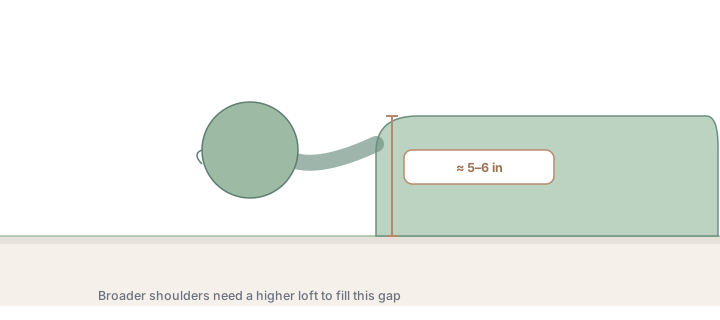
The loft math is slightly different for shoulder pain than for neck pain. Both populations need a pillow that fills the shoulder-to-ear gap exactly, but shoulder-pain sleepers benefit from being at the upper end of their loft range rather than the lower. The reason is mechanical. A pillow at the lower end of an acceptable loft range still works for neck alignment because the cervical spine has some natural tolerance for minor lateral angles. The shoulder joint has far less tolerance — a head that is even slightly drooped toward the mattress loads the upper trapezius and compresses the brachial plexus where it crosses the shoulder.
The working rule we use in this guide: measure the horizontal distance from just below your ear to the outer edge of your shoulder, subtract about half an inch for shoulder compression into the mattress, and choose a pillow whose compressed loft is within a quarter inch of that number. Petite sleepers usually land at 4 to 4.5 inches. Average-build adults usually land at 4.5 to 5.5 inches. Broad-shouldered adults often need 5.5 to 6.5 inches. Verified-buyer reviews of low-loft pillows consistently flag this — sleepers with shoulder pain who buy pillows under 4 inches of compressed loft commonly report that the shoulder ache returns within a week of switching.
Budget tier: $25 to $50 — what is realistic at this price
At the entry level, the pillow universe is dominated by polyester microfiber fills, low-density solid foam, and basic shredded foam blends. The honest assessment is that this tier can work for shoulder pain, but it requires careful selection and acceptance of a shorter useful life.
What works: a shredded memory foam pillow at the right loft, even at this price, can deliver acceptable shoulder support for the first six to twelve months. Look specifically for shredded memory foam (not solid polyester clusters marketed as memory foam) with a zipper opening for fill adjustment. The construction is usually thinner, the cover is usually polyester, and the foam density is on the lower end — but the basic geometry is correct.
What does not work: solid polyester microfiber pillows under $30 nearly always compress to insufficient loft within four to eight weeks for a side sleeper. They feel acceptable at purchase and become useless by the time the return window closes. We do not recommend this format for shoulder pain even at budget prices; the false economy is real.
Expect to replace a budget-tier pillow every twelve to eighteen months. Two budget pillows in three years cost about the same as one mid-range pillow that lasts the full period, with the difference being the gap weeks where the budget pillow is past its useful life but you have not replaced it yet — those weeks are where shoulder pain creeps back in.
Mid-range tier: $50 to $100 — the sweet spot for most readers
The mid-range is where most side sleepers with shoulder pain should shop. The category includes solid memory foam at moderate densities, basic latex (often Dunlop-process rather than the more expensive Talalay), shredded memory foam with denser fills, and contour pillows from established brands.
What works at this price: shredded memory foam with a Tencel or bamboo viscose cover, solid memory foam in a cervical contour shape, and basic Dunlop latex pillows. All three deliver the loft retention required for sustained shoulder support and outlast the budget tier by a factor of two to three. The fills are denser, the covers are better, and the construction quality is more consistent.
The sweet spot inside this tier is shredded memory foam with adjustable fill — the same category that wins for neck pain — paired with a slightly higher loft than the sleeper would choose for neck pain alone. Adjustability matters disproportionately for shoulder pain because the right loft is at the upper edge of comfort, and a fixed-loft pillow that is even a half inch too short reintroduces the original problem.
What does not work as well at this price: budget latex (often a polyfoam-latex blend marketed as natural latex), down-alternative pillows with synthetic clusters trying to imitate down luxury, and contour pillows whose dimensions do not match the buyer's shoulder width. Read product specs carefully and prefer brands with a 60-day or longer return window.
Premium tier: $100+ — where the premium spend earns its keep
Above $100, the category opens up to Talalay latex, shredded latex with high-quality covers, dense memory foam (4 to 5 lb/ft³), specialized cervical contour pillows engineered for shoulder offloading, and adjustable systems with multiple fill options.
What the premium spend genuinely buys: longer useful life (five to seven years for solid latex versus two to three years for memory foam), noticeably better temperature regulation (Talalay latex sleeps significantly cooler than even gel-infused foam), more precise contouring, and adjustability with multiple fill types in one pillow. For broad-shouldered side sleepers with persistent shoulder pain, this is often the right tier because the loft requirements are at the edge of what budget and mid-range pillows can sustain, and the premium build holds the required loft for years.
Where the premium spend does not pay off: marketing-driven "luxury hotel" feel pillows that are essentially down or down-alternative with premium packaging. These pillows can run $150 or more and still compress to insufficient loft for a side sleeper within hours. The premium label means nothing if the construction is optimized for plushness rather than loft retention. The Sleep Foundation repeatedly emphasizes loft retention and material density as the variables that matter for side-sleeper comfort, and high-end down pillows usually underperform on both.
Price-tier comparison at a glance
The table below summarizes what readers can realistically expect at each tier. The honest framing: most side sleepers with shoulder pain are best served in the $50 to $100 range, with the premium tier reserved for sleepers whose shoulder width or sleep position demands the additional support and durability.
How to test a pillow for shoulder pain in the first two weeks
Whatever tier you choose, the testing protocol is the same. Sleep on the pillow for fourteen consecutive nights before judging it. The first three to five nights often feel awkward — the shoulder has adapted to whatever the old pillow was doing, and the right geometry can feel slightly off until the body recalibrates.
The morning check is straightforward. On waking, before getting out of bed, lift the top arm overhead and rotate it through a full circle. Note any clicking, popping, or sticky points. Sit up and gently roll the shoulders backward and forward five times. Stand up and walk for two minutes. Then assess: is the shoulder looser than yesterday, the same, or worse?
Keep a one-line note each morning for the first ten days. A pillow that is helping shows a clear downward trend in stiffness over the first week and a noticeable change by day ten. A pillow that is not helping shows flat or worsening scores by day ten — at which point the return window is still open and a switch is warranted. Pillows that are still ambiguous at day ten almost always continue to be ambiguous, and a different pillow is usually the right move.
Pillow price tiers for side sleepers with shoulder pain
| Tier | Best material | Useful life | Loft retention | Return window expectation |
|---|---|---|---|---|
| $25-$50 budget | Shredded memory foam | 12-18 months | Acceptable to fair | 30 days minimum |
| $50-$100 mid-range | Adjustable shredded memory foam | 3-5 years | Very good | 60-100 days |
| $100-$180 premium | Shredded or solid Talalay latex | 5-7 years | Excellent | 100+ days, often 1-year warranty |
| $180+ luxury | Dense Talalay latex or specialty foam | 7+ years | Excellent | Full year or longer warranty |
Independent video reviews worth watching
We don't test pillows in a lab. Instead, here are independent, hands-on video reviews from sleep and mattress channels that pair well with this guide — useful for seeing loft, fill, and feel before you buy. These are third-party reviews, not ours.
 ▶
▶Sleeping Mattress
Best Pillow for Side Sleepers with Shoulder Pain — Top 5 Picks ▶
▶Sleepopolis
Best Pillows for Side Sleepers of 2026 — Our 8 Favorites!Editor's takeaway
The editorial position on shoulder-pain pillow shopping is that the right answer for most readers lives in the $60 to $100 mid-range, with adjustable shredded memory foam as the default material choice. Above that price band the marginal improvement in shoulder support is modest; below it the build quality compromises the loft retention that shoulder support specifically requires. Broad-shouldered sleepers and sleepers with persistent symptoms are the two groups for whom the premium tier genuinely earns its premium — both because the loft requirements are at the edge of what mid-range pillows can sustain and because the durability of Talalay latex justifies the spend over a five-to-seven-year horizon. The single most-skipped variable in shoulder-pain shopping is the rotational component: the top arm dropping forward and pulling the torso prone, which no head pillow at any price can address on its own. Readers who have tried multiple head pillows without success should consider a body pillow as the next variable to change before assuming the shoulder pain is non-positional.
Frequently asked questions
What is the best pillow material for side sleepers with shoulder pain?
Shredded latex or adjustable shredded memory foam are the two materials that consistently perform best for shoulder pain in side sleepers. Both maintain loft for the full night, both can be tuned to the exact loft your shoulder width requires, and both run cooler than solid memory foam slabs. Between the two, shredded latex sleeps cooler and lasts longer; shredded memory foam contours more deeply and costs less. Either is a defensible starting choice. Solid memory foam contour pillows are a strong third option if the contour dimensions happen to match your shoulder width — they work very well when they fit and noticeably less well when they do not.
How much should I expect to spend on a good pillow for shoulder pain?
Most side sleepers with shoulder pain are well served in the $60 to $100 range. Below $50, the build quality and loft retention compromise the support you need within a few months. Above $150, the additional spend buys longer useful life and better temperature regulation rather than fundamentally better shoulder support. The sweet spot for the average reader is a mid-range adjustable shredded memory foam pillow with a Tencel cover, which lands at roughly $70 to $95 from most reputable brands. Broad-shouldered sleepers or those with persistent pain may benefit from moving up to Talalay latex around $120 to $160.
Can a cheap pillow work for shoulder pain or is it always false economy?
A well-chosen budget pillow can work, but only with realistic expectations. A $30 shredded memory foam pillow at the right loft can deliver acceptable shoulder support for the first six to twelve months. The problem is replacement timing — most budget pillows degrade gradually, and sleepers tend to keep them well past their useful life because the change happens slowly. Two budget pillows over three years cost about the same as one mid-range pillow that holds support for the full period. We recommend budget tier only when cash flow makes the higher tier impractical, and we recommend replacing on a strict twelve-to-eighteen-month schedule rather than waiting for obvious failure.
Are contour pillows worth it for shoulder pain?
They can be, with one important caveat. Cervical contour pillows are engineered with a raised edge that cradles the neck and a lower center that catches the head. When the contour dimensions match the sleeper's shoulder width, the result is excellent — the loft is exactly right at the neck and the head stays neutral. When the dimensions do not match, the contour creates a new alignment problem. The trade-off is precision: a contour either fits or it does not. We recommend contour pillows from brands with at least a 60-day return window, and we recommend committing to a full two-week trial before judging fit. Sleepers who do not stay on one side most of the night usually find an adjustable shredded fill more forgiving than a fixed contour.
Should I use a body pillow alongside my head pillow for shoulder pain?
Often yes. Shoulder pain in side sleepers has two components: cervical loading from the head pillow side, and rotational loading from the top arm dropping forward and pulling the torso into a partial prone position. A head pillow addresses the first; a body pillow addresses the second. Many readers who have tried multiple head pillows without success find that adding a body pillow resolves the residual pain. Our [body pillow for shoulder pain guide](/best-body-pillow-for-side-sleepers-with-shoulder-pain) covers the specific mechanism in more detail. The body pillow does not need to be expensive — a basic shredded memory foam straight body pillow at 54 inches is usually sufficient.
How long should I give a new pillow before deciding it does not work?
Fourteen consecutive nights is the standard. The first three to five nights are usually awkward because the shoulder has been adapted to the old pillow's geometry. By night seven, a pillow that is helping shows a clear downward trend in morning stiffness. By night fourteen, a pillow that is going to work has already produced meaningful relief — typically a 50% or greater reduction in morning pain. A pillow that has not produced meaningful change by day fourteen is unlikely to improve further. Return it within the trial window and try a different material or loft.
Do cooling features matter for shoulder pain or is that a separate concern?
Cooling features matter indirectly. A pillow that sleeps hot causes sleepers to flip, reposition, and partially wake more often, which means the shoulder spends more time in transitional and rotated positions throughout the night. A cooler pillow keeps the sleeper in a stable side-lying position for longer continuous stretches, which lets the shoulder rest at a consistent angle. The cooling features that actually work are ventilated open-cell foam, shredded latex (which sleeps significantly cooler than solid foam by construction), and breathable Tencel or bamboo viscose covers. Phase-change covers and gel infusions help at sleep onset but fade within the first hour.
What firmness should I look for in a pillow for shoulder pain?
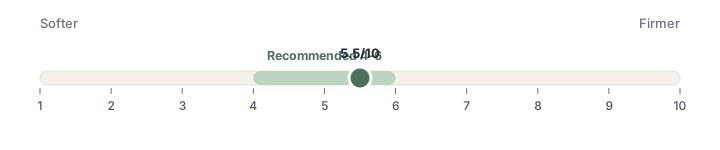
Medium-firm to firm. Soft pillows feel pleasant at purchase but compress under the weight of the head over the course of the night, which lowers the effective loft below what shoulder support requires. By 3 a.m. the pillow that started at the right loft is now too low, and the head droops into the same shoulder you are trying to relieve. Verified-buyer reviews of soft pillows in shoulder-pain contexts consistently report this pattern: initial relief that fades after two to three weeks as the pillow breaks in further. Firmer pillows that resist compression hold their effective loft through the full night.
Is this site medical advice for shoulder pain?
No. We are an editorial team covering pillow ergonomics and product comparison. Shoulder pain that wakes you from sleep, radiates down the arm, is accompanied by numbness, weakness, or limited range of motion, or persists despite a properly fitted pillow should be evaluated by a physician, orthopedist, or physical therapist. A pillow can address sleep-position-driven shoulder discomfort in an otherwise healthy adult; it cannot resolve a torn rotator cuff, impingement syndrome, frozen shoulder, advanced arthritis, or referred pain from the cervical spine. Treat the pillow as one variable in a system that includes mattress, sleep position, daytime ergonomics, and clinical evaluation when warranted.
More in this section
Pillows for Pain Relief — A Side Sleeper Pillar Guide
View all guides in this section →
Keep reading
Related guides
← Back to our main Best Pillow for Side Sleepers guide