Part of Pillows for Pain Relief — A Side Sleeper Pillar Guide
Best Knee Pillow for Side Sleepers with Hip Pain
Best knee pillow for side sleepers with hip pain is the search I helped my mom with last summer, when her right hip — chronically grumpy from years of standing on her feet as a nurse — started waking her up at 4 a.m. every morning. She's a strict side sleeper, in her late 60s, and she wasn't about to start sleeping on her back. The fix was annoyingly simple: an hourglass-shaped memory foam knee pillow, about 6 inches thick, between her thighs and knees, plus a small change in which side she slept on. Within ten days she was sleeping through to her normal wake time. This page is what I learned helping her pick one, plus what to watch for if you've got hip pain and you're a side sleeper.

Why hip pain side sleepers need a knee pillow specifically
Hip pain in side sleepers comes from two main problems, and a knee pillow addresses both.
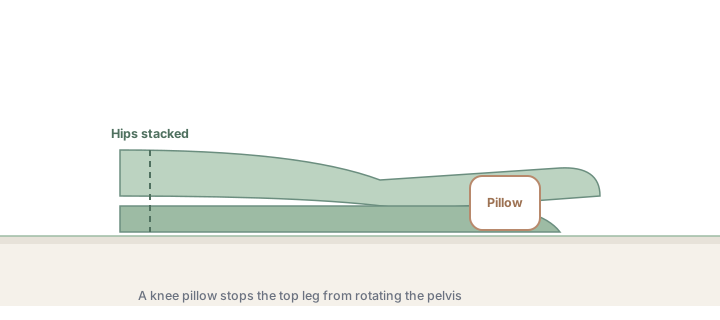
Problem one: pelvic rotation. When you lie on your side without anything between your legs, your top leg slides forward and your top knee falls below the bottom knee. Your top hip rotates inward. This puts uneven pressure on the hip joint itself, on the muscles around it (especially the gluteus medius and minimus), and on the IT band. For a healthy hip, that's tolerable. For an arthritic hip, a bursitis hip, or a labral-tear hip, it's a slow-motion irritation that builds up over the night.
Problem two: top-knee pressure on the bottom knee. Without a pillow between them, your knees touch and rub. Your top knee's weight presses your bottom knee against the mattress. That referred pressure can travel up the leg and aggravate the hip.
A knee pillow keeps your knees apart at the right height, which keeps your hips stacked vertically, which keeps the painful hip joint in a more neutral position all night. The joint isn't being compressed or rotated. It just gets to rest.
The other thing worth knowing for hip pain specifically: which side you sleep on matters. If your right hip is the painful one, sleeping on your left side (right hip up) is usually more comfortable than sleeping on the painful side. Gravity pulls the painful hip away from the mattress, not into it. Many physical therapists for hip-arthritis patients recommend exactly this combination: non-painful side down, knee pillow between legs, slightly bent knees.
The Cleveland Clinic's guidance on hip osteoarthritis covers conservative management broadly, and the sleep-position piece — knee pillow + non-painful side — is a standard part of the comfort recommendations. It's mechanical, not medical, but it's effective.
"Side sleepers with hip pain should aim to keep the pelvis level and the spine neutral. Placing a firm pillow between the knees and lower thighs lifts the top leg sufficiently to prevent pelvic tilt and reduce strain on the lateral hip structures."
This is the principle behind every knee pillow recommendation you'll read from orthopedic and physical therapy sources. The wording varies, but the message is consistent: hip alignment overnight comes from pelvic alignment, and pelvic alignment comes from supporting the top leg at the right height. The American Academy of Orthopaedic Surgeons and similar professional bodies repeatedly reference pelvic alignment as central to hip joint comfort. A knee pillow is the simplest mechanical way to achieve it during sleep.
The practical takeaway: don't think of a knee pillow as 'something between your knees.' Think of it as 'the support that keeps your top hip from rotating inward all night.' That framing changes what you look for in the pillow — loft, density, and placement become the things that matter, not branding or marketing language.
What I'd look for if I were shopping today
Working through the considerations my mom and I went through, in order of importance for hip pain specifically:
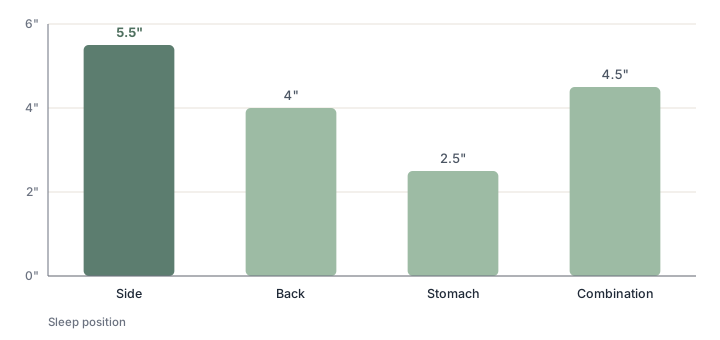
Loft, sized to your body. This is the #1 factor. For an average-build adult, 5 to 7 inches at the widest part of the pillow. For broader-hipped or larger-framed people, 6 to 8 inches. For petite people, 4 to 6 inches. My mom is small-framed and landed at 5.5 inches. Test by lying on your side with the pillow in place — your hips should be vertically stacked when viewed from behind.
Firmness that holds up under leg weight. Memory foam at 3+ lb/ft³ density is the standard. Avoid polyester fiberfill, which compresses overnight. For hip pain, you can't afford to lose loft halfway through the night.
Hourglass shape. Stays put between the legs better than a wedge. For hip-pain sleepers who already toss and turn looking for a comfortable position, a pillow that slides out is going to get thrown across the room by night three.
Cool-running cover. Hip pain in older adults often comes with night sweats from various causes. A bamboo viscose or Tencel cover breathes far better than polyester knit.
Hypoallergenic considerations. If you have skin sensitivities, look for OEKO-TEX certified covers and CertiPUR-US foam, which limit chemical exposure.
Return window. 30 days minimum. Hip pain pillow choice is personal — what works for one person doesn't for another. Buy from somewhere you can return.
For my mom specifically, we ended up with a gel-infused memory foam hourglass pillow, 5.5 inches loft, bamboo viscose cover. Cost about $40. Two years later, still going strong. She has not asked me to research a different one.
Independent video reviews worth watching
We don't test pillows in a lab. Instead, here are independent, hands-on video reviews from sleep and mattress channels that pair well with this guide — useful for seeing loft, fill, and feel before you buy. These are third-party reviews, not ours.
 ▶
▶TrustRanker
Top 5 Best Knee Pillows — Review ▶
▶Geeked Rehab
Best Pillow Setup for Side Sleepers — Pain-Free Sleep TipsEditor's takeaway
My mom is the reason I take hip pain side-sleeping seriously. She tried lots of things — different mattresses, different sleep positions, different over-the-counter creams. The thing that actually moved the needle for her was the boring, simple combination: sleep on the non-painful side, knee pillow between thighs and knees at the right loft, slight knee bend, small support behind her back. Total cost about $40 for the pillow. She's two years in and still telling friends about it. If hip pain is waking you up and you're a side sleeper, this is one of the cheapest experiments you can run before escalating to mattresses, injections, or anything more involved. Give it ten nights of consistent use before deciding either way.
Frequently asked questions
Do I need to sleep on the non-painful side, or can I sleep on the painful side with a knee pillow?
If you can comfortably sleep on the painful side, you can — the knee pillow still helps by preventing pelvic rotation. But most people with one-sided hip pain find sleeping on the painful side directly compresses the affected joint and is more uncomfortable. Sleeping on the non-painful side (painful hip up) lets gravity work for you, takes pressure off the affected hip, and is usually more comfortable. Try the non-painful side first with the knee pillow in place. If that's not comfortable for other reasons (shoulder pain, partner side of the bed, etc.), the painful side with knee pillow is still better than no knee pillow.
How thick should a knee pillow be for hip pain specifically?
Match it to your hip width — the loft needs to lift your top knee enough that your hips are vertically stacked when you lie on your side. Most adults land between 5 and 7 inches. Broader-hipped or larger-framed people may need 7 to 8. Petite or narrow-hipped people often do well at 4 to 5. Don't go thicker than your body needs — a too-thick pillow lifts your top leg too high and can aggravate the hip from the opposite direction. The check: lie on your side with the pillow in place. Hips should be stacked vertically. If they're not, adjust loft.
Will a knee pillow help with hip bursitis?
Often yes, for the sleep portion of the problem. Hip bursitis (greater trochanteric bursitis) is irritation of the bursa on the outside of the hip. Lying directly on the affected side compresses the bursa. Sleeping on the non-painful side with a knee pillow takes pressure off the inflamed bursa and prevents the IT band from being stretched across it. Many bursitis sufferers report meaningful overnight relief from this combination. It's a comfort measure, not a treatment — actual treatment usually involves PT, NSAIDs, and sometimes corticosteroid injections — but as a sleep adjustment it's well worth trying.
Can a knee pillow help hip arthritis?
Yes, for sleep comfort. Hip osteoarthritis means cartilage wear in the hip joint, and any position that compresses or rotates the joint can aggravate it. A knee pillow keeps the joint in a more neutral, less stressful position overnight. Combined with sleeping on the non-painful side, many arthritis sufferers see better mornings. This doesn't treat the arthritis — that's a separate conversation involving PT, sometimes joint injections, possibly eventual surgery. But for managing the sleep portion, knee pillow plus non-painful side is one of the most commonly recommended adjustments.
What if both hips hurt?
First, that's worth flagging to your doctor if you haven't already — bilateral hip pain has a different differential than one-sided pain. For sleep management, alternate sides nightly with the knee pillow always in place. Some people find one side is worse than the other and stick to the less-painful side. If both sides are equally bad and you've got the medical workup underway, look at whether your mattress is part of the problem — a too-firm mattress aggravates hip pressure points, while a too-soft mattress lets your hips sag. A medium-firm mattress with a soft topper is often the friendliest setup for bilateral hip issues.
Is there a difference between a 'hip pain' knee pillow and a regular knee pillow?
Marketing-wise, yes. Functionally, mostly no. Pillows labeled 'for hip pain' are typically standard memory foam knee pillows with hip-focused marketing. The foam, loft, and shape are usually the same as a generic knee pillow at the same price point. Don't pay a premium for the 'hip pain' label — pay for materials (memory foam, 3+ lb/ft³ density, gel infusion if you want it cool), certifications (CertiPUR-US), cover quality (bamboo viscose or Tencel), and the right loft for your body. A $35 standard memory foam knee pillow with the right loft will outperform a $75 'specialized hip pain pillow' with the wrong loft, every time.
How long until I notice a difference?
For mechanical sleep position issues with hip pain, most people notice improvement within 5 to 10 nights of consistent use. The first 2 to 3 nights can feel fiddly because your body is adapting to the new alignment. By night 5 or 6, the pillow should stay in place without much thought and you should be sleeping through more comfortably. By night 10, if loft and placement are right, you should be feeling at least mild morning improvement. If you've given it two weeks of consistent use with no difference, the loft is probably wrong for your body, or your hip pain isn't primarily positional, and it's time to see a PT or doctor.
More in this section
Pillows for Pain Relief — A Side Sleeper Pillar Guide
View all guides in this section →
Keep reading
Related guides
← Back to our main Best Pillow for Side Sleepers guide