Guides & Answers
What Are the Best Pillows for Side Sleepers
What are the best pillows for side sleepers is one of the most-asked questions on this site, and the honest answer is that there is no single best pillow — there are five concrete categories of pillow that each earn their place for a particular kind of side sleeper. This guide walks through all five with equal weight, explains the trade-offs of each, and gives readers a framework for matching the category to their own body and sleep habits. The categories are memory foam, latex, adjustable shredded fill, cooling pillows, and body pillows used in support of the main head pillow. By the end of the guide, readers should know which of the five to start with and which to consider only after the first choice has been tested.

Category 1 — Memory foam, for stillness and contour
Memory foam is the dominant material in side-sleeper pillows and the category most often recommended for sleepers whose primary concern is pain relief or precise cervical support. The viscoelastic behavior — slow response under pressure, deep contouring around the head and neck — is exactly what a cervical pillow shape needs to hold the cervical curve in a neutral position for the full night.
Where memory foam wins: persistent neck pain, shoulder pain, and combined cervical-trapezius pain patterns where the priority is holding the head and neck in a specific position. Solid memory foam contour pillows excel here when the contour dimensions match the sleeper. Shredded memory foam offers the same contouring with the addition of adjustability and noticeably better airflow.
Where memory foam falls short: temperature regulation and combination sleeping. Closed-cell solid foam traps heat against the head; even modern open-cell formulations sleep warmer than latex or shredded fill. Sleepers who shift positions often find the slow rebound of solid memory foam pushes them into one position rather than supporting movement. Density matters more than the marketing suggests — pillows in the 4 to 5 lb/ft³ range hold loft for years; pillows under 3 lb/ft³ compress faster than buyers expect. According to the Sleep Foundation, loft retention and material density are the variables most commonly cited in their side-sleeper recommendations, and both favor mid-to-high density memory foam in this category.
Category 2 — Latex, for bounce, longevity, and cooler sleep
Latex is memory foam's most credible competitor in the side-sleeper market, and for many readers it is the better choice. Natural latex — processed via the Dunlop or Talalay method from rubber-tree sap — is denser than memory foam, more responsive when the sleeper shifts, and significantly more breathable because the cellular structure is open by nature.
Where latex wins: combination sleeping, hot sleeping, and durability. The faster rebound suits sleepers who change positions during the night because the pillow returns to shape rather than holding the previous indent. The open cellular structure runs noticeably cooler than memory foam without any added cooling technology. The material itself outlasts memory foam by years — a Talalay latex pillow commonly holds loft for five to seven years compared to two to three for solid memory foam.
Where latex falls short: weight, price, and a distinctive rubbery smell. A queen-size Talalay latex pillow weighs three to four pounds, costs $90 to $180 at the quality tier, and has an aroma that some sleepers love and others cannot tolerate. Latex allergy is a small but real concern; sleepers with diagnosed latex sensitivity should choose memory foam or shredded fills with no latex content. For most healthy side sleepers in a warm climate or with a tendency to shift positions, latex is the strongest material starting point — particularly in shredded form, which combines the cooling and longevity of latex with the adjustability of shredded fills.
Category 3 — Adjustable shredded fill, for unknown sleepers and changing bodies
Adjustable shredded-fill pillows — whether memory foam, latex, or a blend — are the single most-recommended pillow type in our buying guides because they fit the widest range of side sleepers. The construction is straightforward: a shell with a zippered opening, filled with shredded chunks of foam or latex that can be added or removed to dial loft to the exact requirement of the sleeper.
Where adjustable shredded fill wins: shoppers who do not know their exact loft yet, sleepers with a new mattress whose compression characteristics are still settling, partners whose ideal lofts differ, and sleepers whose body is changing — weight fluctuation, pregnancy, recovery from injury, shoulder bursitis flare-ups all change the effective loft requirement. A fixed-loft pillow cannot follow those changes; an adjustable one can.
Where adjustable shredded fill falls short: precision contouring. A shredded fill contours along the cervical curve well but not as precisely as a solid memory foam contour pillow that has been shaped to match the cervical anatomy. For sleepers with severe cervical pain who need that precision, solid contour foam may outperform shredded fill. For everyone else, shredded fill is the safer default starting point.
This is the category we recommend most often to readers who are not sure where to start. It accommodates the widest range of sleep positions, body types, and changes over time, and it is the format we would point to first for a side sleeper buying their first dedicated support pillow.
Category 4 — Cooling pillows, for hot sleepers and warm climates
Cooling has become its own category in the side-sleeper market, and the marketing has outpaced the engineering in many cases. The genuinely effective cooling technologies fall into four buckets: phase-change material covers, gel infusions, ventilated open-cell foam, and breathable cover fabrics like Tencel or bamboo viscose.
Where cooling pillows win: hot sleepers, warm bedrooms, climates without strong air conditioning, peri-menopausal sleepers experiencing night sweats, and combination sleepers whose position changes are partly driven by overheating. A cooler pillow keeps the sleeper in a stable side-lying position for longer continuous stretches, which compounds into better neck and shoulder alignment as a secondary benefit. Latex deserves a parenthetical mention here as well — it is the only material that sleeps cool by construction without any added cooling technology.
Where cooling pillows fall short: marketing-only cooling. Phase-change covers feel cool to the touch for the first hour, then saturate and stop working. Gel infusions on dense closed-cell foam help modestly but do not transform a hot pillow into a cool one. The combination that delivers real all-night cooling is ventilated open-cell foam or shredded latex, paired with a breathable cover. The Cleveland Clinic consistently emphasizes a cooler sleep environment as a contributor to deeper, less interrupted sleep, and pillow temperature is one of the variables most under the sleeper's direct control.
Category 5 — Body pillows, for rotational stability and arm offloading
Body pillows are not a replacement for the head pillow — they are a supplementary piece of equipment that solves problems the head pillow cannot solve. The mechanism is rotational stability and top-arm offloading: the body pillow blocks the upper torso from rolling forward toward a partial prone position and gives the top arm a stable resting point at chest height instead of letting it drop forward and pull the shoulder out of alignment.
Where body pillows win: persistent shoulder pain (particularly the top shoulder), residual back pain after a knee pillow is in place, combination sleepers who drift toward stomach during the night, pregnant sleepers who need wrap-around support, and any side sleeper who notices the top arm tucked under the head or draped across the body in the morning. Adding a body pillow to a properly-fitted head pillow is the single highest-impact upgrade for combined neck and shoulder pain that has not resolved on the head pillow alone.
Where body pillows are not the right call: sleepers whose primary issue is cervical alignment with no rotational component, sleepers with limited bed space or a partner who finds the additional pillow disruptive, and sleepers who have not yet optimized their head pillow. The order of operations matters — fix the head pillow first, then add the body pillow as the second variable to change, not the first.
Side-by-side category comparison
The table below summarizes the five categories on the variables that distinguish them. The honest reading: most side sleepers should start with either adjustable shredded fill (if they do not know their exact loft yet) or memory foam (if they have a clear cervical pain pattern), with the other three categories as secondary choices based on specific needs.
How to choose between the five — a short decision framework
Match the category to the variable that matters most. The questions below produce a category recommendation for most readers without further research.
- Do you have persistent neck or shoulder pain that has not resolved on previous pillows? Start with memory foam (solid contour or shredded), aiming for the upper end of your loft range with a medium-firm to firm fill.
- Do you sleep hot, live in a warm climate, or wake up sweaty? Start with latex (Talalay or shredded latex), with a Tencel or bamboo viscose cover.
- Are you unsure of your exact loft, recently changed mattresses, or share a bed with a partner whose ideal loft differs? Start with adjustable shredded fill and tune over the first week.
- Is overheating the primary problem and other variables are secondary? Start with the cooling pillow category specifically — ventilated open-cell foam or shredded latex with a phase-change cover.
- Have you optimized your head pillow and still wake with shoulder ache, top-arm numbness, or back pain that suggests rotational drift overnight? Add a body pillow as the second variable, not a replacement for the head pillow.
Most readers fall into one of the first three buckets clearly and should start there. If two buckets seem to apply, default to adjustable shredded fill as the safer of two reasonable starting points — its flexibility accommodates more of the trade-offs you will discover as you tune it in.
Five pillow categories for side sleepers compared
| Category | Best for | Temperature | Adjustable? | Typical price range |
|---|---|---|---|---|
| Memory foam (solid) | Cervical pain, precise contour | Runs warm | No | $60-$140 |
| Latex (Talalay or Dunlop) | Hot sleepers, combination sleepers | Sleeps cool | No (solid) | $90-$180 |
| Adjustable shredded fill | Unknown loft, changing bodies | Moderate to cool | Yes | $60-$160 |
| Cooling-engineered pillow | Hot sleepers, warm climates | Sleeps cool to very cool | Sometimes | $70-$180 |
| Body pillow (supplementary) | Rotational stability, top-arm offload | Variable | Sometimes | $40-$120 |
Independent video reviews worth watching
We don't test pillows in a lab. Instead, here are independent, hands-on video reviews from sleep and mattress channels that pair well with this guide — useful for seeing loft, fill, and feel before you buy. These are third-party reviews, not ours.
 ▶
▶Tool Junkie
Tested the Best Pillows for Side Sleepers in 2026 | Battle PainEditor's takeaway
The honest editorial answer to what are the best pillows for side sleepers is that the category divides cleanly into five working types, and the right starting point depends almost entirely on which variable matters most to the individual reader. Memory foam wins for sleepers chasing pain relief and precise contour. Latex wins for hot sleepers and combination sleepers who prioritize cooling and longevity. Adjustable shredded fill wins for everyone who does not know exactly what they need yet — and that is the largest single group of readers. Cooling pillows are a sub-category that earns its place when overheating is the primary problem, and body pillows are a supplementary purchase that earns its place when the rotational component of side-sleep posture is part of the picture. Most readers should not try all five at once. Start with the category that maps to the variable that matters most, give it two weeks at the correct loft and firmness, and add a second category only if the first does not resolve the issue. The cost of one well-chosen pillow is far less than the cost of three poorly-chosen ones.
Frequently asked questions
What is the single most important spec to look for in a pillow for side sleepers?
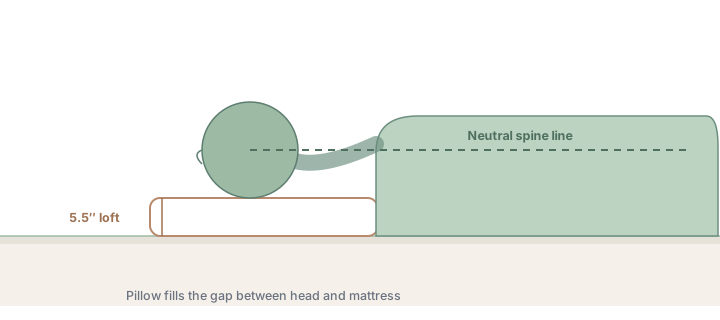
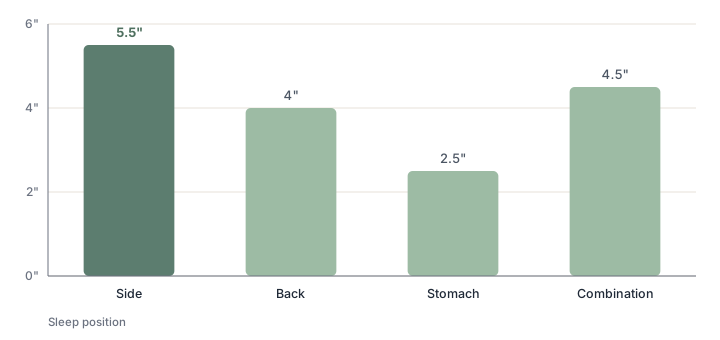
Loft — the vertical height of the pillow under a loaded head. Most side sleepers need between 4 and 6 inches of compressed loft, with broader-shouldered sleepers at the upper end and petite sleepers at the lower end. Every other spec matters, but loft is the one that turns a comfortable pillow into a supportive one. A pillow with the wrong loft at any material, firmness, or price point will produce morning neck or shoulder stiffness within days. Get the loft right first, then optimize the other variables.
Are expensive pillows actually better for side sleepers?
Sometimes, but not always. Premium pillows ($100 to $200+) buy longer useful life, better temperature regulation, more precise contouring, and adjustability with multiple fill options. They do not buy fundamentally better support if the basic loft and firmness are wrong. A $60 adjustable shredded memory foam pillow at the correct loft will outperform a $180 down pillow that compresses below the sleeper's loft requirement. Spend in the middle of the range ($60 to $100) unless you have a specific reason to go higher — usually broad shoulders, persistent pain, or a strong preference for latex's cooling properties.
How long should a pillow last for a side sleeper?
It depends on material. Polyester down-alternative pillows last 12 to 18 months under nightly use. Solid memory foam lasts 2 to 3 years. Shredded memory foam lasts 3 to 5 years with periodic fill replenishment. Down lasts 2 to 4 years. Latex (solid or shredded) lasts 5 to 7 years. Buckwheat can last a decade or more. The honest signal that a pillow is past its useful life is loft loss that does not recover after a day of airing, plus the return of morning stiffness that previously resolved. Side sleepers wear pillows faster than back or stomach sleepers because the head loads the pillow from the side, which compresses the fill more aggressively.
Memory foam vs latex — which is actually better for side sleepers?
Neither universally. Memory foam is better for sleepers prioritizing pain relief and precise contouring; latex is better for sleepers prioritizing temperature regulation and longevity. The middle-ground choice — shredded latex or shredded memory foam in an adjustable format — combines the strengths of both with modest compromises on each. For a reader who is genuinely unsure, shredded latex is the safer single starting point because it accommodates the widest range of body types, position habits, and climate conditions without strong trade-offs.
Do I need a special pillow if I am a combination sleeper?
Yes, if you spend significant time in more than one position. The loft that supports a side sleeper is too tall for a back sleeper and far too tall for a stomach sleeper. Fixed-loft pillows cannot satisfy this geometry; adjustable shredded-fill pillows can, because the fill can be gathered for side-sleep phases and pushed flat for back-sleep phases. For combination sleepers, adjustable shredded fill is the strongest category starting point, full stop. The other four categories work less well when the sleep position changes during the night.
Are cooling pillows worth the extra money?
For hot sleepers in warm climates, yes. The cooling features that actually work — ventilated open-cell foam, shredded latex, breathable Tencel or bamboo covers — produce a meaningful difference in overnight pillow temperature that compounds into fewer wakings, less position-switching, and better aggregate sleep quality. The cooling features that do not work — phase-change covers used alone on dense closed-cell foam, gel infusions on otherwise hot pillows — are marketing more than engineering. Read the construction details rather than the cooling claims.
How do body pillows fit into the picture for side sleepers?
As a supplement to the head pillow, not a replacement. The head pillow controls cervical alignment; the body pillow controls torso rotation and top-arm position. Body pillows are most useful for side sleepers with persistent shoulder pain, residual back pain, combination patterns that drift toward stomach during the night, and pregnant sleepers who need wrap-around support. The order of operations matters: optimize the head pillow first, then add the body pillow as the next variable to change.
Keep reading
Related guides
← Back to our main Best Pillow for Side Sleepers guide