Guides & Answers
What's the Best Pillow for Side Sleepers
What's the best pillow for side sleepers in 2026, and how much of the answer has actually changed since the same question was asked in 2022 or 2018? This guide is the conversational version of the question and a year-in-review for the side-sleeper pillow market. The short answer is that the core principles have not changed — loft, firmness, material, and adjustability still decide everything — but the products that deliver on those principles have shifted noticeably in the last two years. New cooling technologies have matured, adjustable shredded-fill construction has improved, and a flood of marketing buzzwords has made selection harder rather than easier. This is the update for readers who already understand the basics and want to know what is genuinely new and what is still noise.

What's genuinely new in 2026
Three real changes are worth flagging this year.
First, shredded latex with Tencel covers has displaced solid memory foam as the highest-volume premium recommendation in the side-sleeper category. Two years ago, solid memory foam contour pillows dominated the $80-to-$150 band. Today, shredded latex pillows from established brands occupy that band in larger numbers, driven by genuine improvements in latex sourcing (more brands are using GOLS-certified natural latex), more competitive pricing, and growing buyer preference for adjustability over fixed contour. This shift is real and the underlying engineering supports it — shredded latex sleeps cooler, lasts longer, and tunes to the individual sleeper better than solid memory foam.
Second, dual-density and dual-fill pillows have become a credible category. The construction pairs a firmer outer ring or gusset with a softer inner core, or a shredded fill at one end with a different shredded fill at the other. The intent is to combine cervical support with side-to-side adjustability or to provide different lofts for back and side phases in one pillow. Some of these designs work; many do not. The ones that do work are usually from brands that have been in the foam-pillow market for at least five years and have iterated their construction across multiple generations. New entrants tend to over-engineer the dual-density concept and produce pillows that are firmer in patches and softer in patches without a clear ergonomic benefit.
Third, cooling technology has stratified into two clear tiers. The legitimate tier — ventilated open-cell foam, phase-change covers with high-quality Tencel weaves, shredded latex — produces measurable, sustained cooling. The marketing tier — gel infusions on otherwise hot foam, vague "cooling fabric" claims without a specified weave, "ice silk" covers without a phase-change material underneath — produces the cooling sensation for the first 30 to 90 seconds and nothing beyond that. The gap between the two tiers has widened in 2026, which makes it both easier and harder to shop: easier because the good products are clearly better, harder because the marketing on the bad products has become more sophisticated.
What hasn't changed and probably never will
The fundamentals of side-sleeper pillow selection have not changed in any way that matters since the principles were first articulated decades ago in spinal-alignment guidance.
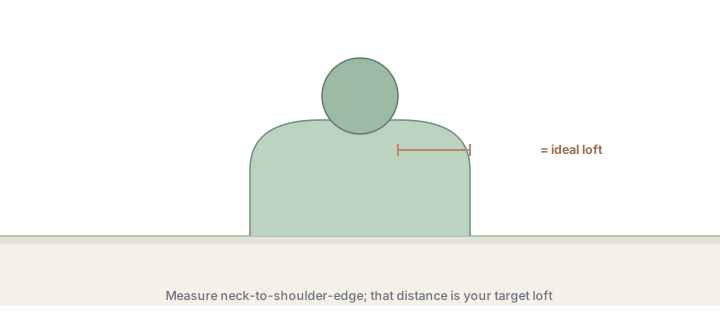
Loft is still the single most important variable. Most adult side sleepers still need between 4 and 6 inches of compressed loft, with the exact number determined by shoulder width and mattress firmness. No technology, no material, no construction has changed this requirement.
Firmness still matters almost as much as loft. A soft pillow that compresses overnight is functionally a too-short pillow by 3 a.m., regardless of how impressive the cooling or construction features are. Medium-firm to firm beats soft for side sleepers, full stop.
Down still underperforms for the average side sleeper. Pure down compresses dramatically under the weight of a side-sleeper's head, which produces insufficient loft within minutes regardless of how high the fill power is. The exceptions are petite or lightweight sleepers and combination sleepers who spend significant time on their back. These have not changed.
The alignment check is still the best diagnostic. Lie on the side, photograph from behind, confirm that the nose, chin, breastbone, and navel form a single straight horizontal line parallel to the mattress. This check has worked for every pillow design ever sold and continues to work for every pillow design coming to market. According to the Sleep Foundation, spinal alignment during sleep remains the single most-cited criterion in their side-sleeper recommendations year after year, and the alignment check is the practical way to confirm any pillow delivers it.
The 2026 default recommendation, updated
Combining what is genuinely new with what has not changed produces a slightly updated default recommendation compared to what we would have written in 2024 or even 2025.
For the average side sleeper without specific complications, the 2026 default is a shredded latex pillow with a Tencel cover, at a compressed loft of 4.5 to 5.5 inches, medium-firm, from a brand offering at least a 60-day return window. The shift from "shredded memory foam or shredded latex" to "shredded latex" reflects the maturation of the latex market and the genuinely better cooling, longevity, and pricing the category now delivers.
For sleepers prioritizing the lowest-cost defensible option, an adjustable shredded memory foam pillow at the same loft and firmness remains a solid choice, particularly with a Tencel or bamboo viscose cover. Expect a useful life of 3 to 5 years rather than the 5 to 7 of latex, and slightly warmer sleep.
For sleepers with persistent cervical pain who have already tried adjustable pillows, a solid memory foam contour pillow from a brand with established cervical-shape construction is still the right next step. The contour beats shredded fill when the dimensions match and the sleeper stays on one side most of the night.
The other categories — cooling-specialized pillows, body pillows, down pillows for petite sleepers, buckwheat for firmness lovers — remain valid niche choices for sleepers who fit those niches. They have not become wrong; they have simply not become the default.
Where the market is heading in late 2026 and 2027
Two trends worth watching, with the caveat that trend predictions are routinely wrong.
First, biometric and active-cooling pillows are entering the market. Pillows with embedded temperature sensors, micro-fans, and water-cooled channels exist as of 2026 but remain niche, expensive, and not yet proven over the multi-year horizon that matters for pillow purchases. We would not recommend them for the average side sleeper this year. By 2027 or 2028, the category may have matured enough to enter the default recommendation set; today it has not.
Second, certified natural and organic latex is becoming more accessible at lower price points. Two years ago, GOLS-certified natural latex was a premium feature commanding $150-plus prices. Today there are mid-range options with the same certification in the $80-to-$120 range. For sleepers who care about certifications — chemical sensitivities, allergies, environmental priorities — this represents a real improvement in market accessibility.
Neither trend changes the fundamental answer to what's the best pillow for side sleepers. They expand the field at the margins. The core recommendation — adjustable shredded fill at the right loft with a breathable cover — remains the right default for most readers, and is likely to remain so for the foreseeable future. The Cleveland Clinic consistently emphasizes that sleep quality is more sensitive to the basics — temperature, alignment, regularity — than to any single advanced feature, which lines up with our editorial view of the pillow market specifically.
What this all means for your next pillow purchase
Three concrete takeaways for a reader shopping in 2026.
One: do not let the 2026 marketing distract you from the 2026 reality. The category has improved at the margins, but the fundamentals are the same. Loft, firmness, material, and adjustability still decide everything.
Two: prefer shredded latex over shredded memory foam if the price difference is reasonable. The cooling and longevity advantages are real, and the market has made the price gap smaller than it was two years ago.
Three: ignore the buzzwords and read the construction specs. Tencel cover, ventilated open-cell foam, GOLS-certified latex, density in lb/ft³, compressed loft in inches — these are the specifications that matter. "Cooling gel," "adaptive," "orthopedic," and "5-star hotel feel" tell you almost nothing.
Readers who internalize these three points will buy a pillow they will still be using comfortably in 2029. Readers who buy on the marketing alone will be back in this category within a year.
Independent video reviews worth watching
We don't test pillows in a lab. Instead, here are independent, hands-on video reviews from sleep and mattress channels that pair well with this guide — useful for seeing loft, fill, and feel before you buy. These are third-party reviews, not ours.
 ▶
▶Mattress Clarity
Best Pillows For Side Sleepers — Don't Buy A Pillow Without Watching This! ▶
▶Aligned Chiropractic
Side Sleeping Ergonomics — Selecting the Right Pillow SizeEditor's takeaway
The honest 2026 update is less dramatic than the marketing might suggest. The fundamentals of side-sleeper pillow selection have not changed and probably will not change in any meaningful way until materials science delivers something fundamentally new, which is not happening this year. The genuine shifts at the margins — shredded latex displacing memory foam as the premium default, cooling technology stratifying into a legitimate tier and a marketing tier, dual-density construction becoming credible from established brands — are worth knowing about but do not invalidate the existing advice for readers who landed on a good pillow in 2023 or 2024. If your current pillow is still holding loft, sleeping at the right temperature, and producing no morning stiffness, you do not need to replace it because of any 2026 development. If you are shopping new, the default has shifted slightly toward shredded latex, and the buzzword pool has grown enough that reading construction specs rather than marketing copy matters more than it did two years ago. The reader who buys on specs will be sleeping well in 2029; the reader who buys on buzzwords will be back in this category within a year.
Frequently asked questions
What's the best pillow material for side sleepers in 2026?
Shredded latex with a Tencel or bamboo viscose cover, edging out shredded memory foam as the top default choice. Two years ago we would have recommended either with equal weight; in 2026 the latex market has matured enough that the cooling, longevity, and pricing advantages tip the balance. Shredded memory foam remains a strong second choice, particularly for sleepers prioritizing the lowest-cost defensible option. Solid memory foam contour pillows are the right pick for sleepers with persistent cervical pain whose contour dimensions match their anatomy.
How has pillow technology actually changed recently?
Three genuine changes. Cooling has stratified into a legitimate tier (ventilated open-cell foam, shredded latex, real phase-change covers) and a marketing tier (gel infusions on dense foam, vague cooling claims without construction detail). Shredded latex has displaced solid memory foam as the highest-volume premium recommendation. Dual-density and dual-fill construction has become a real category from established brands, though it remains over-engineered when attempted by new entrants. The fundamentals — loft, firmness, material, alignment — have not changed.
Are 'cooling pillows' actually cool, or is it marketing?
It depends on the specific construction. Cooling pillows built on ventilated open-cell foam, shredded latex, or genuine phase-change cover material with a breathable Tencel weave deliver real, sustained cooling. Cooling pillows built on dense closed-cell foam with a gel infusion or a vague "cooling fabric" cover produce a cooling sensation for 30 to 90 seconds at sleep onset and nothing beyond. The gap between the two tiers has widened in 2026. Read the construction specs rather than the cooling marketing.
Is the best pillow for side sleepers expensive?
Not necessarily. The sweet spot for most side sleepers is $60 to $100, where mid-range adjustable shredded memory foam or shredded latex pillows live. Below $50, build quality and loft retention compromise the support side sleeping requires. Above $150, the additional spend buys longer useful life and better temperature regulation rather than fundamentally better support. Broad-shouldered sleepers or those with persistent pain are the two groups for whom the premium tier earns its premium.
Should I buy a new pillow every year?
No, unless you have a polyester or down-alternative pillow, which last 12 to 18 months under nightly use. Memory foam pillows last 2 to 3 years, shredded memory foam 3 to 5 years, latex 5 to 7 years, and buckwheat a decade or more. The replacement signal is loft loss that does not recover after airing, plus the return of morning stiffness that previously resolved. Side sleepers wear pillows faster than back or stomach sleepers, but "every year" is overkill for any material above the budget tier.
Are smart or biometric pillows worth trying yet?
Not yet for the average side sleeper. Pillows with embedded sensors, micro-fans, and active cooling exist in 2026 but remain expensive, niche, and unproven over the multi-year horizon that matters for pillow purchases. The category may mature enough to enter the default recommendation set in 2027 or 2028; today it has not. The fundamental variables — loft, firmness, material — are still better solved with a well-built passive pillow than with an active one.
What buzzwords on a pillow listing should I ignore?
Ignore "hotel quality," "5-star hotel feel," "cloud-soft," "adaptive," "smart," "responsive," "orthopedic," "AI-optimized," and any "cooling" claim without specific construction backing. Read the actual specs instead: fill type, density in lb/ft³, compressed loft in inches, cover material, and certifications like GOLS or OEKO-TEX. The specs tell you whether the pillow will work; the buzzwords tell you almost nothing.
Is this site medical advice for choosing a pillow?
No. This is editorial coverage of pillow ergonomics and market analysis. We do not diagnose or treat any medical condition. Persistent neck pain, shoulder pain, or any pain that wakes the sleeper, radiates into the limbs, or comes with numbness, tingling, or weakness should be evaluated by a physician, physical therapist, or chiropractor. A pillow can support healthy sleeping geometry; it cannot substitute for medical care.
Keep reading
Related guides
← Back to our main Best Pillow for Side Sleepers guide