Guides & Answers
What Pillow Is Best for Side Sleepers
What pillow is best for side sleepers — answered directly, then explained. The short answer for most side sleepers is an adjustable shredded memory foam or shredded latex pillow with a compressed loft between 4.5 and 5.5 inches, a medium-firm fill, a breathable Tencel or bamboo viscose cover, and a return window of at least 60 days. That single sentence solves the problem for roughly seven out of ten readers. The rest of this guide explains the reasoning and provides a decision flowchart for the other three out of ten whose specific body or sleep habits push them toward a different choice.

Why this answer works for most readers
The answer above is engineered around four observations that have held up consistently across hundreds of verified-buyer review threads and the published side-sleeper guidance from organizations like the Sleep Foundation, the American Chiropractic Association, and the Cleveland Clinic.
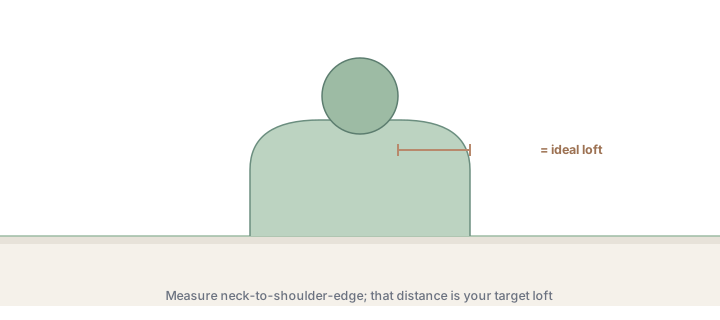
First, loft matters more than anything else, and the 4.5 to 5.5 inch band covers the vast majority of adult side sleepers. Within that band, adjustability lets the individual sleeper fine-tune to their exact shoulder width without committing to a fixed loft that may be a quarter or half inch off.
Second, shredded fills win over solid forms for most side sleepers because they combine the contouring of foam with the adjustability of fill-and-remove construction and significantly better airflow than solid blocks. Solid contour pillows win when the contour dimensions happen to match the sleeper precisely; shredded fills win in every other case.
Third, medium-firm to firm beats soft for side sleepers because a pillow that compresses overnight lowers the effective loft below what the shoulder-to-ear gap requires, which triggers morning neck and shoulder stiffness even if the pillow felt correct at bedtime. Soft pillows are for back and stomach sleepers, not side sleepers.
Fourth, breathable covers are the underrated variable. Tencel and bamboo viscose covers handle surface temperature significantly better than polyester, which prevents the clammy feeling that drives sleepers to flip the pillow throughout the night and break the alignment the pillow was supposed to provide.
Decision flowchart — when to deviate from the default answer
Most readers should stop at the TL;DR. The flowchart below covers the readers who should not. Work through the questions in order. The first question whose answer is yes points to a different category than the default.
- Are you a dedicated side sleeper with persistent, recurring neck pain that has not responded to previous adjustable pillows? Consider a solid memory foam cervical contour pillow instead. The fixed contour holds the cervical curve precisely when the dimensions match — and for dedicated side sleepers with a clear pain pattern, the precision often beats the adjustability of shredded fill. Brands with a 60+ day return window let you test fit safely.
- Do you sleep extremely hot, live in a humid climate without strong air conditioning, or experience night sweats? Skip memory foam entirely and choose shredded latex with a Tencel cover. Latex sleeps cool by construction without depending on cooling tech that fades after the first hour.
- Are you a combination sleeper who spends significant time on your stomach as well as your side? The default answer at 4.5 to 5.5 inches is too tall for the stomach phase. Choose a thinner adjustable shredded fill pillow (3 to 4 inches at the high setting) that can be flattened for stomach phases and gathered for side phases.
- Are you significantly broad-shouldered (shoulder-to-shoulder over 18 inches when standing relaxed)? Aim for the upper edge of the loft range — 5.5 to 6.5 inches — and consider stepping up to Talalay latex, which holds the taller loft better than mid-density memory foam over time.
- Are you significantly petite (under 5'2" or under 130 lbs)? Aim for the lower edge of the loft range — 3.5 to 4.5 inches — and consider whether a softer fill works for you, since the head's weight is lower and the compression risk is reduced.
- Are you pregnant or sleeping with a body pillow already in rotation? The head pillow loft requirement does not change, but a J-shape or U-shape pregnancy pillow may integrate head support and body support in one piece, simplifying the setup. See our body pillow guide for details.
- Do you have a partner whose ideal loft differs significantly from yours? Separate adjustable pillows tuned to each individual's shoulder width are the only realistic shared-bed solution. Do not split the difference on a single pillow — it will favor one partner at the cost of the other.
If none of these questions return a yes, the TL;DR default is the right choice. Most readers should stop here.
How to test the pillow you choose in the first two weeks
Whichever pillow you choose, the testing protocol is the same. Sleep on it for fourteen consecutive nights before judging. The first three to five nights often feel awkward because the body has adapted to the previous pillow's geometry, even when that geometry was wrong.
The night-one alignment check: lie on the side in a normal sleep position. Have someone take a photo from behind. The nose, chin, breastbone, and navel should form a single straight horizontal line parallel to the mattress. If the head is tilted up toward the ceiling, the pillow is too tall. If it is dropping toward the mattress, it is too short. Adjustable pillows let you remove or add fill in small handfuls and re-check.
The daily morning check: on waking, before getting out of bed, gently roll the head from one side to the other and feel for stiffness. Lift the top arm overhead and rotate through a full circle, noting any clicking or sticky points. Sit up and gently roll the shoulders five times. Keep a one-line note each morning for the first ten nights. A pillow that is working shows a clear downward trend in stiffness within the first week. A pillow that is not working shows flat or worsening scores by day ten, at which point the return window is still open. According to the American Chiropractic Association, maintaining the natural curve of the cervical spine during sleep is the single most-cited intervention for sleep-posture-driven neck complaints — the alignment check is the practical way to confirm a pillow is doing that job.

Independent video reviews worth watching
We don't test pillows in a lab. Instead, here are independent, hands-on video reviews from sleep and mattress channels that pair well with this guide — useful for seeing loft, fill, and feel before you buy. These are third-party reviews, not ours.
 ▶
▶Tool Junkie
Tested the Best Pillows for Side Sleepers in 2026 | Battle Pain ▶
▶Mattress Nerd
What Side Sleepers Need From Their PillowEditor's takeaway
The single most useful piece of guidance for the average reader looking for what pillow is best for side sleepers is this: the right pillow is almost always an adjustable shredded fill at a compressed loft of 4.5 to 5.5 inches, medium-firm, with a breathable cover. The reason this answer keeps holding up across thousands of buyer reviews and dozens of authoritative side-sleep guidance documents is mechanical rather than marketing — the format accommodates the widest range of variables a sleeper might bring to the purchase. The decision flowchart in the body of this guide exists for the minority of readers whose body or sleep habits push them toward a deviation. Most readers should stop at the TL;DR, choose a pillow that matches it, and commit to a fourteen-night trial with a return window in place. The most expensive part of pillow shopping is not the pillow itself; it is the months of cycling through wrong pillows before landing on the right one. The flowchart shortens that cycle to a single, defensible starting choice.
Frequently asked questions
What is the single best pillow for side sleepers?
There is no single best pillow because side sleepers are not a single type of buyer. For the widest range of readers, an adjustable shredded memory foam or shredded latex pillow at a compressed loft of 4.5 to 5.5 inches with a medium-firm fill and a Tencel cover is the safest starting point. It accommodates the most body types, the most position habits, and the most mattress firmness levels without strong trade-offs. Sleepers with specific complications — broad shoulders, persistent pain, extreme heat, combination patterns — should deviate from this default per the decision flowchart in the body of this guide.
How thick should a side sleeper's pillow be?
Most side sleepers need between 4 and 6 inches of compressed loft. The exact number depends on shoulder width and mattress firmness. The practical test is the alignment check: lie on the side and have someone confirm from behind that the nose, chin, breastbone, and navel form a single horizontal line parallel to the mattress. Any visible tilt — head up toward the ceiling or down toward the mattress — is a loft mismatch. Petite sleepers usually land at 4 to 4.5 inches. Average-build adults usually land at 4.5 to 5.5 inches. Broad-shouldered adults often need 5.5 to 6.5 inches.
Is memory foam or shredded foam better for side sleepers?
Shredded foam wins for most side sleepers because it combines the contouring of solid memory foam with adjustability, better airflow, and forgiveness for position changes. Solid memory foam wins specifically for dedicated side sleepers with persistent cervical pain who need a fixed contour that holds the curve of the neck precisely — when the contour dimensions match the sleeper, the support is unmatched. For everyone else, shredded foam is the safer default.
Should side sleepers use a soft, medium, or firm pillow?
Medium-firm to firm. Soft pillows compress under the weight of the head through the night, which lowers the effective loft below what the shoulder-to-ear gap requires. By 3 a.m. the pillow that started at the right loft is too low, and the head droops into the shoulder. Soft pillows are appropriate for back and stomach sleepers but not for side sleepers. The exception is petite side sleepers under 130 lbs, who can sometimes use a slightly softer fill because the head's weight is lower and the compression risk is reduced.
Do I need a contour pillow as a side sleeper?
Not usually. Cervical contour pillows are excellent for dedicated side sleepers with persistent neck pain whose anatomy matches the contour dimensions. They are not necessary for healthy side sleepers without persistent pain, and they are actively unhelpful for combination sleepers who change position during the night. The default recommendation for most side sleepers is an adjustable shredded fill, with contour as a step up only when the variable that matters most is precise cervical support and the sleeper stays on one side most of the night.
Are cooling pillows necessary for side sleepers?
Necessary only for hot sleepers in warm climates. For sleepers who do not run hot, cooling features are a nice-to-have rather than a must-have. The cooling features that actually work are ventilated open-cell foam, shredded latex, and breathable Tencel or bamboo covers; the cooling features that do not work as advertised are phase-change covers used alone and gel infusions on dense closed-cell foam. If overheating is part of your sleep problem, prioritize material composition over marketing language.
How long should a side sleeper's pillow last?
It depends on material. Polyester pillows last 12 to 18 months. Solid memory foam lasts 2 to 3 years. Shredded memory foam lasts 3 to 5 years. Latex lasts 5 to 7 years. Buckwheat can last a decade. The signal that a pillow is past its useful life is loft loss that does not recover after a day of airing, plus the return of morning stiffness that previously resolved. Side sleepers wear pillows faster than back or stomach sleepers because the head loads the pillow from the side, which compresses the fill more aggressively.
Does the pillow cover material matter?
Yes, more than most readers realize. The cover handles surface temperature, moisture wicking, and the immediate feel against the skin. Tencel and bamboo viscose covers significantly outperform polyester for breathability and feel. Cotton is acceptable but slower-drying. Polyester covers on otherwise good pillows are a common reason readers describe a pillow as "hot" or "clammy" — the foam inside may not be the actual problem. When buying any pillow, check the cover material in the product spec sheet.
Should I use one pillow or two as a side sleeper?
One pillow under the head. Stacking two head pillows almost always tilts the head too high and creates lateral cervical bend. A second pillow between the knees is a different story and can genuinely help by stabilizing pelvic alignment and reducing lumbar rotation overnight. A body pillow in front of the torso is a third option for sleepers whose top arm drops forward and pulls the shoulder out of alignment. But the under-head pillow should be one properly-sized pillow at the right loft, not a stack of two.
Is this site medical advice for pillow selection?
No. This is editorial coverage of pillow ergonomics and product comparison. The guidance here is intended to help readers select a supportive pillow for sleep-posture-driven discomfort in an otherwise healthy adult. Persistent or worsening pain, pain that radiates into the arms or legs, pain accompanied by numbness or weakness, and pain that wakes the sleeper from sleep all warrant evaluation by a physician, physical therapist, or chiropractor. A pillow can address sleep-posture-driven discomfort; it cannot diagnose or treat any clinical condition.
Keep reading
Related guides
← Back to our main Best Pillow for Side Sleepers guide