Best Firm Pillow for Side Sleepers
The best firm pillow for side sleepers is not simply the hardest pillow on the shelf, and that is an easy mistake to make. Harvard Health does say side sleepers need a firm pillow for support. The same publisher also warns that a pillow that is too high or too stiff keeps the neck bent overnight. Firmness is about how well a pillow holds its shape under your head. It is not the same thing as height. I read the clinical guidance, the side-sleeper trials and every listing below, and this page sorts out what firmness should do for you and which pillows deliver it.

What firm actually means when you sleep on your side
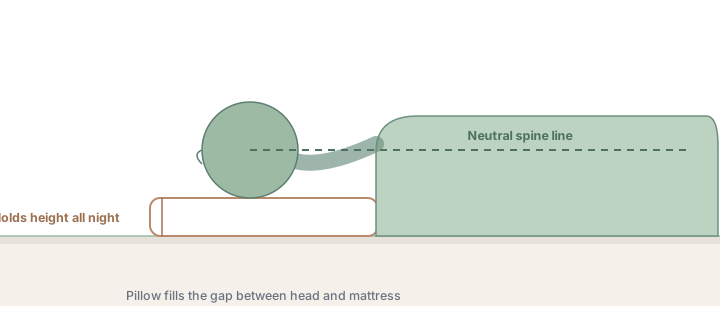
Your shoulder is the reason side sleepers ask more of a pillow than anyone else. Sleep Foundation's side-sleeping guide puts it simply: because the shoulders raise the head further from the bed, side sleepers usually do best with a thicker pillow. A thick pillow only helps if it stays thick. That is the job firmness does.
Harvard Health states it directly: "Side sleepers need a firm pillow for support." The same article explains what happens without it. If you sleep on your side with a soft pillow that gives too little support under the neck, your head has to extend sideways to meet the pillow. A soft pillow that looks tall on the bed can flatten under the weight of your head, and the gap between ear and shoulder opens up again.
Sleep Foundation's side-sleeper buying guide, which is medically reviewed, lands somewhere slightly different: "Pillows with mid-level firmness are usually the best choice for side sleepers." These two statements are less opposed than they look. Harvard is talking about support, meaning the pillow should not let your head sink out of line. Sleep Foundation is describing a middle feel that is neither hard nor squashy. A pillow can be supportive enough to hold its height and still feel medium to the touch. Most of the picks above aim for that zone: their listings call them medium or medium-firm.
There is also a ceiling. Harvard's neck-pain article advises against "too high or stiff a pillow, which keeps the neck flexed overnight and can result in morning pain and stiffness." And Johns Hopkins Medicine says choosing soft versus hard is a matter of preference, as long as you aim for something supportive. So the target is not maximum firmness. It is enough firmness to keep your neck level all night, at a height that matches your shoulder.
One-piece foam vs overstuffed fill
There are two common ways a pillow ends up feeling firm.
- One-piece foam. A solid block of memory foam, like the WEEKENDER or the Royal Therapy contour, resists compression across its whole surface. It feels firm because the material pushes back, and with no loose fill to shift, its shape stays consistent through the night.
- Overstuffed fill. A shredded-foam or fiber pillow packed tight feels firm because the fill has no room to move. Take some out and it softens. That is useful, but loose pieces can also shift as you turn, so the firmness under your neck may drift during the night.
Neither is better across the board. Solid foam gives you predictability and no way to tune it. Packed fill gives you control and a little less consistency. If you have never owned a firm pillow before, an adjustable one is the safer first buy, which matches Sleep Foundation's advice that adjustable pillows are a good choice when you are unsure what loft you need.
Firm pillows: our 5 picks
#1 · Best one-piece firm foam
WEEKENDER Ventilated Gel Memory Foam
A single block of ventilated gel memory foam at 5 inches listed, so the height you see is the height you sleep on. Amazon's summary of buyer reviews calls it supportive and good value, though some buyers find it too firm. It carries a 3-year limited warranty for manufacturer defects, at a budget price.
- Type
- Solid memory foam (ventilated)
- Height
- 5 in listed
- Fill
- Gel-infused memory foam
- Price band
- Budget
#2 · Best firm contour with two heights
Royal Therapy Memory Foam Contour Pillow
Solid memory foam with a removable middle layer, sold at 5 inches in the Queen and 6.5 inches in the Extra sizes. Buyers in Amazon's summary describe it as neither too firm nor too soft, which suits Sleep Foundation's mid-level advice while still holding its shape. The foam is CertiPUR-US certified and the cover is OEKO-TEX.
- Type
- Contour cervical (memory foam, layered)
- Height
- 5 in (Queen); 6.5 in Extra size
- Fill
- Memory foam
- Price band
- Mid-range
#3 · Best firm option for broad shoulders
DreamyBlue Signature Adjustable Pillow
It is 8 inches listed and comes with extra foam, so you can pack it tight for a tall, firm pillow when your shoulders are wide. The 30 x 20 inch queen is large and may overhang a standard pillowcase. Some buyers mention an odor; the foam is CertiPUR-US certified.
- Type
- Adjustable shredded foam
- Height
- 8 in listed; adjustable
- Fill
- Cross-cut shredded memory foam
- Price band
- Mid-range
#4 · Best budget firm pair
SUPA MODERN Cooling Shredded Memory Foam (2-pack)
Two shredded-foam pillows per box at 7 inches listed, and the listing offers a dedicated Firm Queen size. Amazon's summary notes some buyers find them too firm and smell a new-foam odor at first. CertiPUR-US foam with an OEKO-TEX cover.
- Type
- Adjustable shredded foam
- Height
- 7 in listed; adjustable
- Fill
- 85% cross-cut memory foam / 15% microfiber
- Price band
- Budget
#5 · Best for tuning firmness
Coop Home Goods Original Adjustable
The Amazon listing calls it medium and the brand calls it medium-firm: add fill to firm it up, remove fill to soften it. It ships with extra fill, carries CertiPUR-US and GREENGUARD Gold, and the brand site lists a 5-year warranty and 100-night trial. Several buyers mention a strong smell when new.
- Type
- Adjustable shredded foam
- Height
- 8 in listed; adjustable
- Fill
- Cross-cut memory foam + microfiber
- Price band
- Mid-range


We earn a commission if you buy through these links, at no extra cost to you. As an Amazon Associate we earn from qualifying purchases. Prices and availability are shown on Amazon and can change.
Firm vs high loft: two separate dials
Shoppers often treat firm and tall as the same thing. They are not. Loft is the height of the pillow. Firmness is how much it compresses under weight. You can have a tall soft pillow, a short firm one, or anything in between.
For a side sleeper, the two have to work together. Sleep Foundation's side-sleeper guide says side sleepers usually need a medium to high loft, which it describes as at least 4 inches, and that people with broad shoulders may need a pillow over 6 inches. A different Sleep Foundation page, on pillows for neck pain, suggests 3 to 5 inches for side and back sleepers. The numbers do not agree, and the honest reason is that nobody has fixed a correct height: a 2021 review of pillow-height research concluded there are no firm conclusions about the optimal pillow height for the supine and lateral positions.
What both pages share is the measuring idea. Sleep Foundation's sleeping-positions guide says to choose a loft that matches the distance between your neck and your shoulder. Your mattress changes that distance too. Cleveland Clinic chiropractor Andrew Bang explains that a firmer mattress needs a thicker pillow because your shoulder won't sink in much, while a memory foam topper or pillow-top mattress needs a thinner one.
This is where firmness earns its place. The number that matters is the height of the pillow while your head is on it, not the height printed on the listing. A soft pillow can compress well below its listed loft. A firm one is likely to stay closer to it, which makes the listed numbers more useful when you shop.
Two practical rules follow:
- If you have narrow shoulders or a soft mattress, a firm pillow should usually also be a lower one. The Royal Therapy Queen (5 inches) or the WEEKENDER (5 inches listed) is a better starting point than an 8-inch shredded pillow packed full.
- If you have broad shoulders or a firm mattress, you need height and firmness together. That is where the DreamyBlue, packed full, or the Royal Therapy Extra size (6.5 inches) comes in.
A small lab study hints at why too low is a problem as well as too high. In 21 adults lying on their side, a 10 cm foam pillow was rated more comfortable than 5 cm or 14 cm versions, and the 5 cm pillow produced the most activity in the down-side middle trapezius muscle. It is one small study of foam pillows, not a rule, but it fits the idea that the right firm pillow is the one at the right height.
Firm side-sleeper pillows compared
| Spec | WEEKENDER Ventilated Gel Memory Foam | Royal Therapy Memory Foam Contour Pillow | DreamyBlue Signature Adjustable Pillow | SUPA MODERN Cooling Shredded Memory Foam (2-pack) | Coop Home Goods Original Adjustable |
|---|---|---|---|---|---|
| Type | Solid memory foam (ventilated) | Contour cervical (memory foam, layered) | Adjustable shredded foam | Adjustable shredded foam | Adjustable shredded foam |
| Height / loft (as stated) | 5 in listed | 5 in (Queen); 6.5 in Extra size | 8 in listed; adjustable | 7 in listed; adjustable | 8 in listed; adjustable |
| Adjustable fill | No | Yes | Yes | Yes | Yes |
| Fill | Gel-infused memory foam | Memory foam | Cross-cut shredded memory foam | 85% cross-cut memory foam / 15% microfiber | Cross-cut memory foam + microfiber |
| Cover | Polyester | Polyester/rayon-from-bamboo | Rayon from bamboo | Two-sided with ice-silk cooling side | Polyester/rayon-from-bamboo (Lulltra) |
| Firmness (as stated) | Medium-firm (bullet) | Medium | Medium | Medium | Medium (listing); medium-firm (brand) |
| Pack | 1 pillow | 1 pillow | 1 pillow | 2 pillows | 1 pillow |
| Certifications | None stated | CertiPUR-US, OEKO-TEX | CertiPUR-US | CertiPUR-US, OEKO-TEX Standard | CertiPUR-US, GREENGUARD Gold |
| Care | Care instructions on the listing | Care instructions on the listing | Care instructions on the listing | Care instructions on the listing | Care instructions on the listing |
| Price band | Budget | Mid-range | Mid-range | Budget | Mid-range |
4 signs your pillow is too firm or not firm enough
Firmness is easy to get wrong in both directions. These are the signs worth watching for during your first couple of weeks on a new pillow:
- Your head sinks and your ear ends up close to the mattress. The pillow is too soft or too low for your shoulder width. This is the sideways bend Harvard describes when a soft pillow gives too little support under the neck.
- Your neck feels pushed up and stiff in the morning. The pillow may be too high or too stiff, the combination Harvard links to morning pain and stiffness. Lower the height before you give up on firm.
- You keep folding or bunching the pillow. That usually means the height is wrong. With an adjustable pillow, add or remove fill a handful at a time. With solid foam, try a different height rather than stacking two pillows.
- You notice the hardness more than the support. If your cheek or ear feels pressed against a solid block, a medium feel at the same height may suit you better, in line with Sleep Foundation's mid-level suggestion. A shredded-foam pillow with a little fill removed gets you there.
Give any new pillow a fair chance before you judge it. In a motion-capture study of 24 women lying on their side, 70.8% of participants had stabilised on the pillow by 15 minutes or earlier. That is a short-term lab finding, but it is a reminder that the first few minutes on an unfamiliar pillow are not the verdict.
Cleveland Clinic's rule of thumb is a good final check: the pillow should keep your neck parallel to the mattress, rather than bent down or up. Ask someone to look at you from behind while you lie on your side, or take a photo. If your neck tilts down toward the mattress, go firmer or taller. If it tilts up, go lower.
Where to go next depends on why you want a firm pillow. If the reason is a sore neck, our guide to the best pillow for side sleepers with neck pain compares contour and adjustable designs. If it is a wide frame, see our picks for broad shoulders. The side sleeper pillow catalog lists every pillow we cover by need, and our main guide to the best pillow for side sleepers explains how we choose. For the Coop in depth, read the Coop Original review.
Sukie's take
If you take one thing from this page: buy the height first and the firmness second. A firm pillow at the wrong loft is just a hard pillow at the wrong loft.
Firm: common questions
Do side sleepers need a firm pillow?
Usually they need a supportive one. Harvard Health says side sleepers need a firm pillow for support, while Sleep Foundation says mid-level firmness is usually the best choice. The common ground is a pillow that holds its height under your head without feeling like a brick.
Is a firm pillow the same as a high-loft pillow?
No. Loft is height and firmness is how much the pillow compresses. A tall soft pillow can end up lower under your head than a shorter firm one. Choose the height for your shoulder first, then the firmness that keeps it there.
What is the best firm pillow for side sleepers with a soft mattress?
A lower firm pillow, because your shoulder sinks into a soft bed and closes the gap. Cleveland Clinic's Andrew Bang says a topper or pillow-top calls for a thinner pillow. The WEEKENDER (5 inches listed) or Royal Therapy Queen (5 inches) fits that brief, and so does an adjustable pillow with some fill removed.
Is solid memory foam firmer than shredded foam?
Solid foam tends to feel firmer and more consistent, because the whole block pushes back. Shredded foam can feel just as firm when packed full, and softer when you take fill out. Our memory foam pillow guide compares the two in detail.
Can a pillow be too firm for a side sleeper?
Yes. Harvard warns that a pillow that is too high or stiff keeps the neck flexed overnight and can cause morning pain and stiffness. Too firm can show up as a neck pushed upward or a sore cheek and ear. Lowering the height often solves it.
How tall should a firm pillow be?
There is no proven number. Sleep Foundation's side-sleeper guide says at least 4 inches, and over 6 inches for broad shoulders. Its neck-pain page says 3 to 5 inches. A 2021 research review found no firm conclusion on optimal height, so match the pillow to your neck-to-shoulder distance and your mattress.
Does my mattress change how firm my pillow should be?
It changes the height you need, which affects how firm the pillow must be to hold it. A firm mattress keeps your shoulder high, so you need a thicker pillow. A soft mattress or topper lets the shoulder sink, so a thinner pillow works, according to Cleveland Clinic.
Are firm pillows better for neck pain?
The evidence does not single out firmness. A 2021 meta-analysis found pillow shape and height may matter more than fill in side lying, and a 2025 review found no pillow type clearly superior for chronic neck pain. Feather pillows performed worst in a side-sleeper field trial. If neck pain persists, see a clinician.
Is latex a firm pillow material?
It depends on the process. Sleep Foundation's latex explainer says Dunlop latex is generally firmer and denser than Talalay. Our memory foam vs latex guide covers both materials for side sleepers.
Why does my new firm foam pillow smell?
New foam gives off some odor. Amazon's summary of buyer reviews mentions a strong smell out of the box for the Coop Original and a new-foam smell for the SUPA MODERN. CertiPUR-US certifies foam as low in emissions, not free of them, and says few things do not off-gas to some extent.
How long does a firm pillow stay firm?
Sleep Foundation's replacement guidance puts memory foam and polyfoam pillows at 2 to 3 years and latex at 2 to 4 years. If your pillow no longer holds its height under your head, it has stopped doing its job, whatever its age. If you also sleep on your back, see our side and back sleeper picks.
Sources
- Harvard Health — Is your pillow hurting your health? (read October 2026)
- Harvard Health — Say 'good night' to neck pain (read October 2026)
- Sleep Foundation — Best Pillows for Side Sleepers (read October 2026)
- Sleep Foundation — Side Sleeping (read October 2026)
- Sleep Foundation — Best Sleeping Positions (read October 2026)
- Sleep Foundation — Best Pillows for Neck Pain (read October 2026)
- Sleep Foundation — Dunlop vs. Talalay Latex (read October 2026)
- Sleep Foundation — How Often Should You Replace Your Pillows? (read October 2026)
- Cleveland Clinic — Is Your Pillow Giving You a Stiff Neck While You Sleep? (read October 2026)
- Johns Hopkins Medicine — Choosing the Best Sleep Position (read October 2026)
- Lei et al. — Ergonomic Consideration in Pillow Height Determinants and Evaluation (Healthcare 2021) (read October 2026)
- Sacco et al. — The effect of pillow height on muscle activity of the neck and mid-upper back (JMPT 2015) (read October 2026)
- Chun-Yiu et al. — The effects of pillow designs on neck pain: systematic review and meta-analysis (Clin Biomech 2021) (read October 2026)
- Ghosh et al. — Effect of pillow on pain, disability and sleep quality in chronic neck pain: systematic review (Rehabilitación 2025) (read October 2026)
- Gordon et al. — Pillow use: the behavior of cervical stiffness, headache and scapular/arm pain (J Pain Res 2010) (read October 2026)
- Hodkinson et al. — Time to stabilisation of the cervical spine when supported by a pillow in side lying (Ergonomics 2013) (read October 2026)
- CertiPUR-US — Frequently Asked Questions (read October 2026)
- WEEKENDER Ventilated Gel Memory Foam — Amazon listing (read October 2026)
- Royal Therapy Memory Foam Contour Pillow — Amazon listing (read October 2026)
- DreamyBlue Signature Adjustable Pillow — Amazon listing (read October 2026)
- SUPA MODERN Cooling Shredded Memory Foam (2-pack) — Amazon listing (read October 2026)
- Coop Home Goods Original Adjustable — Amazon listing (read October 2026)
- Coop Home Goods — product page (read October 2026)