Body Pillow vs Knee Pillow for Side Sleepers
It's the middle of the night, you're on your side, and you've pulled a spare pillow between your knees again, which is usually where the question of body pillow vs knee pillow for side sleepers begins. Both fix the same problem at the hips. Only one of them also gives your top arm somewhere to go, and that one takes up a lot more of the bed. This guide lays the two side by side, explains which details actually decide it, and ends with a short checklist. If you already know which type you want, skip to our picks for each.

Body pillow vs knee pillow: what each one actually holds
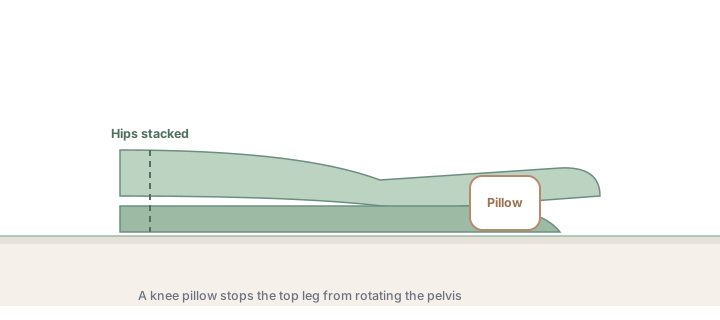
Start with the overlap, because it is bigger than most product pages admit. For the legs, the clinical advice treats the two as interchangeable. Mayo Clinic describes a pillow between the knees for side sleepers with back pain and then says, in the same breath, “Use a full-length body pillow if you prefer.” Johns Hopkins Medicine talks about “a bolster or pillow supporting the legs” without specifying a shape. The job, either way, is the one Cleveland Clinic describes: to stop your upper leg pulling forward and twisting your torso.
So the real difference is everything above the hips.
A knee pillow stops at the knees. Your top arm is on its own: draped in front of you, resting on your side, or pushed under the head pillow. That last habit is one to watch. Cleveland Clinic chiropractor Andrew Bang, quoted in an article about stomach sleepers who tuck an arm under the pillow, warns it can eventually lead to rotator cuff problems or other shoulder issues.
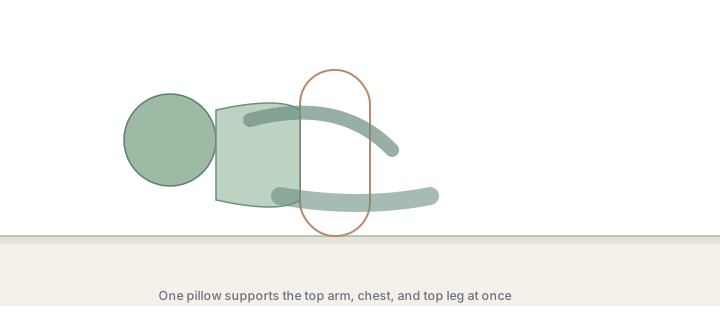
A body pillow carries on up toward the chest, so the top arm has somewhere to rest. That lines up with two pieces of guidance. Sleep Foundation suggests keeping your arms aligned, by your sides or slightly in front of you. And Cleveland Clinic physical therapist Kelly Kinsey's “pillow wall” for a sore shoulder is meant to put the shoulder “in a more neutral position that reduces tension on the joint.”
Put simply: if your hips are the only issue, the extra length of a body pillow is extra bed, not extra help. If your shoulder or arm is part of the story, the length is the point.
The hips themselves don't care which shape you pick, as long as the gap is filled. Sleep Foundation's description of the goal is to relieve pressure on the hips and stop your knees from collapsing onto each other. A firm wedge does that. So does the thick lower end of a well-filled body pillow. A thin, soft body pillow that squashes flat under your leg may not, which is why fill matters as much as shape in the table above.
Decision checklist: answer these five questions
Work down the list. Most people land on an answer by question three.
- Where do you feel it in the morning? Hips or lower back only: a knee pillow covers it. Shoulder, upper arm or a mix: lean toward a body pillow, and look at your head pillow too, since our shoulder pain guide explains why it matters as much.
- Who else is in the bed? A body pillow sits between you and a partner. If the bed is already full, a knee pillow keeps the peace.
- Do you sleep warm? A knee pillow touches only your inner knees. A body pillow presses fabric along your chest, arm and legs.
- Do you roll onto your stomach? Cleveland Clinic says body and side pillows can help habitual stomach sleepers improve their sleep posture, and a long pillow in front of you is a physical barrier a small knee wedge can't be.
- Will it travel with you? A knee pillow fits in a carry-on. A 54-inch body pillow doesn't.
Two answers point the same way? That is usually enough. If you're split, the cheapest way to decide is the free test in the next tip.
One more factor sits outside the checklist: hip width. Knee pillows are fixed heights, and the two listings that state height are far apart, at 6 inches and 10.5 inches. Body pillows are bulkier and, in two of the three we cover, adjustable, so they forgive a wrong guess more easily. If you want a knee pillow but aren't sure of your size, our knee pillow guide has a simple towel test for finding it.
Can you use both, or is one enough?
For most side sleepers, one is enough. The overlap at the knees means a body pillow already does a knee pillow's work, so stacking them adds little. There are a few cases where pairing makes sense, though.
In pregnancy, ACOG suggests side sleeping with one or both knees bent, a pillow between the knees and another under the belly, or trying a full-length body pillow. That is two small pillows or one long one; both routes are on ACOG's list. Our body pillow guide covers what the NHS and ACOG say in more detail, including where sources disagree about which side.
If you share a bed but want arm support, a knee pillow plus an ordinary pillow tucked under your top arm gives you most of a body pillow's support in less space. You can also move them independently when you turn, which suits anyone who changes sides often. Cleveland Clinic recommends switching sides regularly so imbalances don't develop.
Heat is the last tie-breaker. Bedding already creates a warm layer around you: a review in Current Opinion in Physiology puts the skin microclimate under a duvet and nightclothes at around 33 to 35°C. A full-length pillow adds to that coverage. If you run warm, start with the knee pillow and a cool room. Sleep Foundation suggests about 65°F, within a 65 to 68°F range, while Cleveland Clinic gives 60 to 67°F; both point to a cool bedroom.
Care and lifespan differ too. The knee pillows we cover are all memory foam, and Sleep Foundation says solid memory foam pillows should not be machine washed, so you clean the cover and spot clean the foam. The two fiber body pillows are polyester, and Sleep Foundation says polyester pillows can be machine washed on a gentle cycle every 3 to 6 months, if your machine can fit a 54-inch pillow. On lifespan, the same publisher's replacement guide puts memory foam at 2 to 3 years and polyester at 6 months to 2 years. That is general pillow guidance rather than a test of these products, but it suggests a foam knee pillow may outlast a fiber body pillow. Always check the care instructions on the listing first.
Whichever you choose, neither one replaces the pillow under your head. Start there with our main guide to the best pillow for side sleepers, and find more explainers like this one in our side sleeper guides. Our knee and body pillow pages compare specific products: three memory foam knee pillows at 6 and 10.5 inches, and three body pillows in soft fiber, firm fiber and shredded foam.
Knee pillow vs body pillow at a glance
| Knee pillow | Body pillow | |
|---|---|---|
| What it supports | Knees and hips only | Top knee, hips and top arm in one piece |
| Size (products we cover) | Roughly 8 to 10 inches long; 6 in or 10.5 in tall on the two listings that state height | 54 inches long, 20 to 21 inches wide |
| Bed space | Sits between your legs; takes almost no room | A long strip down the bed; some buyers find it too big |
| Turning over | Small to reposition; a strap helps it follow you | Has to be pulled across the bed or left behind |
| Travel | Fits in a suitcase | Not practical to pack |
| Heat | Covers very little of your body | More fabric against you; none of the three listings claims a cooling feature |
| Fill (products we cover) | Memory foam on all three | Soft fiber, firm adjustable fiber, or adjustable shredded memory foam |
| Price band | Budget (all three we cover) | Budget (Utopia, Oubonun) to Mid-range (Coop) |
| Pregnancy (ACOG) | ACOG suggests a pillow between the knees, plus one under the belly | ACOG says you can also try a full-length body pillow |
| Suits | Hip or low-back discomfort, shared beds, warm sleepers, travelers | A sore shoulder or arm that needs resting, huggers, people who drift onto their stomach |
Sizes, fills and price bands from the Amazon listings of the six products in our knee pillow and body pillow guides, read Oct 2026. Positioning guidance from Mayo Clinic, Cleveland Clinic and ACOG.
Body vs knee pillow: common questions
Is a body pillow or a knee pillow better for hip pain?
For the hips alone, either works. Mayo Clinic recommends a pillow between the knees and says a full-length body pillow is fine if you prefer it. A knee pillow is smaller, and all three we cover are in the Budget band, so it is the simpler place to start. Persistent or worsening hip pain is worth discussing with a clinician.
Which is better for shoulder pain?
A body pillow, or any setup that gives your top arm a resting place. Cleveland Clinic's Kelly Kinsey suggests side sleepers with a rotator cuff injury sleep with the injured shoulder up and rest the arm on a pillow wall. A knee pillow doesn't support the arm at all.
Which should I use while pregnant?
ACOG lists both: a pillow between your knees with another under your belly, or a full-length body pillow. The choice is mostly comfort and bed space. The NHS says the safest position to fall asleep in is on your side, left or right, and links going to sleep on your back after 28 weeks to a higher stillbirth risk. Check anything specific with your midwife or doctor.
Which takes up less room in a shared bed?
A knee pillow, by a wide margin. The knee pillows we cover are around 8 to 10 inches long and sit between your legs. The body pillows are 54 inches long and 20 to 21 inches wide, and Amazon's summaries of buyer reviews for two of them include people who find them too big.
Can a body pillow replace my regular pillow?
No. A body pillow supports your arm and legs, not the gap between your head and shoulder. Your head pillow still needs the right height for your build; Sleep Foundation suggests side sleepers usually need at least 4 inches of loft, and more with broad shoulders.
Which one is cooler to sleep with?
A knee pillow, simply because it covers less of you. None of the three body pillows we cover claims a cooling feature (one knee pillow, the Contour Legacy, uses ventilated foam), and no source I found measures how pillows change body temperature. A cool bedroom does more: Sleep Foundation suggests about 65°F.
Sources
- Mayo Clinic — Sleeping positions that reduce back pain (read October 2026)
- Johns Hopkins Medicine — Choosing the Best Sleep Position (read October 2026)
- Cleveland Clinic — Sleeping on Your Stomach: Is it Bad for You? (read October 2026)
- Cleveland Clinic — How to Relieve Rotator Cuff Pain at Night (read October 2026)
- Cleveland Clinic — Is Your Pillow Giving You a Stiff Neck While You Sleep? (read October 2026)
- Cleveland Clinic — Best Sleeping Positions for Pain (read October 2026)
- Cleveland Clinic — What's the Best Temperature for Sleep? (read October 2026)
- Sleep Foundation — Side Sleeping: Which Side Should You Sleep On? (read October 2026)
- Sleep Foundation — Best Pillows for Side Sleepers (read October 2026)
- Sleep Foundation — How to Wash Pillows (read October 2026)
- Sleep Foundation — How Often Should You Replace Your Pillows? (read October 2026)
- Sleep Foundation — Best Temperature for Sleep (read October 2026)
- ACOG — Can I sleep on my back when I'm pregnant? (read October 2026)
- NHS — Stillbirth: Preventing stillbirth (read October 2026)
- Harding, Franks & Wisden — Sleep and thermoregulation (Curr Opin Physiol 2020) (read October 2026)