Best Pillow for Side and Back Sleepers: One Pillow, Two Heights
What is the best pillow for side and back sleepers when your body clearly can't make up its mind? You are not unusual. In a study that tracked 664 working adults with accelerometers, people spent about 54% of their time in bed on their side and 37.5% on their back, shifting position about 1.6 times an hour (Skarpsno et al., Nat Sci Sleep 2017). The trouble is that the two positions want different things from a pillow. This page explains why, compares the three designs that try to solve it, and lists the pillows I'd shortlist after going through the listings and the clinical guidance.

Why does switching between side and back make pillow shopping harder?
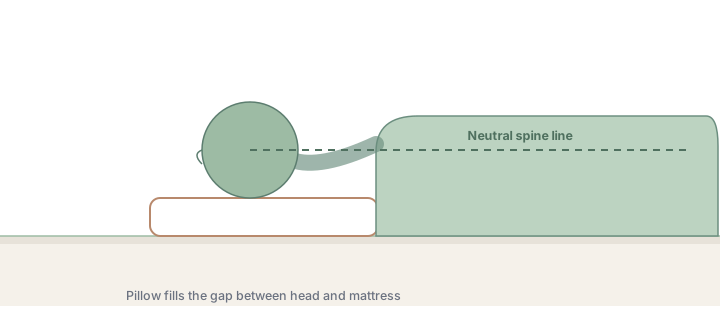
Because each position leaves a different-sized gap between your head and the mattress, and a pillow has to fill that gap without tipping your neck up or down.
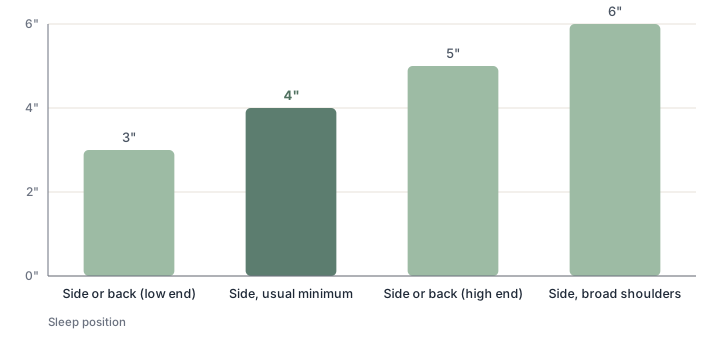
On your side, your shoulder lifts your head away from the bed. Sleep Foundation's medically reviewed side-sleeping page puts it simply: since the shoulders raise the head further from the bed, side sleepers usually do best with a thicker pillow (Sleep Foundation). Its side-sleeper pillow guide says that usually means at least 4 inches, and over 6 inches for broad shoulders (Sleep Foundation).
On your back, your head rests much closer to the mattress. A 2016 biomechanics study of people lying on their backs found that as pillow height went up, the head and neck were raised and extended (Ren et al., PeerJ 2016). Harvard Health adds that a pillow that is too high or stiff keeps the neck flexed overnight and can leave you stiff in the morning (Harvard Health).
So the height that keeps a side sleeper's neck level can be too tall once that same person rolls onto their back. Cleveland Clinic's rule of thumb is the target in both positions: the pillow should keep your neck parallel to the mattress, not bent down or up (Cleveland Clinic).
The sources don't fully agree on the numbers, and that's worth knowing before you buy. Sleep Foundation's neck-pain guide suggests 3 to 5 inches for side and back sleepers alike (Sleep Foundation), while its side-sleeper guide sets 4 inches as the usual floor for side sleeping. Read together, they point to the same practical answer: a combination sleeper needs either a pillow that can be two heights, or one that lands in the narrow overlap and accepts a small compromise.
Side + back pillows: our 6 picks
#1 · Best overall for switching positions
Coop Home Goods Original Adjustable
The listing gives it 8 inches full, and you remove cross-cut memory foam until it suits your side height, so one pillow can be tuned rather than guessed. The extra fill bag means you can put height back if you take out too much. Coop's site lists a 100-night trial and a 5-year warranty, which matters when you are testing a compromise height.
- Type
- Adjustable shredded foam
- Height
- 8 in listed; adjustable
- Fill
- Cross-cut memory foam + microfiber
- Price band
- Mid-range
#2 · Best two-height contour
Royal Therapy Memory Foam Contour Pillow
A memory foam contour with a removable middle layer, so each size gives you two heights. The Queen is listed at 5 inches and the Extra size at 6.5 inches. Amazon's summary of buyer reviews singles out its neck support and the two height levels. Solid foam does hold more heat than shredded fill.
- Type
- Contour cervical (memory foam, layered)
- Height
- 5 in (Queen); 6.5 in Extra size
- Fill
- Memory foam
- Price band
- Mid-range
#3 · Best for smaller frames
UTTU Sandwich Cervical Pillow
Its two edges sit at 5.2 and 4.5 inches, and taking out the middle layer drops them to 4.0 and 3.2 inches, so a narrow-shouldered side sleeper can use the taller edge on their side and the lower one on their back. Broad shoulders will likely find even the top setting short.
- Type
- Contour cervical (removable layer)
- Height
- 5.2/4.5 in; 4.0/3.2 in with layer removed
- Fill
- Memory foam
- Price band
- Mid-range
#4 · Best softer adjustable
Coop Home Goods Eden Adjustable
Coop's medium-soft version, with gel-infused foam and microfiber in a case with a 2-inch gusset. It suits people who spend more of the night on their back or simply prefer a softer feel. Buyer feedback on its cooling is mixed, and it sits in the Premium price band.
- Type
- Adjustable shredded foam
- Height
- 8 in listed; adjustable
- Fill
- Gel-infused memory foam + microfiber
- Price band
- Premium
#5 · Best budget adjustable (2-pack)
QUTOOL Cooling Shredded Memory Foam (2-pack)
Two adjustable shredded-foam pillows (85% memory foam, 15% microfiber, 6 inches listed) in a Budget box, which lets you set one for your side and keep one lower. Amazon's summary of buyer reviews mentions a strong smell, and opinions on the cool-touch side are mixed.
- Type
- Adjustable shredded foam
- Height
- 6 in listed; adjustable
- Fill
- 85% cross-cut memory foam / 15% microfiber
- Price band
- Budget
#6 · Best mid-loft without foam
Casper Original Pillow
A pillow-within-a-pillow: a firmer microfiber core inside a softer outer layer, with a cotton percale cover. Casper calls it mid-loft. It cannot be adjusted, and the buyer summary describes its support for side sleepers as mixed, so it fits people who spend more of the night on their back.
- Type
- Pillow-in-pillow microfiber
- Height
- Mid-loft; 9 in uncompressed (brand)
- Fill
- Microfiber (inner pillow + outer layer)
- Price band
- Mid-range


We earn a commission if you buy through these links, at no extra cost to you. As an Amazon Associate we earn from qualifying purchases. Prices and availability are shown on Amazon and can change.
3 ways to get two heights from one pillow
Every pillow sold for combination sleepers uses one of three tricks. The table above lays them out side by side; here is what each looks like in practice.
1. Loose fill that you set, then let squash
Adjustable pillows are bags of shredded memory foam, usually mixed with fiber. You unzip the cover, remove fill until the side position feels level, and zip it back up. Because the fill is loose, you can also push some of it toward the ends of the case to lower the middle before you settle on your back. Sleep Foundation suggests adjustable pillows when you're unsure what loft you need (Sleep Foundation), and that is exactly the situation of someone who sleeps two ways. The full fill-removal process has its own page: how to set up an adjustable pillow for side sleeping.
2. A contour with a tall edge and a low edge
Cervical contour pillows are shaped foam with a raised roll along each long edge. On the UTTU the two rolls are different heights, listed at 5.2 and 4.5 inches, so you turn the pillow around depending on how you plan to start the night. The Royal Therapy (5 inches for its Queen) works differently: you change its height by removing a middle layer. The catch is that you have to remember to rotate it, and you may not do that half asleep at 3 a.m.
3. A medium height that splits the difference
A mid-loft pillow sits in the overlap between the two positions. It is the simplest choice and the least precise. It tends to suit people whose night leans heavily toward their back, with only a little side sleeping.
How to dial in a pillow you'll use in both positions
The order matters. Set the pillow for your side first, because that is the position with the bigger gap and the one most combination sleepers spend longer in. Then check whether it is tolerable on your back.
- Lie on your side in your usual spot and have someone look at your neck, or use a phone camera on a timer. You're looking for a neck that runs parallel to the mattress and, in Mayo Clinic's words, stays in alignment with your chest and back.
- Give each setting time. In a lab study of side lying, 70.8% of participants had stabilised within 15 minutes on a pillow (Hodkinson et al., Ergonomics 2013), so judge a setting after a quarter of an hour, not after the first ten seconds.
- Roll onto your back. If your chin tips toward your chest, the pillow is too tall for that position. With loose fill, push some of it toward the ends of the case before you settle on your back. With a two-edge contour, turn to the lower edge.
- Keep the setting for a few nights before changing it again, and note how your neck feels on waking.
Your mattress changes the answer too. Cleveland Clinic notes that a firmer mattress needs a thicker pillow because your shoulder won't sink in much, while a topper or pillow-top lets the shoulder sink and calls for a thinner one (Cleveland Clinic). If you add or remove a topper, revisit your pillow height.
Side-and-back pillow specs at a glance
| Spec | Coop Home Goods Original Adjustable | Royal Therapy Memory Foam Contour Pillow | UTTU Sandwich Cervical Pillow | Coop Home Goods Eden Adjustable | QUTOOL Cooling Shredded Memory Foam (2-pack) | Casper Original Pillow |
|---|---|---|---|---|---|---|
| Type | Adjustable shredded foam | Contour cervical (memory foam, layered) | Contour cervical (removable layer) | Adjustable shredded foam | Adjustable shredded foam | Pillow-in-pillow microfiber |
| Height / loft (as stated) | 8 in listed; adjustable | 5 in (Queen); 6.5 in Extra size | 5.2/4.5 in; 4.0/3.2 in with layer removed | 8 in listed; adjustable | 6 in listed; adjustable | Mid-loft; 9 in uncompressed (brand) |
| Adjustable fill | Yes | Yes | Yes | Yes | Yes | Yes |
| Fill | Cross-cut memory foam + microfiber | Memory foam | Memory foam | Gel-infused memory foam + microfiber | 85% cross-cut memory foam / 15% microfiber | Microfiber (inner pillow + outer layer) |
| Cover | Polyester/rayon-from-bamboo (Lulltra) | Polyester/rayon-from-bamboo | Polyester/viscose | Polyester/rayon (Lulltra) | Two-sided with ice-silk cooling side | Cotton percale |
| Firmness (as stated) | Medium (listing); medium-firm (brand) | Medium | Medium | Medium-soft (title) | Medium | Medium-soft (bullet) |
| Pack | 1 pillow | 1 pillow | 1 pillow | 1 pillow | 2 pillows | 1 pillow |
| Certifications | CertiPUR-US, GREENGUARD Gold | CertiPUR-US, OEKO-TEX | OEKO-TEX STANDARD 100 | CertiPUR-US, GREENGUARD Gold | CertiPUR-US | None stated |
| Care | Care instructions on the listing | Care instructions on the listing | Care instructions on the listing | Care instructions on the listing | Care instructions on the listing | Care instructions on the listing |
| Price band | Mid-range | Mid-range | Mid-range | Premium | Budget | Mid-range |
Two-edge contour vs mid-loft: which compromise is easier to live with?
If you reliably fall asleep in one position, the contour is the better compromise. You set the edge for your starting position, and the shaped foam keeps that height through the night. Harvard Health's advice for side sleepers is a pillow that is higher under the neck than under the head (Harvard Health), and a contour's raised roll is built to do just that.
The mid-loft pillow suits people who move constantly and won't rotate anything. It asks nothing of you, but it may feel low on your side if you have broad shoulders, since Sleep Foundation says broad shoulders may need a pillow over 6 inches and a mid-loft pillow aims for the middle.
There's a third option worth naming: an adjustable pillow sits between the two. It has no fixed edges, so you can't rotate it to a lower setting, but you can reshape its loose fill by hand. For most people who switch positions every night, that ability to re-tune the height is why I'd still call shredded fill the best pillow for side and back sleepers as a starting point. Readers whose main issue is neck pain should also see our guide to pillows for side sleepers with neck pain, and solid-foam fans can compare more contour shapes on the cervical pillow page.
Match the pick to your shoulders, mattress and habits
There's no single best pillow for side and back sleepers for every body, so use the list at the top as a starting point, then narrow it down with three questions.
How wide are your shoulders? A 2025 study of side sleepers found that shoulder width, combined with pillow height, predicted the shape of the neck curve, although comfort ratings didn't track it (Tian et al., 2025). In plain terms, what feels comfy isn't always what lines you up. Broad-shouldered readers should lean toward the Coop Original or the 6.5-inch Royal Therapy Extra and see our picks for broad shoulders. Narrow frames suit the UTTU.
How soft is your mattress? If you sink in deeply, Sleep Foundation notes that even a 4-inch loft can be too high. Start lower and add fill.
Which way do you lean? Mostly side with some back: shredded fill set for the side. Mostly back with some side: the Coop Eden with fill removed, or the Casper. Side and stomach instead of back: that's a lower-height problem, covered on our side and stomach sleeper page.
Two small extras help both positions. Mayo Clinic suggests a pillow between your legs when you're on your side and one under your knees when you're on your back (Mayo Clinic). A knee pillow made for side sleepers covers the first. For the wider picture of every pillow type, go back to our main guide to the best pillow for side sleepers or browse the full side sleeper pillow shop.
Three ways to give two positions two heights
| Approach | How it handles side vs back | Main trade-off | Examples on this page |
|---|---|---|---|
| Adjustable shredded fill | You set one height, usually for your side; before lying on your back you can push some fill toward the ends of the case to lower the middle | Takes a few nights of trial and error; some buyers report a smell when new | Coop Original, Coop Eden, QUTOOL |
| Two-height contour | UTTU: turn the pillow so the taller edge is under your neck for side sleeping, the lower edge for back sleeping. Royal Therapy: remove the middle layer to drop the height | Fixed shape; you have to rotate it, and solid foam runs warmer | Royal Therapy, UTTU Sandwich |
| Mid-loft compromise | One medium height that is a little low for the side and a little high for the back | Nothing to set up, but nothing to tune either | Casper Original |
Approach descriptions are editorial; product heights come from the listings, read October 13, 2026.
Sukie's take
If you switch between your side and your back, set the pillow for your side first, then make sure it doesn't push your chin down on your back. Loose shredded fill is easier to re-tune for that shift than anything fixed.
Side + back: common questions
What pillow height works for both side and back sleeping?
There is no single proven number. Sleep Foundation's neck-pain guide suggests 3 to 5 inches for side and back sleepers, while its side-sleeper guide says side sleepers usually need at least 4 inches. If one height has to cover both, the overlap of the two ranges, roughly 4 to 5 inches, is a reasonable place to start, adjusted for your shoulders and mattress.
Is an adjustable pillow better than a contour pillow for combination sleepers?
Neither is proven better. Adjustable fill can be reshaped by hand, which helps if you switch often. A two-edge contour holds a precise height but has to be rotated. Research hasn't shown that contour shapes beat regular ones for side sleepers, so pick the design you'll actually use correctly.
Should I use two different pillows for side and back?
Some people keep a taller and a lower pillow and pull one out when they change position. It works if you change position deliberately, but position shifts mostly happen while you sleep, about 1.6 times an hour in one accelerometer study, so a single pillow that tolerates both is usually more practical.
Why does my neck hurt on my back but not on my side?
A common reason is that a pillow tall enough for side sleeping pushes your head forward when you lie on your back. Harvard Health notes that too high or stiff a pillow keeps the neck flexed overnight. Try removing some fill, or turning a contour to its lower edge. If pain persists, see a clinician.
Is a memory foam pillow good for side and back sleepers?
Memory foam can work in both positions. Shredded memory foam is the easier version for switching because you can change the height, while solid contour foam gives a fixed shape. Our memory foam page compares both forms in detail.
Is a down alternative pillow okay if I sleep on my side and back?
It can be if it's full enough for your side. Soft fiber pillows compress under your head, which is fine on your back but may leave a side sleeper's head tilting down. Amazon's buyer summaries for several fiber pillows in our catalogue mention flattening over time, so check the height regularly.
Do I still need a knee pillow if I switch positions?
It's optional, but Mayo Clinic suggests a pillow between the legs on your side and under the knees on your back for back pain. A small knee pillow can do both jobs.
How often should I replace a pillow I use for both positions?
Sleep Foundation says most experts recommend every 1 to 2 years overall, and lists 2 to 3 years for memory foam and polyfoam pillows. Adjustable pillows let you top up flattened fill with the spare bag, which can help between replacements.
Sources
- Skarpsno et al., Sleep positions and nocturnal body movements (Nat Sci Sleep 2017) (read October 2026)
- Sleep Foundation, Side Sleeping: Which Side Should You Sleep On? (read October 2026)
- Sleep Foundation, Best Pillows for Side Sleepers in 2026 (read October 2026)
- Sleep Foundation, Best Pillows for Neck Pain in 2026 (read October 2026)
- Sleep Foundation, How Often Should You Replace Your Pillows? (read October 2026)
- Ren et al., Effect of pillow height on the head-neck complex (PeerJ 2016) (read October 2026)
- Harvard Health, Say 'good night' to neck pain (read October 2026)
- Harvard Health, Is your pillow hurting your health? (read October 2026)
- Cleveland Clinic, Is Your Pillow Giving You a Stiff Neck While You Sleep? (read October 2026)
- Lei et al., Ergonomic Consideration in Pillow Height Determinants and Evaluation (Healthcare 2021) (read October 2026)
- Gordon et al., Pillow use in side sleepers (Man Ther 2009) (read October 2026)
- Chun-Yiu et al., Effects of pillow designs on neck pain: meta-analysis (Clin Biomech 2021) (read October 2026)
- Hodkinson et al., Time to stabilisation of the cervical spine in side lying (Ergonomics 2013) (read October 2026)
- Tian et al., Individualized optimal pillow height for side sleepers (Med Biol Eng Comput 2025) (read October 2026)
- AASM Sleep Education, Snoring (read October 2026)
- AASM Sleep Education, Positional Therapy (read October 2026)
- Mayo Clinic, Sleeping positions that reduce back pain (read October 2026)
- Coop Home Goods Original Adjustable — Amazon listing (read October 2026)
- Royal Therapy Memory Foam Contour Pillow — Amazon listing (read October 2026)
- UTTU Sandwich Cervical Pillow — Amazon listing (read October 2026)
- Coop Home Goods Eden Adjustable — Amazon listing (read October 2026)
- QUTOOL Cooling Shredded Memory Foam (2-pack) — Amazon listing (read October 2026)
- Casper Original Pillow — Amazon listing (read October 2026)