What Kind of Pillow Should a Side Sleeper Use? Height, Firmness, Shape and Fill
The answer to what kind of pillow should a side sleeper use starts with a definition: a side-sleeper pillow is one tall and supportive enough to fill the space between your mattress and your head, so your neck stays in line with the rest of your spine. A side-lying trial puts it plainly: the pillow's main job is to support the neck “in a neutral position.” Everything else (firmness, shape, the stuff inside) serves that one job. I read the clinical pages and trials in our source register and sorted what they say into four decisions, in the order they matter.

The short version: four decisions, in this order
Most pillow advice starts with materials, because that's how pillows are sold. The sources I read point the other way. A 2021 meta-analysis concluded that cervical alignment in side lying “may be significantly impacted by the shape and height of the pillow,” more than by whether it is rubber or feather (Chun-Yiu et al., Clinical Biomechanics 2021, abstract). Sleep Foundation's medically reviewed side-sleeping page agrees that the most important factors are “the pillow's shape and height, or ‘loft.’”
So the order I'd use is:
- Height (loft): does it fill the gap between your shoulder and your head?
- Firmness: does it hold that height once your head is on it?
- Shape: rectangle, contour, curve or cut-out, and does it give more support under the neck than under the head?
- Fill: what's inside, which decides how the first three behave over months.
If you'd rather skip straight to products, our main guide to the best pillow for side sleepers has a fit finder at the top and ranked picks. If you want to understand why each choice matters, keep reading.
How tall should a side sleeper's pillow be?
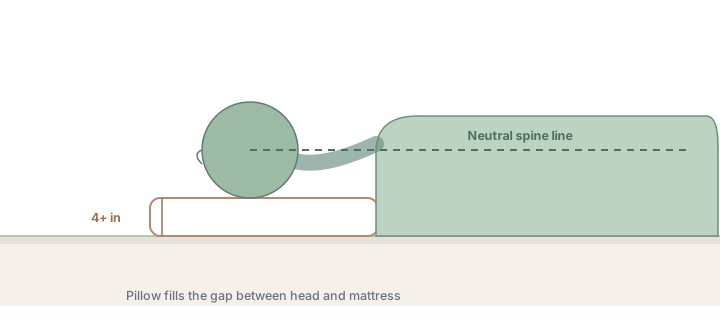
When you lie on your side, your shoulder lifts your head well above the mattress. Sleep Foundation's side-sleeping page puts it simply: “Since the shoulders raise the head further from the bed when side sleeping, side sleepers usually do best with a thicker pillow.”
The most-quoted number comes from Sleep Foundation's side-sleeper guide (medically reviewed by Jenny Iyo, DPT): side sleepers usually need a medium to high loft, which “usually means using a pillow that is at least 4 inches thick.” The same page adds that broad shoulders “may need a pillow that is over 6 inches.”
A different Sleep Foundation page, on pillows for neck pain, suggests “between 3 and 5 inches thick for side and back sleepers.” Those two pages don't agree, and I'd rather show you both than pick one. Where they overlap is 4 to 5 inches.
The research behind any single number is thin. A 2021 review of pillow-height studies concluded there are still “no firm conclusions about the optimal pillow height for the supine and lateral positions” (Lei et al., Healthcare 2021). One small side-lying study is still worth knowing: of three foam pillows at 5, 10 and 14 cm, 21 adults rated the 10 cm one most comfortable, and the 5 cm pillow produced the most down-side trapezius activity (Sacco et al., JMPT 2015, abstract).
Sleep Foundation's measuring principle is the practical takeaway: “Choose a pillow with a loft, or thickness, that matches the distance between your neck and your shoulder.” Our guide to broad-shoulder side sleepers covers the tall end of that range.
Your mattress moves the target
The same person can need two different pillows on two different beds. Sleep Foundation says loft “is dependent on both the shape of your body and how much you sink into your mattress,” and Cleveland Clinic's chiropractor Andrew Bang, DC, explains why in Cleveland Clinic's stiff-neck article:
- Firmer mattress, thicker pillow. Your shoulder won't sink much, so the pillow has “a larger gap between your head and your mattress” to fill.
- Memory foam topper or pillow-top, thinner pillow. Your shoulder sinks into the bed, which shrinks the gap.
- Deep-sinking beds can flip the usual advice. Sleep Foundation notes that if you sink deeply, “even a 4-inch loft is too high.”
This is why a pillow that felt perfect in a hotel can feel wrong at home, and why I'd treat any listed height as a starting point. If you're unsure, Sleep Foundation suggests an adjustable pillow, which lets you remove or add fill until the height matches your bed. Our adjustable pillow guide compares the main options.
What firmness works for side sleeping?
Here the sources lean the same way but use different words, which is worth untangling.
Harvard Health is the most direct: “Side sleepers need a firm pillow for support.” The same article explains the reason for avoiding soft ones: if the pillow doesn't support your neck, “your head has to extend sideways to meet the pillow.” Sleep Foundation's side-sleeper guide is a notch gentler: “Pillows with mid-level firmness are usually the best choice for side sleepers.” Johns Hopkins says choosing soft versus hard “is just a matter of preference,” but to aim for something supportive.
My reading: these agree that support is not optional and disagree only on how firm counts as supportive. Two cautions sit at the other end. Harvard also warns against “too high or stiff a pillow,” which keeps the neck flexed overnight. And firmness and height interact: a soft pillow that measures 6 inches in the box may compress to far less under your head. If you like a firm surface, our firm pillow guide covers the solid-foam options; if you want softness without losing height, look at gusseted or adjustable designs.
Does the shape matter, or only the height?
Shape matters in one specific way, and is oversold in another.
The specific way: Harvard Health's neck-pain article advises side sleepers to use “a pillow that is higher under your neck than your head.” That describes a contour (cervical) pillow, and Sleep Foundation mentions the same option: a cervical pillow with “a higher part to support the neck and a lower loft under the head.” Harvard's other article also notes that rectangular pillows with panels on the side (gusseted pillows) may help: “they're taller than standard pillows.”
The oversold way: trials have not found contour pillows clearly better than regular shapes. In 106 side sleepers, “there is no evidence that the use of a foam contour pillow has advantages over the regular shaped pillows” (Gordon et al., 2009, abstract), and a lab trial found contour and regular foam pillows produced similar spinal slopes (Gordon et al., 2011). Cleveland Clinic's Dr. Bang, on the other hand, says cervical contour pillows “work best for most people.” That's expert opinion against trial evidence, so I'd call it mixed.
Then there are shapes made for side sleepers' shoulders: crescent or curved pillows with an inner curve, and cut-out pillows with a notch for the bottom arm. No source here tested those shapes, so treat them as a comfort choice. Contour pillows are compared in our cervical pillow guide, and the curved and cut-out shapes in our shoulder pain guide.
“Moreover, there may be no change in the alignment of the cervical spine in the side-lying position, regardless of the use of rubber or feather pillows. Rather, the cervical alignment may be significantly impacted by the shape and height of the pillow.”
Fill types, one by one
Fill comes last, but it decides whether the height and firmness you chose survive the night and the year. Here is what each common fill brings, using only what the sources say:
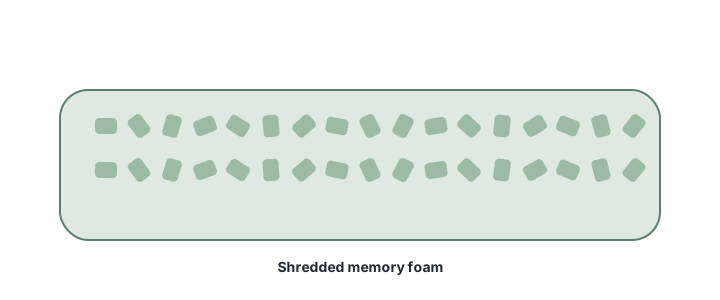
- Shredded (cross-cut) memory foam: usually sold in a zippered cover you can open, so you can remove fill to lower it or add fill to raise it. This is the “adjustable” category Sleep Foundation suggests when you're unsure of your loft. Several listings for this type mention a smell when new in their buyer summaries.
- Solid memory foam: a single block that keeps a fixed height and shape. NASA's history describes it as open-cell, viscoelastic foam that flows to the body and “returned to its original shape once the pressure was removed.” The trade-off is a fixed height unless the design has removable layers.
- Latex (“rubber” in the trials): the strongest trial record. A field trial in side sleepers found “the latex pillow performed best” for waking symptoms (Gordon et al., J Pain Res 2010), and the 2021 meta-analysis found rubber pillows reduced neck pain. Dr. Bang adds that latex supports “without heating you up like memory foam,” and that latex allergy is a reason to choose foam.
- Polyester and down-alternative fiber: soft and inexpensive, but Sleep Foundation lists polyester among “the least durable,” replaced every 6 months to 2 years, and down alternative about every 1 to 2 years.
- Feather and down: the weakest side-sleeper result. Feather “performed least well” in the same field trial, and the 106-person study concluded “Feather pillows should not be recommended.” Harvard notes feather pillows “collapse over time” and should be replaced every year or so.
- Buckwheat hulls: the sources here say little about them. Dr. Bang's main caution is that they are noisy, and Sleep Foundation suggests replacing the hulls about every 3 years.
Our memory foam vs latex comparison goes deeper on the two foams.
3 situations that change the pick
The general answer bends for a few common situations:
- You sleep on your side and your back. A pillow that suits your side will usually be too tall when you roll over. Sleep Foundation's neck-pain page gives 3 to 5 inches for both positions, so a mid-height or adjustable pillow is the compromise. See our side and back sleeper guide.
- You switch between side and stomach. Stomach sleeping is the position that wants the least height (Sleep Foundation suggests 3 inches or less for it), so you'll need something low and squashable. Our side and stomach guide covers slim and adjustable options.
- Your lower back or hips ache. The head pillow isn't the whole setup. Mayo Clinic suggests drawing your legs up slightly “and put a pillow between your legs,” and Cleveland Clinic says that pillow keeps the top leg from twisting your torso. Our knee pillow guide and body pillow guide cover the options.
If a shoulder hurts, Cleveland Clinic's physical therapist suggests sleeping with the injured shoulder up and resting your arm on a “pillow wall” in front of you (Cleveland Clinic).
Putting it together: where to look next
If you've followed the four decisions, you probably know which group you're in. These pages take each group to specific pillows, with heights copied from each listing:
- Not sure of your height, or you share a bed with a changing mattress: best adjustable pillow for side sleepers, plus our Coop Original review, an adjustable shredded-foam pillow listed at 8 inches with extra fill in the box.
- Neck pain is the reason you're shopping: best pillow for side sleepers with neck pain.
- You like a solid foam feel: best memory foam pillow for side sleepers.
- You sleep hot: best cooling pillow for side sleepers.
- You want a soft, hotel-style pillow: our Beckham Hotel Collection review explains what that kind of pillow does and doesn't do for side sleepers.
The full catalogue sits on our side sleeper pillow shop page, and every explainer like this one lives in our guides. Whatever you choose, keep the box and the receipt until you've done the alignment check above on your own mattress for a couple of weeks.
Sukie's take
The studies argue much less about materials than about height and support. If I were starting from nothing, I'd measure the gap, check my mattress, and choose a pillow that can hold that height, and only then worry about what's inside it.
Sources
- Sleep Foundation — Best Pillows for Side Sleepers in 2026 (read October 2026)
- Sleep Foundation — Best Pillows for Neck Pain in 2026 (read October 2026)
- Sleep Foundation — Side Sleeping: Which Side Should You Sleep On? (read October 2026)
- Sleep Foundation — Best Sleeping Positions (read October 2026)
- Sleep Foundation — How Often Should You Replace Your Pillows? (read October 2026)
- Chun-Yiu et al. — The effects of pillow designs on neck pain (Clin Biomech 2021) (read October 2026)
- Lei et al. — Ergonomic Consideration in Pillow Height Determinants and Evaluation (Healthcare 2021) (read October 2026)
- Sacco et al. — The effect of pillow height on muscle activity (JMPT 2015) (read October 2026)
- Hodkinson et al. — Time to stabilisation of the cervical spine in side lying (Ergonomics 2013) (read October 2026)
- Gordon et al. — Pillow use in side sleepers (Man Ther 2009) (read October 2026)
- Gordon et al. — Does pillow type alter cervico-thoracic spinal posture when side lying? (J Multidiscip Healthc 2011) (read October 2026)
- Gordon et al. — Pillow use: cervical stiffness, headache and scapular/arm pain (J Pain Res 2010) (read October 2026)
- Cleveland Clinic — Is Your Pillow Giving You a Stiff Neck While You Sleep? (read October 2026)
- Cleveland Clinic — Best Sleeping Positions for Pain (read October 2026)
- Cleveland Clinic — How to Relieve Rotator Cuff Pain at Night (read October 2026)
- Harvard Health — Is your pillow hurting your health? (read October 2026)
- Harvard Health — Say “good night” to neck pain (read October 2026)
- Johns Hopkins Medicine — Choosing the Best Sleep Position (read October 2026)
- Mayo Clinic — Sleeping positions that reduce back pain (read October 2026)
- NASA Spinoff 2005 — Forty-Year-Old Foam Springs Back With New Benefits (read October 2026)