What Is the 2 2 1 Pillow Rule? Shea McGee's Bed-Styling Formula, Explained
So what is the 2 2 1 pillow rule, and who came up with it? It's a bed-styling formula, not a sleep rule: two sleeping pillows, two shams, and then a small layer of throw pillows on top. Apartment Therapy credits it to interior designer Shea McGee, who “suggests starting out with a 2-2-1 configuration” while admitting there's no one formula for every bed. I went back to the designer's own guide, a 2018 interview, and that 2024 article to pin down exactly what she said, which turns out to be simpler than most of the versions floating around online.

What does each number in 2-2-1 mean?
Read it from the headboard forward: sleeping pillows, then shams, then the throw layer. Here is each number, with what the documented sources actually support:
- 2 sleeping pillows. The pillows you actually put your head on. Studio McGee's own styling guide says “We like to use two pillows on the bottom and two shams on top to coordinate with the bedding look” (Studio McGee).
- 2 shams. Decorative covers on pillows that sit in front of, or on top of, the sleeping pair. McGee calls the sleeping pillows plus shams “a great base.”
- 1 throw layer. This is the fuzzy part. In Apartment Therapy's 2024 article, McGee says to “layer in throw pillows to create a more curated look” and that she loves “odd groupings — three, four, five pillows, or just a lumbar.” The article never states what the “1” stands for. The common reading is a single throw or long lumbar pillow, which matches the simplest option in her own quote.
The point of the formula is restraint. The Apartment Therapy writer describes a bed that had grown to nine pillows, over half purely decorative, and the article's closing line is “Maybe less really is more when it comes to decorative cushions in the bedroom.”
Domino 2018 vs Apartment Therapy 2024: how the formula changed
The idea shows up in three places over six years, and comparing them explains why you'll see different versions online.
- Domino, 2018. In an interview, McGee gave a fuller recipe: “Two sleeping pillows (per person, so four total if you have a queen-size bed), two shams, and three decorative pillows, one of which should be a lumbar pillow” (Domino). She added that she tries “to strike a balance between decorative pillows, shams, and sleeping pillows.”
- Studio McGee's own guide. The studio's styling page keeps the base (two pillows on the bottom, two shams on top) and describes throw pillows loosely: “Whether it's a stacked pyramid look or a simple long lumbar,” they add “texture, pattern, or color.”
- Apartment Therapy, 2024. The “2-2-1” name appears here, by writer Isis Briones. McGee “confirms there's no one-size-fits-all throw pillow formula for every bed” and suggests 2-2-1 as a starting point.
So the base of two sleeping pillows and two shams is consistent across all three. The decorative layer has shrunk from three pillows in 2018 to “just a lumbar” as one acceptable option in 2024.
One version you'll often see, “2 large + 2 medium + 1 accent,” is not in any of these McGee sources. I could only find it on retailer and SEO blogs, so I wouldn't treat it as the designer's rule. It's closer to a different arrangement described in the same Apartment Therapy piece by designer Lucy Small of State & Season: main pillows standing at the back, a long textured pillow, “two larger pillows in one color, then either two more in a different color/pattern/texture and an accent pillow in front.”
Why does this history matter? Because it tells you which parts of the rule are firm and which are taste. The base, two sleeping pillows plus two shams, is the stable core across every version. The decorative layer is where McGee's advice has varied, and where she says “It's really about finding what feels right for you.” If a website tells you the third number must be a specific size, color or fabric, that detail did not come from the designer's own published words.
5 steps to style a bed the 2-2-1 way
Using only what McGee and the other designer quoted actually said, here is how to put it together:
- Start with the sleeping pillows at the back. Lucy Small says “Usually the main pillows of the bed are standing at the back.” These are the two that do the real work at night, so pick them for your sleeping position first.
- Add two shams in front of or on top of them. Studio McGee uses shams “to coordinate with the bedding look,” so this is where the bed's main color or pattern goes.
- Add the throw layer, starting small. One long lumbar is the simplest version McGee mentions. If you want more, she says she loves “odd groupings” and lists three, four or five pillows.
- Decide on a palette before you buy. McGee says “You can keep the palette neutral and mix different textures, or if you're feeling playful, mix in some patterns.” Throw pillows are where she adds “texture, pattern, and color.”
- Scale it to the bed. The Apartment Therapy article notes that “styling does change based on the size of the bed.” Its writer used two standard pillows and one throw pillow on twin beds. McGee's 2018 recipe counts sleeping pillows per person, which means four on a queen.
A practical extra: decide where the decorative pillows go at night before you add them. A pillow arrangement you have to move every evening is one you'll stop using.
Variations for queen beds, twin beds and fewer pillows
The documented sources leave room to adapt, and a few variations follow directly from them:
- Queen bed, two sleepers. McGee's 2018 recipe uses two sleeping pillows per person, so four total, plus two shams and the throw layer.
- Twin bed or guest room. The Apartment Therapy writer went with two standard pillows and one throw pillow. That is a 2-0-1 in effect, and it reads as tidy rather than bare.
- Minimal look. Two sleeping pillows, two shams and one long lumbar is the leanest version that still fits McGee's words.
- Fuller look. Swap the single lumbar for an odd-numbered group of three or five throw pillows, McGee's own preference for a layered bed.
A good test for any variation is McGee's own word, balance. She says she always tries “to strike a balance between decorative pillows, shams, and sleeping pillows.” If the decorative layer is taller or wider than the base, or if you need a chair to hold the pillows at night, the bed has tipped out of balance and it's time to edit, the same conclusion the Apartment Therapy writer reached with her nine-pillow bed.
If you're replacing the sleeping pillows while restyling, our side sleeper pillow shop page lists every pillow we cover by height and fill. A body pillow can also sit along the back of a bed if you use one at night. Our main guide to the best pillow for side sleepers is the place to start if you're not sure which kind you need. More explainers like this one live in our guides.
Sukie's take
What surprised me reading the originals is how little the designer actually prescribes. Two sleeping pillows and two shams, then whatever throw layer feels right. I'd spend the effort on the two pillows you sleep on and keep the decorative layer small.
2-2-1 pillow rule: common questions
What does 2-2-1 stand for in bed styling?
Two sleeping pillows, two shams, and a throw layer. Shea McGee's quoted words are “two sleeping pillows and two shams for a great base,” then throw pillows. The “1” is usually read as a single lumbar or throw pillow, since McGee lists “just a lumbar” as an option, but the article that named the rule doesn't define it.
Did Shea McGee create the 2-2-1 pillow rule?
Apartment Therapy credits it to her in a November 2024 article, where she “suggests starting out with a 2-2-1 configuration.” Her studio's own styling guide doesn't use the 2-2-1 name, but it describes the same base of two pillows on the bottom and two shams on top.
Is the 2-2-1 rule the same as 2 large, 2 medium and 1 accent pillow?
Not according to the McGee sources I read. That version appears on retailer and SEO blogs. McGee's documented formula is sleeping pillows plus shams, then throw pillows. A layered arrangement with larger pillows and an accent in front was described by a different designer, Lucy Small.
What is a pillow sham?
A decorative cover that goes on a pillow displayed on the bed during the day. In Studio McGee's guide, two shams sit on top of the two sleeping pillows “to coordinate with the bedding look.”
How many pillows should be on a queen bed?
There's no fixed rule. McGee's 2018 recipe for a queen was two sleeping pillows per person (four total), two shams and three decorative pillows, one a lumbar. Her 2024 starting point is leaner: two sleeping pillows, two shams and a small throw layer.
Does the 2-2-1 rule work on a twin bed?
A scaled-down version does. The Apartment Therapy writer used two standard pillows and one throw pillow on her guest-room twin beds, noting that styling changes with the size of the bed.
Should the throw pillows be an odd number?
McGee says she loves “odd groupings — three, four, five pillows, or just a lumbar,” so odd numbers are her preference, though her own list includes four. Treat it as a style choice.
Can I sleep on the decorative pillows in the 2-2-1 setup?
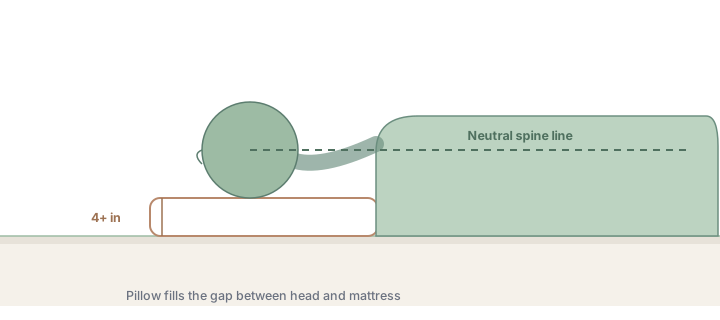
They aren't meant for it. The two sleeping pillows are the ones to choose for support. For side sleepers, Sleep Foundation suggests a medium to high pillow, often at least 4 inches, which most shams and throws aren't designed to be.
Is the 2-2-1 rule about sleep health?
No. It's a decorating formula from an interior designer. It says nothing about pillow height or support. If you're choosing the sleeping pillows for side sleeping, use height and support guidance from sleep sources rather than the styling rule.
Sources
- Apartment Therapy — The “2-2-1” Rule Is the Perfect Formula for Styling Pillows on Your Bed, According to Shea McGee (Nov 7, 2024) (read October 2026)
- Studio McGee — How to Style a Beautiful Bed (read October 2026)
- Domino — The Foolproof Formula Behind Shea McGee's Instagram-Worthy Beds (2018) (read October 2026)
- Sleep Foundation — Best Pillows for Side Sleepers in 2026 (read October 2026)