Best Pillow for Side Sleepers with Arm Under Pillow: Cut-Outs, Crescents and Somewhere Else for the Arm
It's late, you're on your side, and one arm has slid under the pillow again, propping it up like a jack: that habit is what sends many people looking for the best pillow for side sleepers with arm under pillow problems. Maybe you've done it for years. Maybe you only notice when you wake with your shoulder hunched toward your ear and your hand somewhere near the headboard. Either way, the arm is often filling a space the pillow isn't. This page looks at what that space is, what the clinical sources say about the tucked arm (less than you'd hope), and which pillow shapes are designed to give the arm somewhere else to go.

Why do so many side sleepers sleep with an arm under the pillow?
I went looking for a study that explains this habit in side sleepers, and I didn't find one. None of the clinical sources I rely on documents why people tuck an arm under the pillow, so what follows is my reading of the evidence that does exist, not a finding.
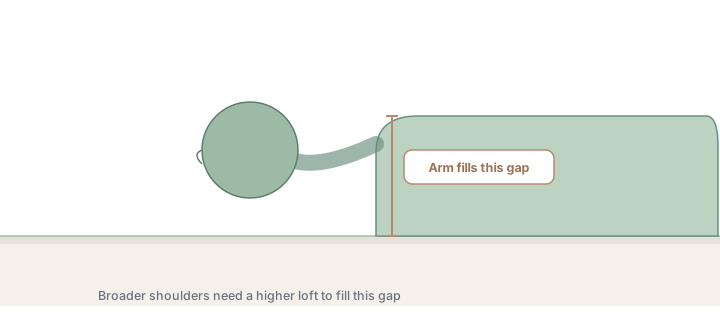
The most likely job the arm is doing is adding height. Sleep Foundation explains that the shoulders raise the head further from the bed when you lie on your side, which is why side sleepers usually do best with a thicker pillow (Sleep Foundation). If your pillow is too low or has gone flat, your arm under it acts as extra height.
The second job is making room. Your bottom shoulder and arm have to go somewhere. With a straight-edged pillow pressed against them, sliding the arm up and under is one way out.
The third is plain habit. A Cleveland Clinic chiropractor, describing stomach sleepers, says, “Most people naturally raise them up, maybe even tucking one arm (or both) under the pillow” (Cleveland Clinic). He was talking about a different position, and none of the sources says whether side sleepers do it for the same reason.
Arm under pillows: our 5 picks
#1 · Best overall for arm-under-pillow sleepers
Coop Home Goods Original Crescent
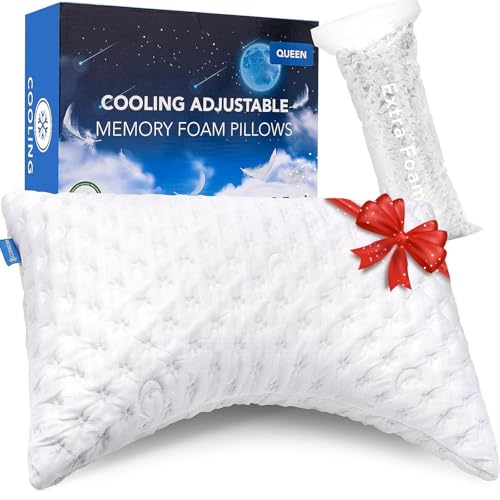
The crescent edge curves inward where your shoulder and bottom arm sit, so there's less reason to shove the arm underneath to make room. The fill is adjustable cross-cut foam, and Coop's site lists a 100-night trial and a 5-year warranty. Amazon's summary of buyer reviews says the crescent shape works well, with mixed views on value.
- Type
- Crescent, adjustable foam
- Height
- Not stated; adjustable
- Fill
- Cross-cut memory foam + microfiber
- Price band
- Mid-range
#2 · Best defined pocket for the arm
Coop Home Goods Cool+ Cut-Out
Instead of a curve, a notch is cut out of the lower edge, giving the bottom shoulder and arm a defined space. The gel memory foam fill is adjustable and the cover is a cooling fabric. It's premium-priced, the listing doesn't state the height, and its Amazon review summary is pooled with another Coop pillow, so buyer feedback on the cut-out itself is thin.
- Type
- Cut-out, adjustable foam
- Height
- Not stated; adjustable
- Fill
- Gel memory foam + microfiber
- Price band
- Premium
#3 · Best budget curved pillow
Sidney Sleep Adjustable Curved Pillow
A budget-tier curved pillow listed at 7 inches with adjustable foam-and-fiber fill, its inner curve designed to wrap the shoulder. That listed height gives you room to work with before your arm has to act as a booster. Some buyers in Amazon's summary find it too firm, so be ready to remove fill.
- Type
- Curved side-sleeper, adjustable fill
- Height
- 7 in listed; adjustable
- Fill
- 75% foam / 25% polyester fiber
- Price band
- Budget
#4 · Best budget curve for warm sleepers
KUCEY Cooling Side Sleeper Pillow
A curved shredded-memory-foam pillow with a two-sided cover, one face cooling fiber, and an OEKO-TEX certified cover. The listing doesn't state the height, but the fill is adjustable. Amazon's buyer summary praises the curve for side sleeping and calls the cooling effect mixed.
- Type
- Curved side-sleeper, shredded foam
- Height
- Not stated; adjustable
- Fill
- Shredded memory foam
- Price band
- Budget
#5 · Best long pillow for the top arm
Coop Home Goods Adjustable Body Pillow
If your top arm drifts forward or wanders under the head pillow, a 20 x 54 inch body pillow gives it a place to rest. Coop's version uses the same adjustable foam fill as its head pillows, with a 100-night trial and 5-year warranty listed on the brand site. Amazon's buyer summary mentions it's heavy and smells when new.
- Type
- Body pillow (adjustable foam)
- Height
- Not stated
- Fill
- Cross-cut memory foam + microfiber
- Price band
- Mid-range



We earn a commission if you buy through these links, at no extra cost to you. As an Amazon Associate we earn from qualifying purchases. Prices and availability are shown on Amazon and can change.
The evidence on the tucked arm is thinner than you'd expect
Here is everything my source register has on arm position, and it pulls in two directions.
On the cautious side, that same Cleveland Clinic chiropractor, Dr. Andrew Bang, warns about the tucked arm: “You're creating a situation that can eventually lead to rotator cuff problems or other shoulder issues.” That's expert opinion, and it was given about stomach sleepers.
On the other side, a 2018 study of 761 workers set out to test exactly this kind of worry. The researchers hypothesized that overhead sleep positions and side sleeping would increase the risk of shoulder pain and rotator cuff tendinopathy, and found “no association with higher prevalence of these shoulder conditions” (Holdaway et al., BMC Musculoskeletal Disorders). A cross-sectional study can't prove the habit is harmless, but it doesn't support alarm either.
What Sleep Foundation does recommend for side sleepers is simple: keep your arms aligned with each other, “either by your sides or slightly in front of you.” And for people with an injured rotator cuff, Cleveland Clinic's physical therapist suggests sleeping with the injured shoulder up and resting the top arm on a wall of pillows.
The gap worth naming: I found no clinical advice at all on hugging a pillow, and no study of side sleepers who sleep with an arm under the pillow. If a site tells you the habit causes a specific injury, ask where that came from.
Cut-out vs crescent: two ways to give the arm room
Two pillow shapes are built around this exact problem. Neither has been tested in a published study that I could find, so what you're buying is a design idea, not a proven fix.
A crescent pillow has a lower edge that curves inward. Coop's listing sells its crescent for shoulder, neck and head support, and the inward curve leaves a hollow for the shoulder and the top of the bottom arm. Because the curve is gradual, it may suit people who sleep with the arm only partly under the pillow, or who shift between arm positions during the night. Adults change position on average 1.6 times an hour in one accelerometer study of 664 workers (Skarpsno et al.), so a shape that forgives movement is worth something.
A cut-out pillow takes a notch out of the lower edge; Coop's listing calls it a shoulder cut-out. It's a more defined pocket: the shoulder and upper arm go into the gap and the rest of the pillow stays under your head and neck. If your arm habit is strong and consistent, the cut-out gives it a specific place to land.
Curved pillows like the Sidney Sleep and KUCEY sit between the two. Their whole outline bends around the shoulder, and their shredded fill lets you shape the edge with your hand. Our page on the best pillow for side sleepers with shoulder pain compares these shapes for people whose shoulder actually hurts.
Height first: the arm only leaves if your head is held up
A cut-out can't help much if the pillow is too low, because your arm may go back under it to make up the height. So get the loft right before you worry about shape.
Sleep Foundation's side-sleeper guide suggests side sleepers usually need a pillow at least 4 inches thick, and broad-shouldered sleepers may need over 6 inches (Sleep Foundation). Its neck-pain guide gives a lower range of 3 to 5 inches for side and back sleepers. Those numbers don't agree, and no study has settled on a single correct height, so treat them as a range to adjust within.
Your mattress shifts the range. Cleveland Clinic's Dr. Bang explains that a firmer mattress needs a thicker pillow because your shoulder won't sink much, while a topper or pillow-top lets the shoulder sink and calls for a thinner one (Cleveland Clinic). His goal is a neck that stays parallel to the mattress.
That's why every head pillow on my list has adjustable fill. Sleep Foundation suggests an adjustable pillow if you're unsure what loft you need, and someone who has been using an arm as a height booster for years genuinely doesn't know. If you have a wide frame, our guide to the best pillow for side sleepers with broad shoulders covers taller options, and the adjustable pillow guide explains how shredded fill changes as you remove it.
3 places to put the arm instead
Moving the arm out from under the pillow only sticks if it has somewhere comfortable to go. These are the options the sources support, from simplest to most involved:
- By your side or slightly in front of you. This is Sleep Foundation's general advice for side sleepers, with both arms aligned with each other.
- Into the pocket of a cut-out or crescent pillow. The bottom arm and shoulder sit in the shaped edge instead of under your head.
- On a second pillow in front of you. Cleveland Clinic's physical therapist recommends a pillow wall the height of your body for side sleepers with a rotator cuff injury, so the top arm rests on a “puffy shelf” instead of hanging forward (Cleveland Clinic).
On the third option, I want to be precise. That advice was given for an injured shoulder, and I found no clinical guidance on hugging a pillow for people without one. A long pillow is still a practical way to stop the top arm drifting, and Mayo Clinic notes you can use a full-length body pillow if you prefer one when side sleeping with back pain. Our guide to the best body pillow for side sleepers compares the long options.
Will a new pillow actually break the habit?
Honestly, it might not, and I'd rather say that than promise otherwise. Nothing in my source register tests whether a pillow shape changes where people put their arms at night. Harvard Health is frank that the benefits of pillows “don't go much further than comfort and positioning” (Harvard Health).
What a better pillow can do is remove the reasons the arm went there. If your head is held at the right height and your bottom shoulder has a hollow to sink into, the arm has less work to do. Give any new pillow a few nights, and adjust the fill more than once; in one lab study, most people's necks had settled on a pillow in side lying within about 15 minutes, and your habits will take longer than that.
If you wake with shoulder pain that doesn't settle, or the American Academy of Orthopaedic Surgeons' description of night pain on the affected shoulder sounds familiar, see a clinician rather than another pillow.
My shortlist in one paragraph
I built this list from listings, brand pages and Amazon's summary of buyer reviews; I don't sleep-test pillows. The Coop crescent is my first choice because it pairs a shoulder-friendly edge with adjustable fill and the clearest trial and warranty terms. The Coop cut-out is for a strong, consistent arm habit and a bigger budget. The Sidney Sleep and KUCEY curves are budget routes, the Sidney with a listed 7-inch height, the KUCEY with a cooling face. The Coop body pillow is for the top arm. If you're still choosing between the shapes, the best pillow for side sleepers with arm under pillow habits is the one that holds your head level first and gives your shoulder room second. Browse more options in the side sleeper pillow shop, or start with our main guide to the best pillow for side sleepers.
Arm under pillow: common questions
Is it bad to sleep with your arm under the pillow?
The sources disagree. A Cleveland Clinic chiropractor warns the tucked arm can eventually lead to rotator cuff problems, speaking about stomach sleepers, while a 2018 study of 761 workers found no link between overhead or side sleep positions and more shoulder pain. Sleep Foundation suggests keeping arms by your sides or slightly in front.
Do cut-out pillows really help side sleepers who tuck an arm?
They give the bottom shoulder and arm a defined space, which is the reason they exist. I found no published study testing them, so the benefit is the manufacturer's design claim. Buy one with adjustable fill and a trial period, and set the height first.
Should I hug a pillow instead?
There's no clinical advice on pillow-hugging for healthy shoulders that I could find. For an injured rotator cuff, Cleveland Clinic's physical therapist recommends resting the top arm on a pillow wall in front of you. A second pillow is a practical way to keep the top arm from drifting, though no source we found tests it.
Sources
- Sleep Foundation, “Side Sleeping: Which Side Should You Sleep On?” (read October 2026)
- Sleep Foundation, “Best Pillows for Side Sleepers in 2026” (read October 2026)
- Sleep Foundation, “Best Pillows for Neck Pain in 2026” (read October 2026)
- Cleveland Clinic, “Sleeping on Your Stomach: Is it Bad for You?” (read October 2026)
- Cleveland Clinic, “Is Your Pillow Giving You a Stiff Neck While You Sleep?” (read October 2026)
- Cleveland Clinic, “How to Relieve Rotator Cuff Pain at Night” (read October 2026)
- Cleveland Clinic, “Best Sleeping Positions for Pain” (read October 2026)
- Holdaway et al., “Is sleep position associated with glenohumeral shoulder pain and rotator cuff tendinopathy” (BMC Musculoskeletal Disorders, 2018) (read October 2026)
- Skarpsno et al., “Sleep positions and nocturnal body movements based on free-living accelerometer recordings” (Nat Sci Sleep, 2017) (read October 2026)
- Hodkinson et al., “Time to stabilisation of the cervical spine when supported by a pillow in side lying” (Ergonomics, 2013) (read October 2026)
- Harvard Health, “Is your pillow hurting your health?” (read October 2026)
- Mayo Clinic, “Sleeping positions that reduce back pain” (read October 2026)
- OrthoInfo (AAOS), “Rotator Cuff Tears” (read October 2026)
- Coop Home Goods Original Crescent — Amazon listing (read October 2026)
- Coop Home Goods — product page (read October 2026)
- Coop Home Goods Cool+ Cut-Out — Amazon listing (read October 2026)
- Sidney Sleep Adjustable Curved Pillow — Amazon listing (read October 2026)
- KUCEY Cooling Side Sleeper Pillow — Amazon listing (read October 2026)
- Coop Home Goods Adjustable Body Pillow — Amazon listing (read October 2026)
- Coop Home Goods — product page (read October 2026)