What Pillows Do Doctors Recommend for Side Sleepers? What Clinicians Actually Say
What pillows do doctors recommend for side sleepers? If you were hoping for a brand name, the honest answer is that the clinicians quoted by major medical centers don't give one. Mayo Clinic states outright that it does not endorse companies or products. What they do give is consistent guidance on height, firmness and shape, and in a few places they disagree with each other. I read the patient pages from Cleveland Clinic, Harvard Health, Johns Hopkins and Mayo Clinic, plus the published pillow trials. This guide quotes who said what, then turns it into a checklist you can shop with.

The short answer: criteria, not a brand
No clinician source on this site recommends a specific pillow brand. Mayo Clinic's sleeping-positions page says plainly that it does not endorse companies or products. If you see a pillow sold as the one doctors recommend, that claim doesn't come from any of the medical centers below.
What clinicians do agree on, across institutions, comes down to a few points:
- The pillow's job is to keep your neck in line with the rest of your spine.
- Side sleepers usually do best with a thicker pillow, because the shoulder lifts the head.
- The pillow should be supportive enough that your head doesn't droop.
- Too high or too stiff is also a fault, not just too low.
- There is no single pillow type that suits everyone.
The rest of this guide shows where each point comes from, and the few places where the experts part ways.
“Each pillow has its pros and cons. There isn't one type of pillow that will satisfy everyone's needs.”
What Cleveland Clinic's clinicians say
Cleveland Clinic has the most pillow-specific advice of the sources I read, most of it from chiropractor Andrew Bang in Is Your Pillow Giving You a Stiff Neck While You Sleep?. His key points:
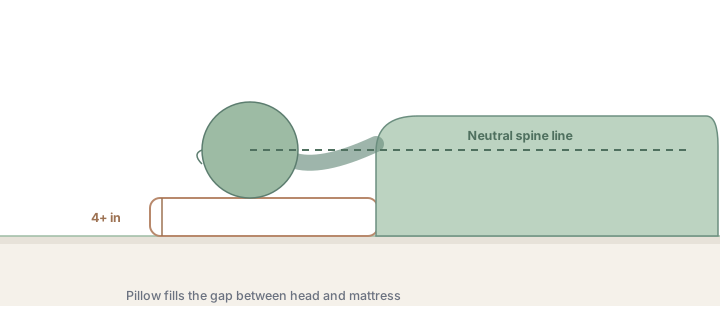
- Alignment rule: the pillow should keep your neck parallel to the mattress, rather than bent down or up.
- Mattress matters: on a firmer mattress your shoulder won't sink much, so the pillow has to fill a larger gap. On a pillow-top or memory foam topper, you need a thinner pillow.
- Shape: he says cervical contour pillows work best for most people.
- Fill: feather pillows cause the most neck pain, because they don't provide much neck stability.
- Materials: natural latex offers support without heating you up like memory foam, but if you're allergic to latex, use memory foam.
In a separate Cleveland Clinic article with Dr. Bang on sleeping positions for pain, the advice adds that your pillow should be thick enough to support your head and neck without letting it droop down, and that you should train yourself to sleep on both sides and switch regularly.
Two other Cleveland Clinic clinicians cover the rest of the body. Physician Geraldine Dapul recommends starting out on your side with a pillow between your legs, avoiding a sore shoulder if you have one. Physical therapist Kelly Kinsey suggests that side sleepers with a rotator cuff injury sleep with the injured shoulder up and rest the arm on a pillow wall in front of them.
Harvard Health: firmer, taller under the neck, and a straight spine
Harvard Health Publishing's advice is short and specific. Its neck pain article tells side sleepers to keep the spine straight by using a pillow that is higher under your neck than your head, and warns against a pillow that is too high or stiff, which keeps the neck flexed overnight and can cause morning pain and stiffness.
In a second article, physical therapist Matthew O'Rourke of Spaulding Rehabilitation Hospital is quoted on the bigger picture: “Try to get the spine in a relatively straight position. But everyone's recipe will be a little different.” The same article says side sleepers need a firm pillow for support, and that rectangular pillows with panels on the side may help because they are taller than standard pillows.
It also explains what goes wrong with a soft pillow: if it doesn't support the neck, your head has to extend sideways to meet it.
Harvard is also the source most careful about limits. It says the benefits of pillows don't go much further than comfort and positioning, and that a pillow won't eliminate problems such as sleep apnea, even though some pillows are marketed that way.
Johns Hopkins and Mayo Clinic on support and alignment
The Johns Hopkins sleep-position guide, medically reviewed by sleep neurologist Rachel Salas, M.D., treats firmness as personal: “Choosing soft-versus-hard is just a matter of preference, but aim for something supportive.” It adds that if you have neck or shoulder pain, a supportive pillow designed to cradle the neck could be helpful, and that a bolster or pillow supporting the legs could ease lower back pain.
Mayo Clinic's staff-written page keeps to the goal rather than the product: your pillow should keep your neck in alignment with your chest and back. For side sleepers with back pain, it suggests drawing your legs up slightly and putting a pillow between them, or using a full-length body pillow if you prefer.
Note what these two sources leave out. Neither gives a height in inches, names a fill, or ranks pillow types. Their advice is about the outcome, a neutral neck and supported hips, and leaves the product to you.
Do contour pillows have clinical backing?
This is the main point where clinician opinion and trial evidence pull apart.
Dr. Bang's view is that cervical contour pillows work best for most people. The trials are less certain. In a randomized study of 106 side sleepers, the authors found no evidence that a foam contour pillow has advantages over the regular shaped pillows. A blinded lab trial found contour and regular foam shapes produced similar spinal slopes in side lying.
The trials do agree with clinicians on feathers. The same research group found that a feather pillow performed least well for waking symptoms, while the latex pillow performed best. A 2021 meta-analysis favored rubber (latex) pillows for reducing neck pain, but a 2025 review of chronic neck pain found no particular type clearly superior.
So a contour pillow is a reasonable option that one clinician favors, not a proven upgrade. Our cervical pillow guide walks through who it suits and who it doesn't.
Sleep Foundation's height numbers, and who reviewed them
None of the medical-center pages gives a pillow height in inches. The most-cited numbers come from Sleep Foundation, an editorial site whose side-sleeper and neck pain guides list a medical reviewer.
Its side-sleeper guide, medically reviewed by physical therapist Jenny Iyo, DPT, says side sleepers usually need a medium to high loft, which usually means at least 4 inches, possibly over 6 inches for broad shoulders. It adds that mid-level firmness is usually the best choice for side sleepers. Its neck pain guide, reviewed by the same clinician, gives a different range: 3 to 5 inches for side and back sleepers.
Its side-sleeping page, reviewed by sleep physician Brandon R. Peters, MD, explains the reason: since the shoulders raise the head further from the bed, side sleepers usually do best with a thicker pillow.
The research itself doesn't settle on one number. A 2021 review of pillow-height studies concluded there remain no firm conclusions about the optimal pillow height for the side position. Use the inch figures as a starting range, then adjust for your shoulders and mattress.
10 checks that turn clinician advice into a shopping list
Here is the guidance above as a checklist. Each item names its source.
- Height fills the shoulder gap. Your neck stays parallel to the mattress, not bent up or down (Cleveland Clinic).
- Start around 4 inches, more for broad shoulders. Sleep Foundation's guidance; its neck pain page says 3 to 5.
- Adjust for your mattress. Firm mattress, taller pillow; pillow-top or topper, thinner pillow (Cleveland Clinic).
- Firm enough not to collapse. Harvard says side sleepers need a firm pillow; Johns Hopkins says supportive, with softness a matter of taste.
- Not too high or stiff. A pillow that flexes your neck can cause morning stiffness (Harvard).
- Higher under the neck than the head. Harvard's shape advice; a contour pillow is one way to get it.
- Skip feathers if your neck hurts. Both Dr. Bang and the side-sleeper trials rank feather pillows worst.
- Choose memory foam if you're allergic to latex (Cleveland Clinic).
- Add a pillow between your knees. Mayo Clinic, Cleveland Clinic and Sleep Foundation all suggest it for hip and spine alignment.
- Unsure of your height? Go adjustable. Sleep Foundation suggests adjustable pillows when you don't know what loft you need.
For products that match this list, see our pages on the best pillow for side sleepers with neck pain, the best adjustable pillow for side sleepers and the best knee pillow for side sleepers. If your shoulder is the problem, start with our shoulder pain page.
Sukie's take
I went into this looking for the pillow doctors pick and came out with a list of tests instead. That turned out to be more useful: every source agreed on a straight neck, enough height for the shoulder, and support that doesn't collapse. Brands came and went in the product listings; none of the clinicians named one.
What doctors say: common questions
Is there a specific pillow brand doctors recommend for side sleepers?
Not among the medical sources I read. Mayo Clinic states it does not endorse companies or products, and Cleveland Clinic's Dr. Bang says there isn't one type of pillow that will satisfy everyone. Clinicians describe what a pillow should do, not which brand to buy.
Do chiropractors recommend contour pillows for side sleepers?
One prominent example does: Cleveland Clinic chiropractor Andrew Bang says cervical contour pillows work best for most people. A 2009 trial in 106 side sleepers, though, found no advantage for a foam contour pillow over regular shapes.
What firmness do clinicians suggest for side sleepers?
Harvard Health says side sleepers need a firm pillow for support. Johns Hopkins says soft versus hard is a matter of preference, as long as it is supportive. Sleep Foundation says mid-level firmness is usually best. The common thread: firm enough that your head doesn't sink and your neck doesn't bend.
How high do doctors say a side sleeper's pillow should be?
The medical-center pages describe the goal, a neck parallel to the mattress, rather than a number. Sleep Foundation, with a physical therapist as medical reviewer, suggests at least 4 inches for most side sleepers, or 3 to 5 inches on its neck pain page.
Do doctors say feather pillows are bad for side sleepers?
For neck pain, yes. Dr. Bang says feather pillows cause the most neck pain, and in side-sleeper trials the feather pillow performed worst for waking symptoms. That is about neck support, not allergies, where the evidence on feathers versus synthetics conflicts.
Should side sleepers use a pillow between their knees?
Several sources suggest it. Mayo Clinic says to draw your legs up slightly and put a pillow between them, Cleveland Clinic says a leg pillow keeps the upper leg from twisting the torso, and ACOG suggests one during pregnancy.
What pillows do doctors recommend for side sleepers with shoulder pain?
Cleveland Clinic physical therapist Kelly Kinsey suggests sleeping with the injured shoulder up and resting your arm on a pillow wall in front of you. Physician Geraldine Dapul says to avoid lying on a sore shoulder and notes side sleeping won't work for all shoulder pain.
Sources
- Mayo Clinic — Sleeping positions that reduce back pain (read October 2026)
- Cleveland Clinic — Is Your Pillow Giving You a Stiff Neck While You Sleep? (read October 2026)
- Cleveland Clinic — Best Sleeping Positions for Pain (read October 2026)
- Cleveland Clinic — How To Keep Sore Hips, Knees and Shoulders From Ruining Your Sleep (read October 2026)
- Cleveland Clinic — How to Relieve Rotator Cuff Pain at Night (read October 2026)
- Harvard Health — Say 'good night' to neck pain (read October 2026)
- Harvard Health — Is your pillow hurting your health? (read October 2026)
- Johns Hopkins Medicine — Choosing the Best Sleep Position (read October 2026)
- Sleep Foundation — Best Pillows for Side Sleepers in 2026 (read October 2026)
- Sleep Foundation — Best Pillows for Neck Pain in 2026 (read October 2026)
- Sleep Foundation — Side Sleeping: Which Side Should You Sleep On? (read October 2026)
- ACOG — Can I sleep on my back when I'm pregnant? (read October 2026)
- Gordon et al. — Pillow use in side sleepers (Man Ther 2009, abstract) (read October 2026)
- Gordon et al. — Does pillow type alter cervico-thoracic spinal posture when side lying? (J Multidiscip Healthc 2011) (read October 2026)
- Gordon et al. — Pillow use: cervical stiffness, headache and scapular/arm pain (J Pain Res 2010) (read October 2026)
- Chun-Yiu et al. — Pillow designs and neck pain: meta-analysis (Clin Biomech 2021, abstract) (read October 2026)
- Ghosh et al. — Pillows in chronic neck pain: systematic review (Rehabilitación 2025, abstract) (read October 2026)
- Lei et al. — Pillow height determinants and evaluation (Healthcare 2021) (read October 2026)