Best Soft Pillow for Side Sleepers: Soft Feel Without a Dropped Head
The best soft pillow for side sleepers is not the softest pillow you can find. A lot of people assume side sleeping calls for something squishy, so the shoulder and ear can sink in. The sources I read say the opposite about pure softness: a pillow that collapses under your head lets your neck bend toward the mattress. What you can have is a soft surface on top of something that holds its height. Below I explain the evidence, who can genuinely get away with a soft pillow, and five picks that give you the feel without the drop.

The soft-pillow myth, and what the sources actually say
The worry behind the myth is understandable: a firm pillow sounds uncomfortable when one side of your face rests on it all night. But the clinical sources I read describe what happens when a pillow is too soft, and it isn't comfort.
Harvard Health quotes physical therapist Matthew O'Rourke on exactly this case: “if you sleep on your side with a soft pillow that doesn't provide enough support under your neck, your head has to extend sideways to meet the pillow.” The same article says plainly that “Side sleepers need a firm pillow for support.” Cleveland Clinic makes the same point from the other direction: your pillow should be thick enough to support your head and neck “without letting it droop down.”
Not every source goes as far as Harvard. Sleep Foundation's side-sleeper guide says “Pillows with mid-level firmness are usually the best choice for side sleepers,” and Johns Hopkins says soft versus hard “is just a matter of preference,” as long as you aim for something supportive. Put together, the message is consistent: softness is fine as a feel, but the pillow has to keep its height under the weight of your head. A plush pillow that looks tall on the bed but flattens once your head is on it is the real problem.
The trials point the same way. In a field trial of side sleepers, the feather pillow, the classic soft pillow, “performed least well, producing the highest frequency of waking symptoms,” while latex performed best (Gordon et al., J Pain Res 2010). That doesn't make all soft pillows bad, but it does mean the classic soft fill had the weakest record in that side-sleeper trial.
Soft pillows: our 5 picks
#1 · Best soft pillow overall
Coop Home Goods Eden Adjustable
Coop sells the Eden as medium-soft: gel-infused memory foam and microfiber in a gusseted case, listed at 8 inches with an extra bag of fill. The squish is real, but you control the height by adding or removing fill, which is exactly what a side sleeper who likes soft needs. Amazon's summary of buyer reviews praises how easy it is to adjust; the cooling effect gets mixed feedback.
- Type
- Adjustable shredded foam
- Height
- 8 in listed; adjustable
- Fill
- Gel-infused memory foam + microfiber
- Price band
- Premium
#2 · Best soft feel with a firmer core
Casper Original Pillow
A pillow-within-a-pillow: a firmer inner core inside a softer outer layer, in a cotton percale cover, listed as medium-soft and mid-loft (9 inches uncompressed, per the brand). The idea is a soft feel against your face with a firmer core for structure. Amazon's summary of buyer reviews says support for side sleepers is mixed, so it suits average frames better than broad shoulders.
- Type
- Pillow-in-pillow microfiber
- Height
- Mid-loft; 9 in uncompressed (brand)
- Fill
- Microfiber (inner pillow + outer layer)
- Price band
- Mid-range
#3 · Best soft contour pillow
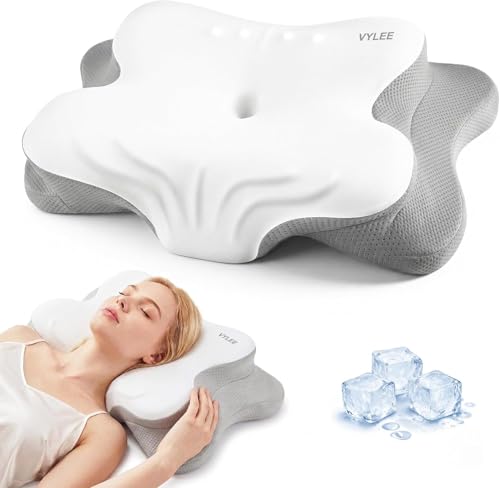
VYLEE Cervical Neck Pillow
Contour pillows are usually molded foam blocks. The VYLEE listing calls this one “soft but supportive,” with two edge heights, 3.9 and 4.9 inches, so you can choose the higher neck roll for average shoulders or the lower one for a smaller frame. Some buyers mention lumpiness, and you can't adjust beyond the two edges.
- Type
- Contour cervical (dual height)
- Height
- 3.9 in / 4.9 in (two edges)
- Fill
- Memory foam
- Price band
- Mid-range
#4 · Best plush hotel-style pair
Beckham Hotel Collection (2-pack)
Two down-alternative pillows in cotton covers, listed at 8 inches and plush (the listing says 1,050g of hollow-fiber fill). That tall starting height gives a side sleeper some room before the fiber compresses. Amazon's summary of buyer reviews calls them luxurious and huggable but reports flattening over time and mixed views on support.
- Type
- Down alternative (gel fiber)
- Height
- 8 in (plush, listed)
- Fill
- Down alternative
- Price band
- Budget
#5 · Best soft budget pair for smaller frames
Bedsure Down Alternative Pillows (2-pack)
A soft down-alternative pair listed at 5.2 inches with OEKO-TEX STANDARD 100 certification. The lower, softer build suits petite side sleepers or anyone on a plush mattress. Buyers report flattening and mixed quality, so treat it as a short-lifespan pillow.
- Type
- Down alternative
- Height
- 5.2 in listed
- Fill
- Down alternative
- Price band
- Budget




We earn a commission if you buy through these links, at no extra cost to you. As an Amazon Associate we earn from qualifying purchases. Prices and availability are shown on Amazon and can change.
Who can still get away with a soft pillow
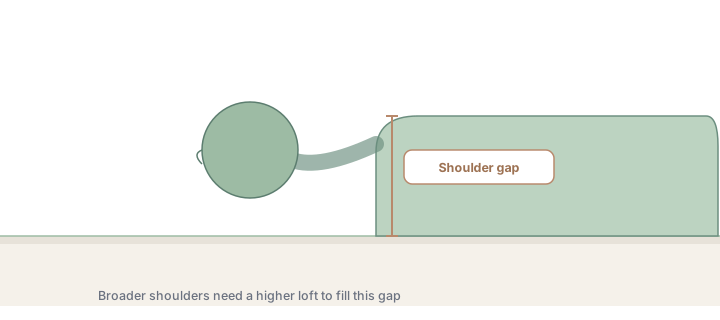
A soft pillow works when the gap between your shoulder and your head is small to begin with. Sleep Foundation's measuring principle is to choose a loft that “matches the distance between your neck and your shoulder,” and a few situations shrink that distance.
The first is a smaller frame. Sleep Foundation's height guidance scales with shoulder width: at least 4 inches for most side sleepers and over 6 inches for broad shoulders. If your shoulders are narrow, a soft pillow that compresses to the low end of that range may still keep your neck level.
The second is a soft mattress. Cleveland Clinic's chiropractor Andrew Bang, DC, says that with a memory foam topper or a pillow-top mattress “you'll need a thinner pillow because your shoulder will sink into the bed” (Cleveland Clinic). Sleep Foundation goes further: if you sink deeply into your bed, “even a 4-inch loft is too high.” On a plush bed, a soft pillow may be the right height, not a compromise.
The third is a side sleeper who also spends time on their stomach. Sleep Foundation's neck-pain page suggests a pillow of 3 inches or less for stomach sleepers, so a soft, squashable pillow can serve both positions. Our side and stomach sleeper guide covers that combination in detail.
If none of these describes you, and especially if you have broad shoulders on a firm mattress, a soft pillow may well let your head drop. Our broad-shoulder guide and firm pillow guide are better starting points.
Soft vs supportive: why you don't have to choose
Softness describes how a pillow feels when your cheek first touches it. Support describes how much height is left once your head has settled. A few designs separate the two, and they're the ones I'd look at if you love a soft pillow.
Gusseted pillows have a fabric side wall, which makes them taller and boxier than standard pillows. Harvard notes that rectangular pillows with panels on the side may help side sleepers: “they're taller than standard pillows.” The Coop Eden is gusseted, so its soft fill sits in a shape that keeps its edges up near your shoulder.
Adjustable pillows let you choose softness and height separately. With the Eden, you can keep it fuller for height and still get the medium-soft feel of its gel-infused foam and microfiber mix, rather than having to flatten it to make it softer. Our adjustable pillow guide explains how the fills differ.
Pillow-in-pillow designs, like the Casper Original, wrap a softer outer layer around a firmer inner core. Softer contour pillows, like the VYLEE, give you a defined neck roll with a feel the listing describes as soft but supportive. Both aim for the same thing: a gentle surface over a height that doesn't disappear.
A note on warranties and trials, since a soft pillow is partly a matter of taste and you may not know until you've slept on it for a while. The Coop brand site lists a 100-night trial and a 5-year warranty for the Eden, and Casper's brand site lists a full refund within 30 days of delivery plus a 1-year limited warranty. The VYLEE listing states a 12-month manufacturer warranty, and Beckham's brand site lists a 30-night trial. The Bedsure listing doesn't state either, so check the return window when you order.
Plush fiber pillows flatten: here's what that means for you
Down-alternative and polyester fiber is what makes most hotel-style pillows soft and light. It is also prone to losing height, and Sleep Foundation counts polyester among the least durable fills. Amazon's summary of buyer reviews reports flattening as the main complaint for both the Beckham and Bedsure pairs, and Sleep Foundation's replacement guidance says down-alternative pillows tend to last about 1 to 2 years and polyester pillows 6 months to 2 years, compared with 2 to 3 years for memory foam (Sleep Foundation).
That doesn't rule them out. It means you should match the starting height to your frame and expect to replace them sooner. The Beckham's listed 8 inches gives you a margin to lose; the Bedsure's 5.2 inches suits a smaller frame from day one. Both are easy to care for: Sleep Foundation says down-alternative and polyester pillows can be machine washed on a gentle cycle with mild detergent. Our Beckham Hotel Collection review looks at the trade-offs of that pillow in more depth.
Real down and feather pillows are another soft option, but I didn't include one here. In side-sleeper research, a 106-person study concluded “Feather pillows should not be recommended,” and Harvard says feather pillows “collapse over time” and should be replaced every year or so.
Which soft pillow should you pick?
If you want one soft pillow that works for most side sleepers, I'd choose the Coop Eden, because its adjustable fill lets you keep the height your neck needs while getting the medium-soft feel you're after. If you dislike foam altogether, the Casper Original's firmer-core design is the fiber alternative. If neck support is your main concern but rigid foam feels harsh, look at the VYLEE's softer contour. And if you are petite or sleep on a plush mattress or topper, a soft fiber pair such as the Bedsure or Beckham may be all you need.
Whichever you choose, judge it by your neck, not the first touch. A pillow that feels like a cloud but leaves your head tilted down will cost you more comfort over a night than it gives you at lights-out. For the full reasoning on height, firmness, shape and fill, see our guide to what kind of pillow a side sleeper should use. You can compare every pillow we cover on our side sleeper pillow shop page, or head back to our main guide to the best pillow for side sleepers and use the fit finder at the top.
Sukie's take
Reading the sources changed how I think about soft pillows. The goal isn't to give up softness, it's to stop softness from costing you height. A gusseted or adjustable pillow gets you both.
Soft: common questions
Are soft pillows bad for side sleepers?
Not always, but very soft pillows often let the head drop. Harvard Health warns that with a soft pillow that doesn't support the neck, a side sleeper's “head has to extend sideways to meet the pillow.” A soft surface over a pillow that holds its height is a better choice than a pillow that is soft all the way through.
What firmness should a side sleeper's pillow be?
Sources differ slightly. Harvard says side sleepers need a firm pillow, Sleep Foundation says mid-level firmness is usually best, and Johns Hopkins calls soft versus hard a matter of preference as long as the pillow is supportive. All three agree that support matters.
Is the best soft pillow for side sleepers different for petite people?
Yes. A narrower shoulder leaves a smaller gap between head and mattress, so a soft, lower pillow is more likely to keep a petite side sleeper's neck level. The Bedsure pair (5.2 in listed) or the VYLEE's lower 3.9 in edge are examples of lower options.
Sources
- Harvard Health — Is your pillow hurting your health? (read October 2026)
- Harvard Health — Say “good night” to neck pain (read October 2026)
- Sleep Foundation — Best Pillows for Side Sleepers in 2026 (read October 2026)
- Sleep Foundation — Best Pillows for Neck Pain in 2026 (read October 2026)
- Sleep Foundation — Best Sleeping Positions (read October 2026)
- Sleep Foundation — How Often Should You Replace Your Pillows? (read October 2026)
- Cleveland Clinic — Is Your Pillow Giving You a Stiff Neck While You Sleep? (read October 2026)
- Cleveland Clinic — Best Sleeping Positions for Pain (read October 2026)
- Johns Hopkins Medicine — Choosing the Best Sleep Position (read October 2026)
- Gordon et al. — Pillow use: cervical stiffness, headache and scapular/arm pain (J Pain Res 2010) (read October 2026)
- Gordon et al. — Pillow use in side sleepers (Man Ther 2009) (read October 2026)
- Coop Home Goods Eden Adjustable — Amazon listing (read October 2026)
- Casper Original Pillow — Amazon listing (read October 2026)
- VYLEE Cervical Neck Pillow — Amazon listing (read October 2026)
- Beckham Hotel Collection (2-pack) — Amazon listing (read October 2026)
- Bedsure Down Alternative Pillows (2-pack) — Amazon listing (read October 2026)