How High Should a Pillow Be for Side Sleepers? Every Source's Number, Compared
On the question of how high should a pillow be for side sleepers, the most-quoted number is 4 inches: Sleep Foundation says side sleepers usually need a pillow “at least 4 inches thick.” But a different Sleep Foundation page says 3 to 5 inches, broad shoulders may need over 6, and a sinking mattress can make even 4 too high. Clinical sources give principles rather than inches, and a 2021 research review says no optimal height has been established. I lined up what each source actually says, explain why they disagree, and show how to turn the range into a number for your own body and bed.

Every source's height guidance, side by side
I built the table on this page from the sources in our register, using their own words rather than a summary. Three things stand out when you read it top to bottom.
First, only one publisher gives inches. Every number in the table except the lab study comes from Sleep Foundation, an editorial site whose pages cited here are medically reviewed. The clinical sources, Cleveland Clinic and Harvard Health, describe what the pillow should do (keep your neck level, stay higher under the neck than the head) without saying how many inches that takes.
Second, the numbers move with your body and bed. Sleep Foundation's own side-sleeper page goes from “even a 4-inch loft is too high” for deep sinkers to “over 6 inches” for broad shoulders, on the same page.
Third, the research behind any single figure is thin. A 2021 review of pillow-height studies concluded that “there remain no firm conclusions about the optimal pillow height for the supine and lateral positions” (Lei et al., Healthcare 2021). The numbers are practical starting points, not measurements of what your neck needs.
Why the numbers don't agree
The most visible conflict is between two Sleep Foundation pages. The side-sleeper guide says side sleepers usually need “at least 4 inches,” while the neck-pain guide suggests “between 3 and 5 inches thick for side and back sleepers.”
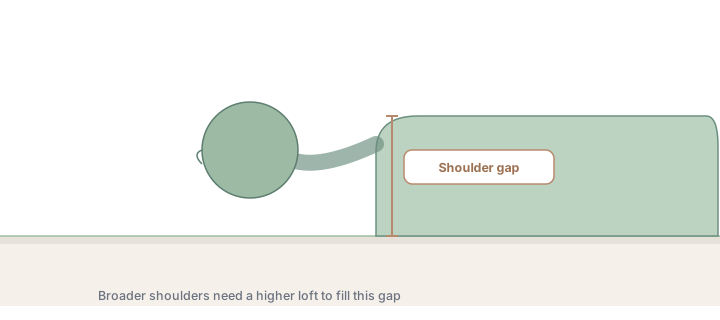
They're answering slightly different questions. The neck-pain page gives one range for two positions, and back sleepers need less height than side sleepers, because the shoulder isn't lifting the head. Sleep Foundation's side-sleeping page explains that “Since the shoulders raise the head further from the bed when side sleeping, side sleepers usually do best with a thicker pillow.” A range that also has to suit back sleepers will naturally sit lower.
The side-sleeper page also builds in its own exceptions, for broad shoulders and for deep-sinking mattresses, while the neck-pain range doesn't mention either. Read together, the two pages overlap at 4 to 5 inches. That's a sensible place for an average frame on a medium mattress to start, but it isn't a rule, and I'd rather show you both figures than quietly pick one.
3 things that set your number
Across the sources, three variables decide where you land in the range:
- Shoulder width. It's the gap your pillow fills. A 2025 side-sleeper study (9 people) found that a measure “calculated by the subject's shoulder width and absolute pillow height” predicted the curve of the neck and the individual optimal height (Tian et al., 2025, abstract). Interestingly, comfort ratings were “not sensitive” to it, so feeling comfortable doesn't prove the height is right.
- Mattress firmness. How far your shoulder sinks changes the gap. More on that below.
- How you move. Sleep Foundation's neck-pain page gives 3 inches or less for stomach sleepers, so if you spend part of the night on your stomach or back, the height that's ideal on your side will be too much there. An adjustable pillow helps here.
Pillow shape is a fourth, smaller factor: a contour pillow usually has two heights, one for the neck roll and one for the head area, so compare the neck-roll height with your gap.
Measuring at home: from neck to shoulder
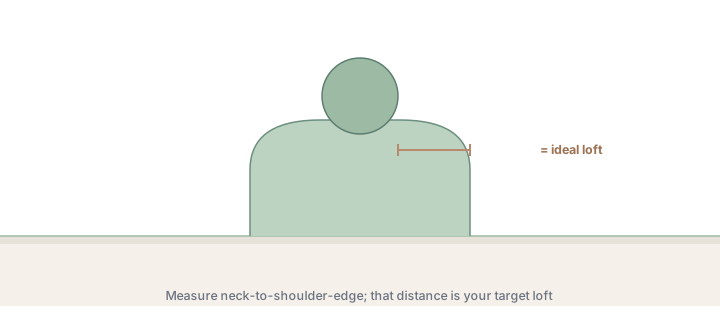
Sleep Foundation's measuring principle is simple: “Choose a pillow with a loft, or thickness, that matches the distance between your neck and your shoulder” (Sleep Foundation). Here is the home approximation I'd use, with one caveat in the next section:
- Stand straight against a wall with your shoulders relaxed.
- Have someone measure, with a tape or ruler, from the side of your neck (where a pillow would meet it) straight across to the outer edge of your shoulder.
- Write that number down in inches. That's your rough starting loft on a medium mattress.
- Adjust it for your mattress: add a little on a firm bed, take some away on a soft one or with a topper.
Remember that the number has to be the height under your head, not the height in the box. Soft and fiber pillows compress, so a pillow listed at your number may end up lower once you lie on it. The diagram on this page shows the distance the measurement captures.
Why does your mattress change the height you need?
Because the pillow fills the gap between your head and the mattress surface, and that surface moves. Cleveland Clinic's pillow article, with chiropractor Andrew Bang, DC, explains both directions:
- On a firmer mattress “you'll need a thicker pillow because your shoulder won't sink into the mattress very much.”
- With a memory foam topper or pillow-top, “you'll need a thinner pillow because your shoulder will sink into the bed.”
Sleep Foundation agrees that loft “is dependent on both the shape of your body and how much you sink into your mattress,” and notes that deep sinkers may find “even a 4-inch loft is too high.” So if you change mattresses, add a topper, or travel, expect your ideal height to change with it. That's one of the strongest arguments for an adjustable pillow, which Sleep Foundation suggests “if you are unsure what pillow loft you need.”
“If you sleep on your side, keep your spine straight by using a pillow that is higher under your neck than your head.”
Too high is a problem too
Most side sleepers err on the low side, but a pillow can also be too tall. Harvard Health warns against “too high or stiff a pillow, which keeps the neck flexed overnight and can result in morning pain and stiffness.” Cleveland Clinic's rule of thumb covers both errors: the neck should stay parallel to the mattress, “rather than bent down or up.”
The one side-lying lab study in our register shows both ends. Of three foam pillows at 5, 10 and 14 cm, the 21 adults rated the 10 cm pillow (about 3.9 inches) most comfortable compared with both the lower and the higher one, and the lowest pillow produced the most activity in the down-side middle trapezius muscle (Sacco et al., JMPT 2015, abstract). It's a small study of people without symptoms, so I wouldn't treat 10 cm as a target, but it's a useful reminder that the middle option won on both sides.
If your pillow pushes your head up toward the ceiling, remove fill from an adjustable pillow, take out the layer on a layered contour pillow, or choose a lower size.
From range to pillow: adjustable, layered or fixed
Once you have a rough number, there are three ways to buy it.
Adjustable fill lets you set the height yourself. The Coop Original and DreamyBlue are both listed at 8 inches with extra fill included, so there's room for broad shoulders and you can remove fill for a lower setting. Our adjustable pillow guide compares them, and the Coop Original review goes deeper.
Layered contour pillows give you a few fixed steps. The UTTU Sandwich covers 3.2 to 5.2 inches with its removable layer, which suits smaller frames, and the Royal Therapy is listed at 5 inches in Queen, with an Extra size at 6.5 inches. See our cervical pillow guide.
Fixed heights are fine if you already know your number. The Bluewave slim pillow comes in heights from 1.75 to 4 inches, for side sleepers on soft beds or those who also sleep on their stomach (side and stomach guide). For the tall end, see our broad-shoulder guide.
If you'd like help narrowing it down, use the fit finder at the top of our main guide to the best pillow for side sleepers. Our explainer on what kind of pillow a side sleeper should use covers firmness, shape and fill, and more explainers live in our guides.
Side sleeper pillow height: what each source says
| Source | Height guidance | Applies to | What to know |
|---|---|---|---|
| Sleep Foundation, side-sleeper guide | Medium to high loft, “at least 4 inches thick” | Side sleepers in general | Medically reviewed (Jenny Iyo, DPT); updated July 2026 |
| Sleep Foundation, side-sleeper guide | “Over 6 inches” | Side sleepers with broad shoulders | Same page; “may need,” not “must have” |
| Sleep Foundation, side-sleeper guide | “Even a 4-inch loft is too high” | People who sink deeply into the mattress | Loft depends on body shape and mattress sink |
| Sleep Foundation, neck-pain guide | 3 to 5 inches | Side and back sleepers with neck pain | Stomach sleepers: 3 inches or less; conflicts with the 4-inch minimum above |
| Sleep Foundation, sleeping positions | No number: match the neck-to-shoulder distance | Side sleepers | The measuring principle behind every number |
| Cleveland Clinic (Andrew Bang, DC) | No number: thicker on a firm mattress, thinner on a topper or pillow-top | All side sleepers | Goal: neck parallel to the mattress |
| Harvard Health | No number: “higher under your neck than your head”; avoid “too high or stiff” | Side sleepers | Describes shape as well as height |
| Sacco et al., 2015 (lab study) | 10 cm (about 3.9 in) rated most comfortable vs 5 and 14 cm | 21 adults without symptoms, lying on their side | Small study; abstract only |
| Lei et al., 2021 (research review) | No optimal height established | Back and side positions | “No firm conclusions” on optimal height |
Compiled from each source's own wording, read October 2026. Quoted phrases are verbatim; inch conversion of the 10 cm study pillow is ours.
Sukie's take
What I took from lining these sources up is that the inch figures come from one publisher and the clinical sources talk about alignment instead. I'd use 4 to 6 inches only to narrow the shelf, then let the mirror check on my own mattress make the final call.
Pillow height: common questions
How high should a pillow be for side sleepers, in inches?
Sleep Foundation's side-sleeper guide suggests at least 4 inches for most side sleepers and over 6 inches for broad shoulders. Its neck-pain page gives 3 to 5 inches for side and back sleepers. Clinical sources don't give a number; they say to keep your neck level with your spine.
Is a 4-inch pillow enough for a side sleeper?
For many people of average build on a medium mattress, it's a reasonable start, and it's the minimum Sleep Foundation's side-sleeper guide suggests. Broad shoulders or a firm mattress usually call for more. On a deep-sinking mattress, Sleep Foundation says even 4 inches can be too high.
Is a 6-inch pillow too high for a side sleeper?
Not necessarily. Sleep Foundation says broad-shouldered side sleepers may need a pillow over 6 inches. It can be too high for a smaller frame or on a soft mattress. If your head tilts up toward the ceiling when you lie on your side, it's too tall for you.
How do I measure the right pillow height for me?
Sleep Foundation's principle is to match the pillow's loft to the distance between your neck and your shoulder. At home, have someone measure from the side of your neck to the outer edge of your shoulder, then adjust for your mattress. No clinical source publishes a formal protocol, so confirm with an alignment check.
Does my mattress change how high my pillow should be?
Yes. Cleveland Clinic says a firmer mattress needs a thicker pillow because your shoulder won't sink much, while a memory foam topper or pillow-top needs a thinner one because your shoulder sinks into the bed.
What are the signs my pillow is too high?
Your head tilts up toward the ceiling when you're on your side, and you may wake with a stiff neck. Harvard Health warns that a pillow that is too high or stiff keeps the neck flexed overnight and can cause morning pain and stiffness.
What are the signs my pillow is too low?
Your head drops toward the mattress. Harvard Health says that with too little support under the neck, a side sleeper's head has to extend sideways to meet the pillow. Cleveland Clinic says the pillow should be thick enough that your head and neck don't droop down.
Should a contour pillow be higher under the neck?
That's what Harvard Health recommends for side sleepers: a pillow that is higher under your neck than your head. Contour pillows usually have two heights, so compare the taller neck-roll height with your neck-to-shoulder gap.
What pillow height works for both side and back sleeping?
Sleep Foundation's neck-pain page suggests 3 to 5 inches for side and back sleepers. Because back sleeping needs less height, an adjustable pillow set in the middle of your side-sleeping range is one practical compromise.
Sources
- Sleep Foundation — Best Pillows for Side Sleepers in 2026 (read October 2026)
- Sleep Foundation — Best Pillows for Neck Pain in 2026 (read October 2026)
- Sleep Foundation — Best Sleeping Positions (read October 2026)
- Sleep Foundation — Side Sleeping: Which Side Should You Sleep On? (read October 2026)
- Cleveland Clinic — Is Your Pillow Giving You a Stiff Neck While You Sleep? (read October 2026)
- Cleveland Clinic — Best Sleeping Positions for Pain (read October 2026)
- Harvard Health — Say “good night” to neck pain (read October 2026)
- Harvard Health — Is your pillow hurting your health? (read October 2026)
- Lei et al. — Ergonomic Consideration in Pillow Height Determinants and Evaluation (Healthcare 2021) (read October 2026)
- Sacco et al. — The effect of pillow height on muscle activity (JMPT 2015) (read October 2026)
- Tian et al. — The individualized optimal pillow height and neck support design for side sleepers (Med Biol Eng Comput 2025) (read October 2026)
- Hodkinson et al. — Time to stabilisation of the cervical spine in side lying (Ergonomics 2013) (read October 2026)