Pillow to Keep You on Your Side: Body Pillow Backstops, Positional Therapy and Where a Pillow Stops
The most practical pillow to keep you on your side is a long body pillow, placed so it blocks the roll you are trying to stop: behind your back if you wake up face-up, in front of you if you drift onto your stomach. The general idea has clinical support. Cleveland Clinic says body and side pillows can improve sleep posture for habitual stomach sleepers, and Mayo Clinic suggests a full-length body pillow for side sleepers. What a pillow cannot do is treat sleep apnea. If breathing is the reason you want to stay off your back, the plan belongs to a sleep doctor, and the pillow is only a helper.

Every option, sorted by how much evidence stands behind it
The table above lists the common methods for staying on your side, next to what a named clinical source actually says about it. Reading it top to bottom, three groups appear.
The first group is pillows whose general use clinicians describe: a body pillow in front of you, a pillow between the knees, a full-length body pillow, and a pillow wall for a sore shoulder. None of those sources measured whether the pillow keeps you on your side all night. They describe it as a way to support a side position you have already chosen.
The second group is positional therapy, which is a medical plan, not a product. The American Academy of Sleep Medicine describes it in the context of sleep apnea, and a sleep doctor decides whether you need it.
The third group is everything I could not source: a pillow wedged behind your back, wedge pillows and the homemade devices you will find in forum threads. I've kept the behind-the-back setup on this page because it is the most direct answer to the question, but I label it as a practical arrangement rather than tested advice.
Staying on your side pillows: our 4 picks
#1 · Best firm backstop
Oubonun Adjustable Body Pillow
Listed at 54 x 21 x 10 inches with firm polyester fill; the listing says you can add or remove fill to set height and firmness. It is the only body pillow in our catalogue with a stated height. My reasoning for putting a firm one first: a barrier only works if it keeps its bulk, and I'd expect a soft tube to flatten when you lean back into it. Amazon's summary of buyer reviews praises its support for side sleeping, is mixed on durability, and notes that some find it too big.
- Type
- Body pillow (adjustable fiber)
- Height
- 10 in tall
- Fill
- Polyester fiber (adjustable)
- Price band
- Budget
#2 · Best adjustable foam body pillow
Coop Home Goods Adjustable Body Pillow
A 20 x 54 inch body pillow filled with cross-cut memory foam and microfiber that you can add to or take out. The foam is CertiPUR-US certified and the pillow GREENGUARD Gold, and Coop's site lists a 100-night trial and a 5-year warranty. Amazon's buyer summary is mixed on its weight, with some finding it heavy to move, and reports an unpleasant smell.
- Type
- Body pillow (adjustable foam)
- Height
- Not stated
- Fill
- Cross-cut memory foam + microfiber
- Price band
- Mid-range
#3 · Cheapest way to try the setup
Utopia Bedding Full Body Pillow
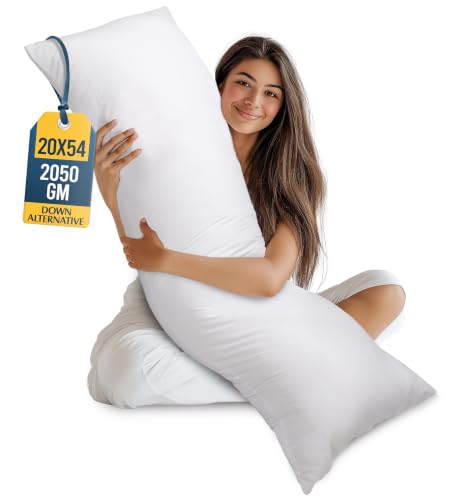
A plain 20 x 54 inch polyester-fiber body pillow, soft and not adjustable, with OEKO-TEX STANDARD 100 on the listing. Amazon's buyer summary praises its support for the arm and shoulder and the knees and hips, calls it suitable for side sleepers and pregnancy, and says some find it too big. It is a low-cost way to find out whether a pillow behind or in front of you helps before you spend more.
- Type
- Body pillow (fiber)
- Height
- Not stated
- Fill
- Polyester fiber
- Price band
- Budget
#4 · Add-on for the knees
Everlasting Comfort Memory Foam Knee Pillow
A 10.5-inch-tall memory foam knee pillow that buyers say stays in place through the night, with a lifetime replacement policy on the listing. It will not stop a roll on its own, but it holds the bent-knee position Mayo Clinic suggests for side sleepers, which in my view makes the side a more comfortable place to stay.
- Type
- Knee pillow (memory foam, strap)
- Height
- 10.5 in tall
- Fill
- Memory foam
- Price band
- Budget



We earn a commission if you buy through these links, at no extra cost to you. As an Amazon Associate we earn from qualifying purchases. Prices and availability are shown on Amazon and can change.
Why you end up on your back anyway
Moving in your sleep is normal. In a study of 664 working adults who wore motion sensors to bed, people changed position on average 1.6 times per hour (Skarpsno et al., Nat Sci Sleep 2017). The same study found they spent 54.1% of their time in bed on their side, 37.5% on their back and 7.3% on their front. On average, then, more than a third of time in bed was spent on the back.
So the realistic goal isn't to pin yourself in place. It's to make your side the position you settle back into after each shift, and to make the roll onto your back or stomach a little harder than the roll back onto your side. A pillow does that by taking up the space you would otherwise roll into, and by making the side position comfortable enough that you don't go looking for another one.
The second half matters as much as the first. If your head pillow is too low, your shoulder aches, or your top knee drops, your body will look for relief, and the back is usually where it finds it. Fix the side position first, then add the barrier.
Setting up a body pillow as a backstop
Here is the arrangement I would start with. It combines the placements clinicians describe with the behind-the-back barrier, which is my practical suggestion rather than a studied method:
- Head pillow first. Use a pillow that keeps your neck level. Cleveland Clinic's rule of thumb is that it should keep your neck “parallel to the mattress, rather than bent down or up.”
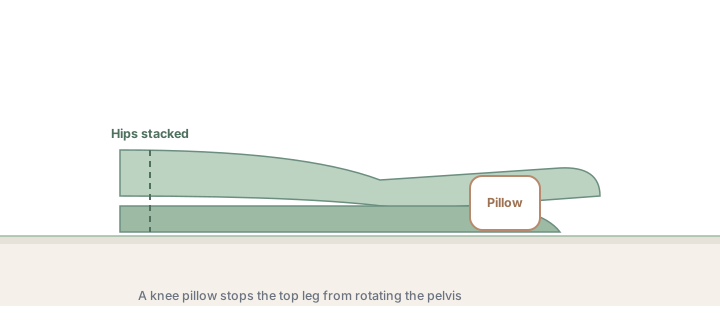
- Knees bent, pillow between them. Mayo Clinic suggests drawing your legs up slightly and putting a pillow between them.
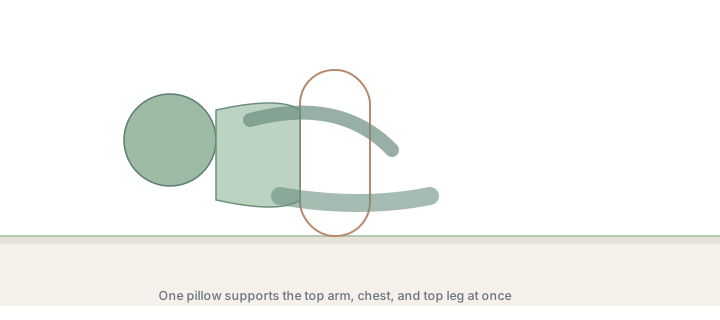
- Long pillow along your back. Lay a body pillow lengthwise behind you, pushed against your back from shoulder blades to hips, so rolling backward means rolling onto it.
- Optional pillow in front. If you also drift onto your stomach, hug a second pillow or let the knee pillow extend up to your chest.
- Pick one side to start. Cleveland Clinic advises training yourself to sleep on both sides and switching regularly, so move the backstop when you change sides on later nights.
My reasoning is that a firm pillow does this job better than a soft one: I'd expect a soft fiber tube to flatten when you lean back into it, leaving less to roll over. No source in our register tests this. That's why the Oubonun, with its firm, adjustable fill and stated 10-inch height, leads the picks on this page.
In front or behind: match the pillow to the roll you're stopping
Before you buy anything, notice which way you go. Waking up on your back and waking up on your stomach call for different setups.
If you end up face-up, the pillow belongs behind you. One full-length pillow along your back covers the whole torso. Two standard pillows laid end to end are a rougher version of the same idea, though I'd expect them to drift apart during the night.
If you end up face-down, the pillow belongs in front. This is the case Cleveland Clinic's chiropractor describes: body and side pillows can improve sleep posture for people in the habit of stomach sleeping. Hugging a body pillow puts your top arm and top knee on something solid, which, as I see it, leaves less reason to tip forward. Our guide to the best pillow for side and stomach sleepers covers the head-pillow side of that problem, because Sleep Foundation suggests a lower pillow, 3 inches or less, for stomach sleeping.
If you go both ways, use two pillows: a body pillow in front and a firm one behind. It takes up the most bed, but it boxes in the side position from both directions.
“Flexing your knees and having a pillow between your legs can help align your spine, pelvis and hips. This position takes pressure off your spine. Use a full-length body pillow if you prefer.”
Long, narrow, firm: what to look for in the pillow itself
People searching for a long narrow pillow to stop rolling over are describing a body pillow, and the useful details are on the listing:
- Length. All three body pillows in our catalogue are listed at 54 inches, long enough to run from your shoulders to past your hips when laid along your back.
- Width and height. The Utopia and Coop are listed at 20 x 54 inches, the Oubonun at 54 x 21 x 10 inches. Only the Oubonun states a height, and height is what a barrier needs.
- Firmness. The Oubonun is listed as firm, while the Utopia is soft. The Coop is listed as soft, but its fill is adjustable, and the listing says you can add fill to make it firmer.
- Adjustability. The Oubonun and Coop listings both say you can add or remove fill, so you can take some out if the pillow pushes you too far forward.
- Weight. Amazon's buyer summary for the Coop is mixed on its weight, with some noting it's heavy to move from side to side, which matters if you shift the backstop when you change sides.
Our body pillow guide compares the three on fill and feel in more depth, and our body pillow vs knee pillow comparison helps if you're unsure whether you need the full length at all.
Sharing a bed with a body pillow
A pillow behind your back sits between you and a partner, and at 20 to 21 inches wide and 54 inches long (as listed), it takes up a sizeable strip of mattress. Amazon's buyer summaries for both the Utopia and the Oubonun include people who find the pillow too big, so measure your bed space before ordering.
There are a few ways to keep the peace. Sleep on the side of the bed where your back faces the edge, so the backstop sits between you and the edge rather than between you and your partner. Or face your partner, with the body pillow behind you along the outer edge. If neither works, a knee pillow plus one standard pillow behind your back takes less room, though it gives up some coverage.
If your partner is the one asking you to stay on your side, because of snoring, read the next section before buying anything. Snoring can be more than a nuisance, and a pillow is not the whole answer.
Is positional therapy the same as a pillow?
No. The AASM's positional therapy page describes it as a strategy for a specific situation: “If your breathing is interrupted primarily when you are sleeping on your back, and normal when sleeping on your side or stomach, then your sleep doctor might recommend positional therapy for you.”
Two things in that sentence matter. First, it starts with knowing *when* your breathing is interrupted, which is something your sleep doctor works out, not something you can tell from waking up on your back. Second, it is the doctor who recommends it.
That page describes positional therapy in general terms. Our source register does not document specific positional devices or how well any of them work, so I am not going to rank or describe them here. If a sleep doctor recommends staying off your back, ask them which method they want you to use; the body pillow setup on this page is something you can raise with them, not a substitute for their advice. If you've been diagnosed with apnea and want to know which head and body pillows suit side sleeping, our shop pages cover the comfort side of that question.
Pregnancy, shoulder injury and heartburn: three reasons to stay on one side
Pregnancy. The NHS says research suggests going to sleep on your back after 28 weeks of pregnancy can increase the risk of stillbirth, and that the safest position to fall asleep in is on your side, “either left or right.” It adds: “Don't worry if you wake up on your back – just turn onto your side before going back to sleep.” ACOG suggests side sleeping in the second and third trimesters with one or both knees bent, a pillow between the knees and another under the belly, or “a full-length body pillow for support.” Your midwife or doctor should guide anything beyond that.
A painful shoulder. For side sleepers with a rotator cuff injury, Cleveland Clinic physical therapist Kelly Kinsey recommends sleeping with the injured shoulder up and building a “pillow wall” in front of you to rest your arm on, as tall as your body. As a side effect, I'd expect that wall to make a roll forward harder too. Our shoulder pain picks cover head pillows for this.
Heartburn. Johns Hopkins notes that sleeping on your right side can make heartburn worse, and suggests flipping to your left. A backstop may help you stay on the left once you're there.
When to see a clinician instead of buying another pillow
A pillow is a positioning tool. Harvard Health puts it plainly: the benefits of pillows “don't go much further than comfort and positioning.” Talk to a doctor rather than adding more pillows if:
- Someone has noticed your breathing stop or struggle while you sleep, or your snoring is loud and regular. The AASM's positional therapy guidance starts with knowing when your breathing is interrupted, and that takes a clinician.
- You are pregnant and unsure how to set up your bed. The NHS and ACOG guidance above is a starting point for that conversation.
- Shoulder or hip pain is what keeps turning you over. Cleveland Clinic's physician adds that side sleeping won't work for all shoulder pain.
For everyone else, the setup above costs little to try. Start with the firm Oubonun or a budget Utopia behind your back, add a knee pillow, and make sure your head pillow fits; our main guide to the best pillow for side sleepers has a fit finder for that. Our explainer on what pillows doctors recommend for side sleepers covers the clinical criteria, the side sleeper pillow shop lists every pillow we cover, and more explainers live in our guides.
Ways to stay on your side, and what our sources say about each
| Method | How it is meant to work | What the sources say | Who it suits |
|---|---|---|---|
| Body pillow in front of you | Gives you something to lean into so you settle on your side instead of rolling face-down | Cleveland Clinic (Andrew Bang, DC): body and side pillows can improve sleep posture for habitual stomach sleepers | Side sleepers who drift onto their stomach |
| Body pillow behind your back | Puts bulk behind you that a roll onto your back has to climb over | No source in our register tests this placement; it is a practical arrangement, not studied advice | People who keep waking up on their back |
| Pillow between the knees | Keeps the top leg from pulling forward and twisting the torso | Mayo Clinic and Cleveland Clinic recommend it for spine and hip alignment, not as a way to stop rolling | Side sleepers with back or hip discomfort |
| Full-length body pillow, hugged | Supports the top arm and top knee in one piece | Mayo Clinic: “Use a full-length body pillow if you prefer.” ACOG suggests trying one in pregnancy | Pregnancy, or anyone who wants one pillow instead of several |
| “Pillow wall” in front of you | A shelf for the top arm so an injured shoulder stays up | Cleveland Clinic PT Kelly Kinsey, for rotator cuff injuries: the wall should be the height of your body | Side sleepers with a painful shoulder |
| Positional therapy | A treatment plan for breathing problems that happen mainly on the back | AASM: a sleep doctor might recommend it when breathing is interrupted mainly on your back and normal on your side or stomach | People with diagnosed or suspected positional sleep apnea |
| Wedge pillows | Varies by product | Our register has no source on wedges for keeping you on your side | Not assessed here |
| Homemade devices | Varies | Not covered by any source in our register | Not assessed here |
Compiled from Cleveland Clinic, Mayo Clinic, ACOG and the American Academy of Sleep Medicine, read October 2026. “Not assessed” means we found no qualifying source, not that the method fails.
Sukie's take
If I kept waking up on my back, I'd try the cheapest version first: a firm body pillow along my back and a knee pillow, for a couple of weeks. But if the reason is snoring a partner has noticed, I'd book the doctor's appointment before buying anything, because a pillow can only help with position.
Staying on your side: common questions
Can a pillow stop me rolling onto my back?
It can make the roll harder, not impossible. People change position about 1.6 times an hour on average, so a firm body pillow along your back works by giving you something to roll against and making the side the easier place to settle. No source in our register has measured how well this works.
Will sleeping on my side with a body pillow fix my sleep apnea?
No. Harvard Health says a pillow won't eliminate sleep apnea, even though some are marketed that way. The American Academy of Sleep Medicine describes positional therapy as something a sleep doctor might recommend when breathing is interrupted mainly on your back. Speak to a doctor first.
Sources
- American Academy of Sleep Medicine — Positional Therapy (Sleep Education) (read October 2026)
- American Academy of Sleep Medicine — Snoring (Sleep Education) (read October 2026)
- Duce et al. — Community prevalence of positional obstructive sleep apnea (J Clin Sleep Med 2025) (read October 2026)
- Johns Hopkins Medicine — Choosing the Best Sleep Position (read October 2026)
- Harvard Health — Is your pillow hurting your health? (read October 2026)
- Cleveland Clinic — Is Your Pillow Giving You a Stiff Neck While You Sleep? (read October 2026)
- Cleveland Clinic — Best Sleeping Positions for Pain (read October 2026)
- Cleveland Clinic — How to Relieve Rotator Cuff Pain at Night (read October 2026)
- Cleveland Clinic — How To Keep Sore Hips, Knees and Shoulders From Ruining Your Sleep (read October 2026)
- Mayo Clinic — Sleeping positions that reduce back pain (read October 2026)
- Skarpsno et al. — Sleep positions and nocturnal body movements (Nat Sci Sleep 2017) (read October 2026)
- NHS — Stillbirth: Preventing stillbirth (read October 2026)
- ACOG — Can I sleep on my back when I'm pregnant? (read October 2026)
- Oubonun Adjustable Body Pillow — Amazon listing (read October 2026)
- Coop Home Goods Adjustable Body Pillow — Amazon listing (read October 2026)
- Coop Home Goods — body pillow product page (read October 2026)
- Utopia Bedding Full Body Pillow — Amazon listing (read October 2026)
- Everlasting Comfort Memory Foam Knee Pillow — Amazon listing (read October 2026)