Best Down Alternative Pillows for Side Sleepers: 4 Picks and the Height Catch
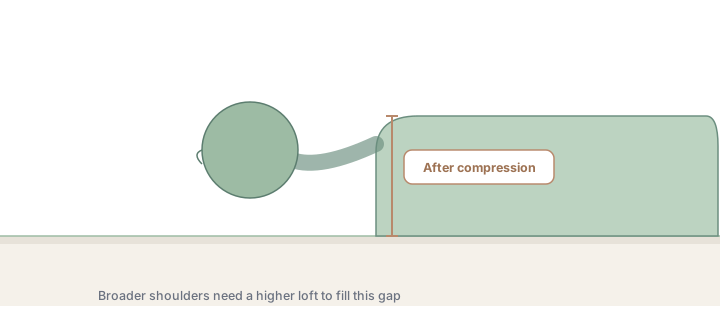
The best down alternative pillows for side sleepers are bought for height and structure before softness, and the Casper Original is the place to start. You've ruled out real down, over an allergy worry, an objection to animal products, a pillow you can't wash or the cost, and now you're scrolling and every listing shows the same white rectangle. You sleep on your side, so the photos are hiding the one thing you need to know: how much of that height survives once your head is on it. Sleep Foundation says down alternative is “known to compress significantly under the sleeper’s head.” Below are four pillows from our catalogue, sorted by the differences that matter here, including a care instruction that rules one of them out if washing was your reason for buying.

Which one should you buy?
Match the pillow to your situation rather than to the softest description. These rules come from the listed specs and the loft guidance later on this page. They're reasoning from documents, because this site doesn't test pillows by hand.
- Average frame, medium mattress, one pillow: the Casper Original, for the inner-pillow build.
- Broad shoulders or a firm mattress: the Beckham pair is the tall option here, but read the catch below first. Our broad-shoulder guide covers pillows built for that gap.
- You want a gusseted edge: the Utopia pair, if spot cleaning is acceptable. That it keeps its shape is the seller's claim.
- Smaller frame, soft mattress or a topper: the Bedsure pair. See also our petite side sleeper guide.
- Machine washing is the point: Casper, Beckham or Bedsure, never Utopia.
- Filling a guest room: Bedsure and Utopia both sell queen and king 4-packs.
- Neck pain: look elsewhere first. Sleep Foundation says down alternative pillows “may not be suitable for people with neck pain,” and our neck-pain guide is a better start.
All four are the best down alternative pillows in our catalogue, which is a narrow claim. Sleep Foundation's list leads with brands such as Saatva and Brooklinen. Those aren't sold through this catalogue, so nothing here is compared with them. If you're open to any fill, our main guide to the best pillow for side sleepers has the fit finder, and if softness is the priority, start with the soft pillow guide.
Down alternative pillows: our 4 picks
#1 · Best inner-pillow build
Casper Original Pillow
The listing describes a supportive inner pillow inside a softer outer pillow, and Casper's site gives a Mid-Loft of 9 inches uncompressed with a 2-inch gusset. My reasoning, not a tested finding, is that a separate core gives the fiber something to hold it up. It's sold singly in Standard, and the inner pillow can come out for washing or for a lower loft. Amazon's buyer summary is mixed, with some calling it too firm and short on support for side sleepers.
- Type
- Pillow-in-pillow microfiber
- Height
- Mid-loft; 9 in uncompressed (brand)
- Fill
- Microfiber (inner pillow + outer layer)
- Price band
- Mid-range
#2 · Best tall two-pack
Beckham Hotel Collection (2-pack)
The listing gives a plush 8-inch loft from hollow-fiber fill in a cotton cover, the tallest listed height among the three pairs here, so it has the most to lose before it drops below Sleep Foundation's 4-inch guide. The seams are sewn shut, so you can't add fill. Amazon's buyer summary reports buyers saying they go completely flat quickly, and our Beckham review covers its conflicting specs.
- Type
- Down alternative (hollow fiber)
- Height
- 8 in (plush, listed)
- Fill
- Down alternative
- Price band
- Budget
#3 · Best gusseted pair
Utopia Bedding Gusseted Pillow (2-pack)
Sleep Foundation says a gusseted edge may help with compression, and this is the gusseted pair in our catalogue, listed at 5 inches. The listing's claim that the gusset maintains loft over time is the seller's, and Amazon's buyer summary says the pillows become extremely flat over time. Its care instruction is spot clean, so skip it if washing is your reason for leaving down.
- Type
- Gusseted fiber pillow
- Height
- 5 in listed
- Fill
- Fiber fill, "plush" (fiber type not stated)
- Price band
- Budget
#4 · Best soft pair for smaller frames
Bedsure Down Alternative Pillows (2-pack)
Listed at 5.2 inches and described as soft, this suits a narrower shoulder gap or a soft mattress more than a broad frame. It comes in 2-pack and 4-pack sets, and the listing says to machine wash it cold and tumble dry low. Amazon's buyer summary is split on support, with some reporting no support at all.
- Type
- Down alternative
- Height
- 5.2 in listed
- Fill
- Down alternative
- Price band
- Budget


We earn a commission if you buy through these links, at no extra cost to you. As an Amazon Associate we earn from qualifying purchases. Prices and availability are shown on Amazon and can change.
Listed height, gusset and inner pillow compared
Comparing the best down alternative pillows means reading specs that don't always agree. Here is what each listing or brand page actually says, read October 2026, with the disagreements left in.
- Casper Original: Casper's site gives 9 inches uncompressed. Amazon's thickness field says 2 inches, which matches the 2-inch gusset on Casper's site, so it looks like a gusset measurement rather than a pillow height. That's my inference. The fill is polyester microfiber, the cover cotton, and firmness reads medium-soft in a bullet and medium in the attribute field.
- Beckham Hotel Collection: a plush 8-inch loft in the bullets. Firmness conflicts within the listing: “medium-firm” in a bullet, “Plush” in the attribute field.
- Bedsure: 5.2 inches, soft, with a polyester fabric field. Queen is 28 x 19 inches.
- Utopia Bedding: 5 inches, plush, polycotton cover. The fill field says only “plush,” so the fiber isn't named. Queen is listed at 26 x 18 inches, smaller than the other queens, so check your pillowcases.
Listed weight is a rough clue to how much fill you're getting, with the warning that these fields can be unreliable. Amazon lists the Casper at 3.5 pounds for one pillow, and the Bedsure and Utopia at 4 pounds for two. The Beckham is listed at 1.8 kg for two, while its bullets mention 1,050 grams of fill without saying whether that's per pillow.
Three of the four have no adjustment: Beckham and Bedsure list sewn seams, and Utopia describes no way in. The Casper has one narrow option. Casper's site says you can “remove the inside if you prefer a low loft,” which gives a lower setting and no way to add height. If you want control, Sleep Foundation suggests buying “a down alternative pillow with extra filling,” and our adjustable pillow guide covers that route.

Allergies: where the sources split
Nobody can honestly promise that down alternative is better for allergies, because the sources conflict. If allergy is your reason for shopping, here is what each one says.
- For synthetic: NIEHS advises you to “Replace wool or feathered bedding products with synthetic materials.” Sleep Foundation's down alternative guide calls it “an allergy-free option for people who suffer from allergies to animal dander.”
- Against synthetic: a 12-month study of paired pillows found “Synthetic pillows accumulate Der p 1 more rapidly than feather pillows” (Rains et al., 1999, abstract; Der p 1 is a mite allergen). Harvard Health says synthetic cotton makes “a more attractive climate for dust mites,” and a culture study of 10 used pillows found a higher number of fungal species “from synthetic pillows” (Woodcock et al., 2006, abstract).
- Is it the feathers at all? In 269 adults referred to a Finnish university clinic, “A clinically significant feather allergy was found in one patient only,” and the authors concluded that most positive feather skin tests “are probably caused by mite allergens present in feathers” (Kilpiö et al., 1998, abstract). That's one older clinic study of feather extracts, so it's a reason to ask, not a verdict.
The practical reading is that switching fill removes the animal material, but it may not remove mites, which are what several of these sources are measuring. If a clinician has told you to avoid down or feathers, follow that. If you're guessing at the cause, an allergist can tell you what you're reacting to before you spend anything.
These steps apply to any fill. NIEHS advises encasing pillows in “dust-proof or allergen impermeable covers” and keeping humidity at or below 50 percent. Expect modest results: Cleveland Clinic reports that such covers reduced exposure, yet “allergy symptoms didn’t significantly improve for participants.”
Bedsure's attribute field says “Hypoallergenic.” That's seller wording, and the listing cites no test.
Washing: same category, different instructions
Check this before you buy, since even the best down alternative pillows don't share one care routine. Sleep Foundation's guide warns that some of these pillows “may be dry-clean or spot-clean only.” Each listing, read October 2026, says:
- Bedsure: “Machine washable in cold water and tumble dry low.” The attribute field adds do not bleach.
- Beckham: machine wash and air dry.
- Casper: separate the inner and outer pillows, rezip the outer one, machine wash, run the rinse cycle twice, tumble dry low with dryer balls, and make sure both are completely dry before reassembling. It suggests washing every 3 to 6 months.
- Utopia Bedding: spot clean. That's the only care instruction given in the listing.
There's a conflict here for anyone washing to control dust mites. NIEHS says to wash bedding weekly in water at “130 to 140 degrees Fahrenheit,” while Sleep Foundation's replacement page says down alternative pillows take cold water every 3 to 6 months, and Bedsure's listing also says cold. No listing here approves hot water, so follow the tag on the pillow you receive. A washable encasement and pillowcase can take the hot weekly cycle instead, if their own labels allow it. NIEHS also says non-washable bedding “can be frozen overnight.”
Whatever the fill, dry it fully before you sleep on it. Sleep Foundation says to use “the lowest heat options over multiple cycles” in a dryer.
How to tell if the pillow still holds you up
Run this check in the first days, then repeat it every few months, because the answer changes as fiber settles.
- Measure the distance from your neck to your shoulder. Sleep Foundation says loft should match it, and our pillow height guide explains the method and its limits.
- Lie on your side on your usual mattress. Your shoulder sinks further into a soft bed or topper, so you need less height there and more on a firm one.
- Give it time before you judge. In a lab study of 24 women lying on their side, “70.8% of participants had stabilised by 15 min or earlier” (Hodkinson et al., 2013, abstract).
- Have someone look from behind, or take a photo. Cleveland Clinic says your neck should stay parallel to the mattress, “rather than bent down or up.”
- If your head droops, the pillow has compressed too far for you. Try fluffing it, then add support or move to something taller.
- Fold the pillow in half. Sleep Foundation gives this test for down and feather pillows: replace one that doesn't spring back. Borrowing it for fiber is my suggestion, not the source's.
Expect a short life. Sleep Foundation's replacement page says down alternative pillows last “approximately 1 to 2 years” and polyester pillows “6 months to 2 years,” and that page has no medical reviewer. Its down alternative guide says machine-drying and fluffing “can help boost the loft for a while,” but that “eventually, the contents will flatten out.” Plan for that if you're comparing these with foam, and see what kind of pillow a side sleeper should use for the other fills.
4 label terms worth decoding
Shoppers also search for imitation down pillows, and the terms on those pages promise less than they seem to. Here is what the sources support.
- “Down alternative.” Sleep Foundation defines it as “polyester fibers, or more rarely cotton fibers, that are designed to mimic the properties of down,” and says it “does not contain any animal parts.” None of the four listings mentions a vegan certification, so if ethics is your reason, the fill field and the absence of feathers are what you have to go on. The FTC's textile labeling guide lists pillows as covered bedding, yet the words “down” and “down alternative” don't appear in it, and it says fiber disclosure isn't required for filling used only for structural purposes, adding that “if you voluntarily say or imply anything about their fiber content, the requirements of the statutes and rules apply.” It doesn't say how pillow fill is classed, so a fill field that says only “plush” tells you little. It's a reading of a business guide, not legal advice.
- “Fill power.” IDFL says it “measures the loft or insulation properties of down products.” None of these four listings gives a figure, so there's no shortcut number for comparing fiber pillows.
- “OEKO-TEX.” The Beckham, Bedsure and Utopia listings show it, and Bedsure gives certificate number 24.HCN.63690. OEKO-TEX describes STANDARD 100 as “a label for textiles tested for harmful substances.” That's a chemical test, so it says nothing about allergy, mites, organic status or loft. Our catalogue records no certification for the Casper.
- “Hotel” and “cool.” These are seller descriptions. None of these listings defines a hotel standard or publishes a temperature measurement.
After reading the labels, the best down alternative pillows for a side sleeper come down to the checks above: height under your head, edges or a core that resist collapse, and a care instruction you'll follow.
The four down alternative pillows side by side
| Pillow | Listed height | Gusset | Inner pillow | Pack | Care |
|---|---|---|---|---|---|
| Casper Original | 9 in uncompressed (Casper site) | 2 in (Casper site) | Yes | 1 | Machine wash; separate inner and outer first |
| Beckham Hotel Collection | 8 in, plush | None listed | No | 2 | Machine wash, air dry |
| Bedsure | 5.2 in | None listed | No | 2 | Machine wash cold, tumble dry low |
| Utopia Bedding | 5 in | Yes | No | 2 | Spot clean |
From each Amazon listing or brand page, read October 2026. Listing fields can conflict; the notes on this page give the disagreements.
Sukie's take
What stood out from reading these four listings side by side is that the feature people assume comes with synthetic fill, easy washing, isn't universal: one of them says spot clean only. I'd read the care line and the listed height before anything else on the page.
Down alternative: common questions
Are down alternative pillows good for side sleepers?
They can work if the pillow starts tall and has some structure. Sleep Foundation says the fill compresses significantly, which can lead to neck and shoulder pain in side sleepers, and that a gusseted edge may help. Choose a higher loft than you think you need, then check that your neck stays level on your own mattress.
Are down alternative pillows better for allergies than down?
That isn't settled. NIEHS advises replacing feather bedding with synthetic, while a 12-month study found mite allergen built up faster on synthetic pillows than feather ones, and Harvard Health calls synthetic cotton a more attractive climate for mites. Ask an allergist what you're reacting to, and consider an allergen-impermeable cover on any pillow.
How long do down alternative pillows last?
Sleep Foundation's replacement page says approximately 1 to 2 years, and polyester pillows 6 months to 2 years. Replace one sooner if your neck starts dropping when you lie on your side, even if the pillow still looks fine.
What is the difference between down and imitation down pillows?
Down comes from ducks and geese, while imitation down, sold as down alternative, is usually polyester or more rarely cotton fiber made to feel similar. IDFL's lab tests sort a sample as down when its declared down content is over 30%. Sleep Foundation says down alternative contains no animal parts and costs much less.
Sources
- Sleep Foundation — Best Down Alternative Pillows (updated Sept 28, 2026; no medical reviewer listed) (read November 2026)
- FTC — Threading Your Way Through the Labeling Requirements Under the Textile and Wool Acts (read November 2026)
- Kilpiö et al. — Allergy to feathers (Allergy 1998; abstract) (read November 2026)
- Cleveland Clinic — Does Hypoallergenic Bedding Work? (Jan 3, 2023; John McDonnell, MD) (read November 2026)
- Sleep Foundation — Best Pillows for Side Sleepers in 2026 (read October 2026)
- Sleep Foundation — Side Sleeping: Which Side Should You Sleep On? (read October 2026)
- Sleep Foundation — Best Sleeping Positions (read October 2026)
- Sleep Foundation — How Often Should You Replace Your Pillows? (read October 2026)
- Sleep Foundation — How to Wash Pillows (read October 2026)
- NIEHS — Dust Mites and Cockroaches (read October 2026)
- Rains et al. — House dust mite allergen (Der p 1) accumulation on new synthetic and feather pillows (Clin Exp Allergy 1999; abstract) (read October 2026)
- Woodcock et al. — Fungal contamination of bedding (Allergy 2006; abstract) (read October 2026)
- Harvard Health — Is your pillow hurting your health? (read October 2026)
- Cleveland Clinic — Is Your Pillow Giving You a Stiff Neck While You Sleep? (read October 2026)
- Hodkinson et al. — Time to stabilisation of the cervical spine in side lying (Ergonomics 2013; abstract) (read October 2026)
- IDFL — Explanation of Down and Feather Tests (read October 2026)
- OEKO-TEX — OEKO-TEX STANDARD 100 (read October 2026)
- Casper Original Pillow — Amazon listing (read October 2026)
- Casper — product page (read October 2026)
- Beckham Hotel Collection (2-pack) — Amazon listing (read October 2026)
- Bedsure Down Alternative Pillows (2-pack) — Amazon listing (read October 2026)
- Utopia Bedding Gusseted Pillow (2-pack) — Amazon listing (read October 2026)