How Often Should You Replace Pillows? What the Numbers Rest On
The standard answer to how often should you replace pillows is every 1 to 2 years, and we could not trace that number to any study. Sleep Foundation's guide gives seven kinds of fill lifespans from 6 months to 4 years, yet it cites no study and lists no medical reviewer. Title searches of PubMed run for this page found no study of replacement timing either. So treat the interval as a prompt to check your pillow. For a side sleeper, the check that counts is height: whether the pillow still fills the gap your shoulder creates.

Pillow replacement intervals by fill, with warranties from our catalogue
| Fill | Sleep Foundation: replace | Sleep Foundation: clean | Warranty on a pillow in our catalogue |
|---|---|---|---|
| Memory foam | Every 2 to 3 years | Spot clean; hand wash every 2 months; no washing machine or dryer | Bluewave slim: 3 years limited. Weekender: 3 years limited, manufacturer defects |
| Shredded memory foam blend | No separate row; the nearest row is memory foam | Follow the label | Coop Original: 5 years (brand site) |
| Polyfoam | Every 2 to 3 years | Spot clean; hand wash every 2 to 3 months | No warranty on record |
| Down or feather | Every 1 to 3 years (Harvard Health: feather “every year or so”) | Machine wash every 3 to 6 months if the label allows; some are dry clean only | No down or feather head pillow in our catalogue |
| Down alternative | About every 1 to 2 years | Machine wash cold, gentle cycle, every 3 to 6 months | Casper Original: 1 year limited |
| Polyester | Every 6 months to 2 years | Machine wash cold, gentle cycle, every 3 to 6 months | No warranty on record |
| Latex | Every 2 to 4 years (the same page's text says “up to 3 years”) | Spot clean; hand wash every 2 to 3 months; do not submerge | Purple Harmony (latex core): 1 year (brand site) |
| Buckwheat hulls | Replace the hulls about every 3 years | Keep dry; use a removable, washable cover | No buckwheat pillow in our catalogue |
Intervals and cleaning from Sleep Foundation, “How Often Should You Replace Your Pillows?” (updated May 22, 2023; no medical reviewer listed), read November 2026. Feather note from Harvard Health, read October 2026. Warranties from Amazon listings and brand pages, read October 2026; they cover defects where stated and are not lifespan promises.
Where the 1 to 2 year figure comes from
The best-known version of the figure is one sentence: “Most experts recommend replacing pillows every 1 to 2 years,” from Sleep Foundation's replacement guide, updated May 22, 2023. The page doesn't name those experts, gives no references for its intervals and shows no medical reviewer. Its author is the site's product testing manager. That makes the table above practical editorial guidance, and this page uses it only as that.
Clinical sources say less. Johns Hopkins Medicine reports that “Salas recommends replacing old mattresses and pillows,” without saying what counts as old. Harvard Health gives a number for one fill only: “Feather pillows will collapse over time, however, and should be replaced every year or so.” We found no clinical body that publishes an interval by fill, or one based on dust mites or allergens.
The numbers also shift from page to page. Sleep Foundation's text says “a latex pillow might last up to 3 years,” while the table on the same page says “every 2 to 4 years.” Casper's blog lists latex at every 3 to 5 years, and Calm's blog says 3 to 4. Neither ties its latex figure to a study. Casper's post lists Huffington Post, Bustle and Sleep.org at the foot, and Calm's lists no sources. Sleep Foundation adds that “the quality of the materials or the density of the foams can also play a role,” so a fill-wide number can't describe your particular pillow.
The publishers also have a stake in the answer. Casper sells pillows. Sleep Foundation's guide carries a pillow-finder quiz and advertising. This site earns a commission when you buy through our Amazon links, so weigh our advice the same way.
So use the table to decide when to start checking. If a pillow passes the checks below at year 3, no published evidence says it must go. If it fails them at month 8, its age doesn't excuse it.
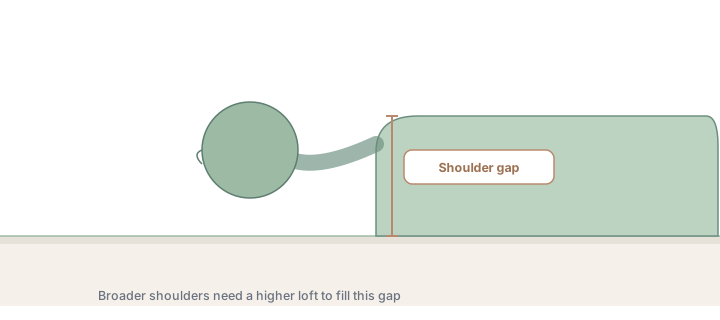
A side sleeper runs out of height first
Your position is the reason lost height matters more. Sleep Foundation's side-sleeping page explains: “Since the shoulders raise the head further from the bed when side sleeping, side sleepers usually do best with a thicker pillow.” The pillow has to span that whole distance, and Cleveland Clinic's rule of thumb is that it “should keep your neck parallel to the mattress, rather than bent down or up.”
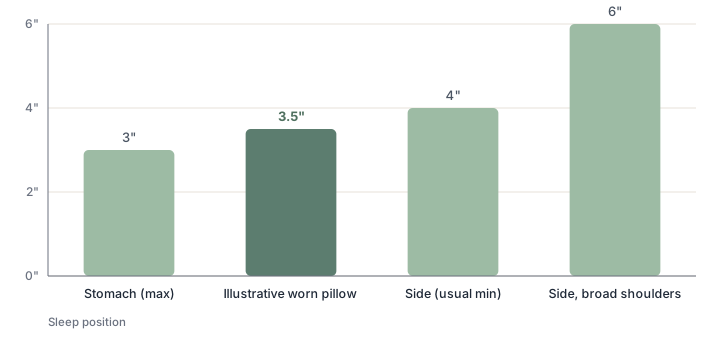
The chart on this page lines up Sleep Foundation's published heights. Its side-sleeper guide says side sleepers usually need at least 4 inches and broad shoulders may need over 6, while its neck-pain guide suggests 3 inches or less for stomach sleepers. Here is an illustrative example, using no measured wear data: take a pillow that started at 5 inches and has sunk to 3.5. For a stomach sleeper it's still on the high side. For a side sleeper it's now under the 4-inch guideline. For someone with broad shoulders it was short already.
When the height runs out, the sources describe two results. Harvard Health says that with a soft pillow lacking support under the neck, “your head has to extend sideways to meet the pillow.” Sleep Foundation's replacement guide adds: “Side sleepers may also experience sore shoulders from a flattened pillow.”
One lab study gives a hint of the effect. Among 21 adults lying on their side on foam pillows of 5, 10 and 14 cm, the 5 cm pillow produced the highest activity in the down-side middle trapezius muscle (Sacco et al., JMPT 2015, abstract). That study compared pillow heights, so it says nothing about worn pillows.
Comfort may not be a reliable warning. In the Sacco study the 5 cm pillow was also rated least comfortable, but a nine-person lab study of healthy adults lying on their side reported that comfort perception was “not sensitive” to its measure of shoulder width and pillow height (Tian et al., 2025, abstract). So a pillow that feels fine hasn't proved its height is right, which is why the next section measures.
The gap in the evidence is worth stating plainly. We found no published measurement of how quickly any fill loses height, and no source gives side sleepers a shorter replacement interval than anyone else. The honest advice is to check more carefully, since no number says to replace sooner.
20 minutes to test your pillow, then refill or replace
These six steps use what the sources publish. Steps 3 and 5 are home approximations, since no clinical body publishes a measuring protocol.
- Strip it and look. Take off the case. Sleep Foundation says to replace pillows “when they start sagging or developing lumps,” and to consider it when you notice “excessive yellowing.”
- Down or feather only: fold it in half. It's time for a replacement “if the pillow doesn't spring back to its normal shape after you fold it in half.” Sleep Foundation gives this test only in its down and feather row and publishes no equivalent for foam, latex or fiber. It also warns: “Fluffing or folding it can only get you so far.”
- Find your target. Sleep Foundation's principle is a loft “that matches the distance between your neck and your shoulder.” Our guide on how high a pillow should be for side sleepers has the method and each source's numbers.
- Lie on your side on your own bed. Stay there a while before judging: in a lab study of 24 women, “70.8% of participants had stabilised by 15 min or earlier” (Hodkinson et al., 2013, abstract). Then have someone look from behind or take a photo. Your neck should continue the line of your spine.
- Record the height. Stand a ruler beside the pillow on a flat table and note the number and date. Soft pillows compress further under a head, so this is only a comparison with the listed height and with your next reading. It's our own rough method, and no source validates it. Since nobody publishes wear data, your own record is the best you'll get.
- Rule out the mattress. On a firmer mattress “you'll need a thicker pillow,” and with a topper or pillow-top “you'll need a thinner pillow,” Cleveland Clinic says. If your bed changed, the pillow may not be what wore out.
Then read the result:
- Neck level, no sagging or lumps: keep it, whatever its age, and see the hygiene notes below.
- Neck droops, adjustable fill: add fill before you buy. Coop sells a Pillow Fill Refill described as “an extra bag of fill designed to refresh or adjust the loft and firmness” of its adjustable pillows, chosen to match your fill type. The Coop Original and the DreamyBlue both come with an extra bag, so check whether you still have yours. These are seller descriptions, and we found no independent measurement of how well new fill restores support.
- Buckwheat: Sleep Foundation suggests “replacing the buckwheat hulls once they start to flatten out,” so the shell can stay.
- Neck droops, fixed height: replace it. Compare the options in our side sleeper pillow catalogue, or read the adjustable pillow guide if you'd like to be able to refill the next one. The fit finder in our main guide to the best pillow for side sleepers narrows the choice, and our reviews cover single models.
- Head tilts up: the pillow is too high and age isn't the issue. Harvard Health warns that “too high or stiff a pillow” can cause morning pain and stiffness. Remove fill or go lower.
- Everything passes but you wake sore: Sleep Foundation says a sore neck “might mean” lost support, and that word matters. Our neck pain guide covers pillow options, but pain that continues is a question for a clinician.
Dust mites, allergens and the doubled-weight claim
Sleep Foundation's other argument for replacing is hygiene: “An old pillow can accumulate allergens like dust mites, fungus, mold, and pet dander.” The research supports accumulation. It doesn't support an expiry date.
A 12-month study put pairs of new synthetic and feather pillows on 12 beds. After a year the synthetic pillows held 19.28 µg/g of the mite allergen Der p 1 and the feather pillows 6.45 µg/g. The authors concluded that the rate “is governed by the Der p 1 concentration in the immediate environment,” and pillow levels tracked the mattress levels measured at the start (Rains et al., 1999, abstract). That suggests a new pillow on the same bed won't stay allergen-free for long. A separate study cultured 10 used pillows aged from 1.5 to more than 20 years and found 4 to 16 fungal species per pillow (Woodcock et al., 2006, abstract). Neither study set an age limit or tested whether a new pillow eases symptoms.
The sources also conflict on fill, so no fill is settled as better for allergies. NIEHS says to “Replace wool or feathered bedding products with synthetic materials,” the Rains study found the opposite trend for mite allergen, and Harvard Health says down and feather “repel dust mites” while synthetic cotton makes “a more attractive climate.”
For mite allergy, NIEHS's steps don't depend on pillow age. It says mites “cannot be completely eliminated,” and advises encasing pillows in allergen-impermeable covers, washing bedding weekly at 130 to 140 degrees Fahrenheit, and keeping humidity at or below 50 percent. It adds that “Non-washable bedding can be frozen overnight.” Check the label first: Sleep Foundation says solid memory foam shouldn't be machine washed, and Sleep Foundation's guides differ on down: one says some should be dry cleaned, the other says many can only be dry cleaned. Washing helps with buildup, but we found no source saying it restores height.
Then there's the line that an old pillow doubles in weight from mites. No source in our register supports it, Sleep Foundation's guide doesn't mention it, and our PubMed searches found no study that weighed one. The closest version we could trace is about mattresses. A Straight Dope column followed a Wall Street Journal line to Ohio State's Emmett Glass, who wrote that he had repeated figures seen online and told the reporter “none of them are in the literature.” University of Virginia mite researcher Thomas Platts-Mills told the column: “I'm sure there's an added weight but I don't think anyone has ever actually measured it.” The column also quotes a commercial site saying a six-year-old pillow can be a tenth debris by weight. It notes that an Ohio State fact sheet backed this up and that the experts it spoke to doubted it. We treat every percent-by-weight figure as unsupported.
Replacing pillows: common questions
How often should you replace pillows if you sleep on your side?
No source gives side sleepers a separate interval. Sleep Foundation's 1 to 2 years applies to everyone, and it isn't based on a cited study. Side sleepers depend more on pillow height, so check whether your neck still stays level, and refill or replace when it doesn't.
Is my neck pain a sign I need a new pillow?
It might be. Sleep Foundation says waking with a sore neck might mean the pillow no longer gives enough support, but Harvard Health also warns that a pillow that's too high can cause morning pain and stiffness. Run the height check first. If your pillow passes and the pain continues, see a clinician.
How long do shredded foam pillows last?
Sleep Foundation's table has no row for shredded foam, so the nearest figure is 2 to 3 years for memory foam. Fill can be added to an adjustable pillow, which changes the question: Coop sells matching refills, and its page says not to wash the fill. We found no independent lifespan data.
Does the fold test work on a memory foam pillow?
Sleep Foundation gives the fold test only for down and feather pillows, and it publishes no equivalent for foam, latex or fiber. For those fills, use its general signs of sagging and lumps, along with the height check on your own bed.
Can I wash a pillow instead of replacing it?
Washing can help with buildup if the label allows it, but we found no source saying it brings back lost height. Sleep Foundation advises against machine washing solid memory foam and latex. Let any pillow dry fully before use, on the lowest heat over multiple cycles if you use a dryer.
How often to change pillows if I have dust mite allergy?
We found no clinical body that sets an interval for this. Sleep Foundation suggests looking at new pillows if your allergies act up at night, but the Rains study found allergen builds up on new pillows within a year. NIEHS's steps are allergen-impermeable covers, weekly hot washing where the label allows, and humidity at or below 50 percent.
How often should I replace pillowcases and protectors?
Sleep Foundation says to wash pillowcases at least once a week and replace them every 1 to 2 years. It gives no separate interval for pillow protectors, and neither does any other source in our register.
Does a 5-year warranty mean a pillow lasts 5 years?
No. A warranty is a seller's promise with its own terms, and the Weekender listing says its 3-year limited warranty protects from manufacturer defects. We couldn't read Coop's warranty terms, so we can't say whether its 5-year warranty covers lost height. Ask the seller before relying on it.
Sources
- Sleep Foundation — How Often Should You Replace Your Pillows? (updated May 22, 2023) (read October 2026)
- Sleep Foundation — How to Wash Pillows (read October 2026)
- Sleep Foundation — Side Sleeping (read October 2026)
- Sleep Foundation — Best Sleeping Positions (read October 2026)
- Sleep Foundation — Best Pillows for Side Sleepers (read October 2026)
- Sleep Foundation — Best Pillows for Neck Pain (read October 2026)
- Johns Hopkins Medicine — Choosing the Best Sleep Position (read October 2026)
- Harvard Health — Say “good night” to neck pain (read October 2026)
- Harvard Health — Is your pillow hurting your health? (read October 2026)
- Cleveland Clinic — Is Your Pillow Giving You a Stiff Neck While You Sleep? (read October 2026)
- NIEHS — Dust Mites and Cockroaches (read October 2026)
- Rains et al., Clin Exp Allergy 1999 (abstract) (read October 2026)
- Woodcock et al., Allergy 2006 (abstract) (read October 2026)
- Sacco et al., JMPT 2015 (abstract) (read October 2026)
- Tian et al., Med Biol Eng Comput 2025 (abstract) (read October 2026)
- Hodkinson et al., Ergonomics 2013 (abstract) (read October 2026)
- The Straight Dope (Cecil Adams) — Does a mattress double its weight due to dust mites and their debris? (read November 2026)
- Coop Sleep Goods — Pillow Fill Refill (read November 2026)
- Coop Sleep Goods — Original pillow page (read October 2026)
- Casper blog — how often to replace pillows (compared for its published figures only) (read November 2026)
- Calm blog — how often to replace your pillow (compared for its published figures only) (read November 2026)
- Bluewave Bedding Ultra Slim Gel Memory Foam — Amazon listing (read October 2026)
- WEEKENDER Ventilated Gel Memory Foam — Amazon listing (read October 2026)
- Casper Original Pillow — Amazon listing (read October 2026)
- Purple — Harmony product page (read October 2026)
- DreamyBlue Signature Adjustable Pillow — Amazon listing (read October 2026)