Is It Better to Sleep Without a Pillow? What the Studies Show for Each Position
Is it better to sleep without a pillow? For most adults, no. The case for dropping the pillow holds up only for some stomach sleepers and possibly some back sleepers, and even there the support is thin. A search of PubMed and Europe PMC found no trial that followed people sleeping with no pillow overnight. What exists are short lab studies in healthy young adults, plus clinical guidance that says to use a low pillow, which is a different thing from no pillow. Below is what those sources say for each position, how to test a lower height safely, and when neck pain needs a clinician and not a bedding change.

Your sleep position decides the answer
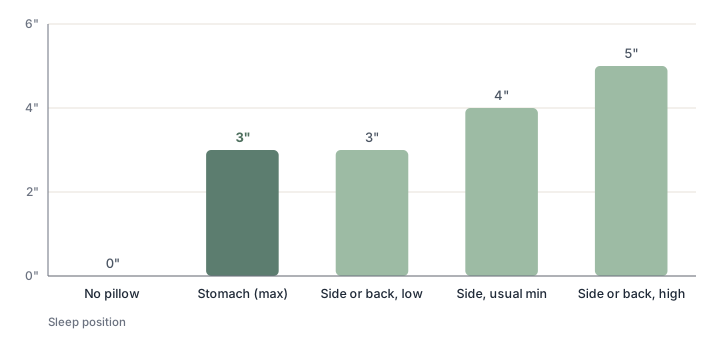
The gap between your head and the mattress changes with your position, so a height that suits one position can fail in another. Here is the short version, and the sections below show the evidence for each.
Side: keep a pillow. Your shoulder lifts your head off the bed. Sleep Foundation's side-sleeping page says that “Since the shoulders raise the head further from the bed when side sleeping, side sleepers usually do best with a thicker pillow,” and its side-sleeper guide suggests “at least 4 inches” for most people.
Back: it depends, so start low and not at zero. Cleveland Clinic gives a useful test: “A pillow that's too low will send your jaw pointing toward the ceiling; too high, and your jaw aims toward your chest.” Sleep Foundation's neck-pain guide suggests 3 to 5 inches for side and back sleepers.
Stomach: the most defensible case for very little. The same Sleep Foundation guide suggests a pillow “3 inches thick or less,” and Harvard Health says “Back and stomach sleepers may want to use thinner, softer pillows.” Sleep Foundation's two pages differ on going without. Its sleep positions guide tells stomach sleepers to “try using a very thin pillow or no pillow at all,” while its neck-pain guide says that for preventing neck pain, avoiding unsupportive pillows “includes using no pillow at all.”
Most people also move. An accelerometer study of 664 working adults counted about 1.6 position shifts per hour (Skarpsno et al., 2017), so if part of your night is spent on your side, that position still needs support. If that's you, the fit finder on our main guide to the best pillow for side sleepers will get you further than removing the pillow.
What happened when researchers took the pillow away
The useful studies with a true no-pillow condition are small, and none of them lasted a night. Three are worth knowing.
A 2026 randomized crossover trial. Kiatkulanusorn et al. had 30 healthy adults lie on their backs on a treatment table under six conditions, including no pillow. On a 100 mm comfort scale, no pillow averaged 36.41 mm, against 61.09 to 75.52 mm for the five pillow conditions, and every pillow was rated significantly more comfortable. The authors say no pillow “consistently produced the lowest physiological and comfort outcomes.” The limits matter, though. Each condition ran for about 10 minutes with participants awake, pillow height was set to their comfort, and the authors warn the results “should not be generalized to habitual sleep without further longitudinal validation.”
A 2015 X-ray study. Kim et al. took neck X-rays of 16 adults aged 20 to 30, without symptoms, lying on their backs at “flat (0 cm), 10-cm, and 20-cm” heights. The neck-curve angle (C2-7 Cobb) rose from 10.34° flat to 14.93° at 10 cm and 17.40° at 20 cm. The authors recommended 10 cm, about 3.9 inches, “considering the normal cervical lordosis.” They measured the shape of the neck at one moment. They did not measure pain or sleep.
A 2007 crossover trial, read only as a summary. A 2021 review reports that Lin and Huang found “The condition without pillows would cause an unstable posture and keep sternocleidomastoid activated,” referring to a muscle at the side of the neck. The same summary says the trapezius muscles had not changed within 30 minutes on the back, with pillows or without.
Two gaps stand out. I found no study that tested side lying with no pillow, and the 2021 review says of stomach sleeping that “Prone and other intermediate postures were barely evaluated.” That review also concludes “there remain no firm conclusions about the optimal pillow height for the supine and lateral positions.”
One correction if you read further: Ren et al., 2016 calls its lowest condition “H0,” but H0 was a 110 mm pillow, about 4.3 inches. It tells you nothing about sleeping without a pillow.
So is it better to sleep without a pillow over months or years? The studies I could find don't measure that. In short lab tests, some support beat none on the measures used, and that is as far as the evidence goes.
Why side sleepers lose the most without a pillow
Lying on your side with no pillow leaves your head with nothing to rest on until it reaches the mattress, across the full width of your shoulder. Harvard Health describes the milder version of this problem: “if you sleep on your side with a soft pillow that doesn't provide enough support under your neck, your head has to extend sideways to meet the pillow.” No pillow is that problem at its extreme. That step is my reasoning, since no study I found tested it directly.
The nearest evidence comes from low pillows. In 21 adults without symptoms lying on their side, a 10 cm foam pillow was rated most comfortable against 5 cm and 14 cm, and the lowest pillow produced the most activity in the down-side middle trapezius muscle (Sacco et al., 2015, abstract). That 5 cm pillow was about 2 inches, which is still more than nothing. A 2025 study of nine healthy adults lying on their side found that shoulder width together with pillow height predicted the curve of the neck (Tian et al., 2025, abstract), so my reading is that a flat setup suits broad shoulders worst.
Clinical guidance agrees. Cleveland Clinic's neck pain page says “If you sleep on your back or side, use a pillow to support your head so your head and neck are aligned with the rest of your body.”
Your mattress can shrink the gap. Sleep Foundation says that if you sink deeply into your bed, you “might find that even a 4-inch loft is too high,” and Cleveland Clinic says a topper or pillow-top means “a thinner pillow.” That argues for a lower pillow on a soft bed, and no source I read extends it to none.
If your current pillow gives you a sore neck on your side, change the height before you give up on pillows. Our guide on how high a pillow should be for side sleepers walks through the measuring, and smaller frames can start with the pillows for petite side sleepers.
Back sleepers have the most room to experiment
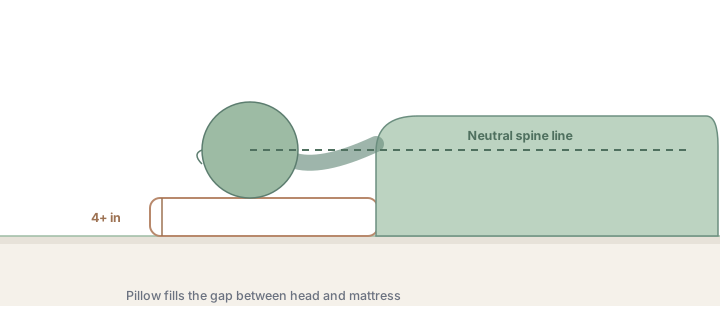
Back sleeping has the smallest gap to fill, so this is where a reduction can be reasonable. There are real reasons to go lower if your pillow is tall. Harvard Health warns against “too high or stiff a pillow, which keeps the neck flexed overnight and can result in morning pain and stiffness” (Harvard Health, 2022), and a separate Harvard article says “sleeping on your back with too much firm support pushes the neck too far forward.”
Going lower still has a floor. Cleveland Clinic's advice is a height “that keeps your head in a neutral position to reduce strain on your neck,” and the same page warns that a pillow can be too low. Harvard Health doesn't suggest removing support either. It says to “choose a rounded pillow to support the natural curve of your neck, with a flatter pillow cushioning your head.” The 2015 X-ray study and the 2026 trial above both leaned toward some height.
No source gives a rule for who can go fully flat. My decision rule is the jaw test. Lie on your back on your usual mattress and have someone check your profile. If your jaw tips toward the ceiling, you need more height. If it tips toward your chest, you need less. If a low pillow already keeps it level, you have nothing to gain from removing the pillow. For your lower back, Mayo Clinic adds “If you sleep on your back, place a pillow under your knees,” which you can try alongside any change.
Three groups should be more careful. The American Academy of Sleep Medicine says “Sleeping on your back may make you more likely to snore,” and I found nothing on how pillow height changes that, so if you've been told you have sleep apnea, leave your setup to your sleep doctor. After 28 weeks of pregnancy, the NHS advises going to sleep on your side. And if you have reflux, ask your doctor first: in a 2025 single-hospital study of 323 reflux patients, Cao et al. reported that self-reported pillows under 10 cm were “the strongest correlate” of reflux reaching the throat. That study can't show cause. The authors say reverse causality is possible, pillow height was self-reported, and the under-10 cm band covers ordinary low pillows, so it isn't a no-pillow finding.
If you switch between back and side, see the pillows for side and back sleepers.
Is stomach sleeping the exception?
Partly. This is the position where a very thin pillow, or none, makes the most mechanical sense. Harvard Health describes stomach sleeping as “a position that hyperextends the neck backward” and says “using a firm pillow pushes the head back even farther.” Sleep Foundation's upper limit of 3 inches points the same way. If you stay on your stomach, less height under the head is the logical direction. Sleep Foundation's sleep positions guide says the same directly, but that is editorial guidance, because no study I found compared pillow heights on the stomach.
The larger issue is the position itself, and removing the pillow doesn't fix it. Your head still has to turn. Cleveland Clinic says “Sleeping with your belly against your bed requires a turn of your head one way or the other,” and quotes Dr. Andrew Bang: “Stretching your neck muscle for that long creates soreness.” Physical therapist Matthew O'Rourke, quoted by Harvard Health, calls it “a full rotation position, and that can become painful.” The NHS lists “do not sleep on your front” among its ways to prevent neck pain, and Cleveland Clinic's neck pain page says “Avoid sleeping on your stomach with your head turned.” One research paper, summarizing an earlier survey, notes that people who reported this as their main position “also reported the highest percentage of waking cervical symptoms” (Cary et al., 2021). That is an association, and it doesn't show the position was the cause.
Watch your arms too. Stomach sleepers often tuck an arm under the pillow, and Dr. Bang warns “You're creating a situation that can eventually lead to rotator cuff problems or other shoulder issues.”
So you have two sensible routes. If you plan to stay on your stomach, use a thin, soft pillow or none, and notice how your neck feels in the morning. The Bluewave Ultra Slim is sold in heights starting at 1.75 inches, and our side and stomach sleepers guide covers the low options. If you'd like to move off your stomach, Cleveland Clinic suggests that “body and side pillows can improve your sleep posture,” and that a few pillows can act as “bumpers.” Our guide to the pillow to keep you on your side has the setups.
Neck pain and posture: what going flat can't promise
Neck pain and posture are the two main reasons people ask “is it better to sleep without a pillow,” and neither has direct support for removing it.
Neck pain. The strongest relevant line I found is the NHS self-care advice to “use a low, firm pillow.” It gives no inches, and it says low, not none. The same page says “when sleeping, make sure your head is the same height as the rest of your body,” which on your side takes a fair amount of pillow. The 2026 trial and the 2015 X-ray study both enrolled people without neck pain, so neither tells you what happens to a sore neck. Research on pillow changes in general is modest too. A 2025 review of five studies found “limited evidence” for specific pillows in chronic neck pain, “with no particular type (latex, foam or standard) demonstrating clear superiority” (Ghosh et al., abstract). Harvard Health sums up the wider point: “the benefits of pillows don't go much further than comfort and positioning.”
The NHS also says “Most neck pain only lasts a few weeks,” so a neck that feels better after a change at home may simply have been improving anyway. That makes a before-and-after test weak proof, which is one more reason to change one thing at a time. For side sleepers with a sore neck, our neck pain pillow guide is a better next step.
Posture. I found no study showing that sleeping without a pillow improves daytime posture. The research above looks at how the neck sits while lying down, for minutes at a time. A claim that going pillow-free straightens your spine or fixes forward head posture goes beyond anything I could source, so treat it as unproven.
6 steps to test a lower height safely
No clinical body publishes a protocol for this, as far as I could find. The routine below is a cautious one built from the alignment guidance above, and the timings are my judgment, not study results. Skip it if you sleep mostly on your side, and fix the fit instead.
- Record a baseline. For three mornings, rate your neck stiffness from 0 to 10 and note any headache, before changing anything.
- Make the height adjustable. Take a small handful of fill out of an adjustable pillow, or use a thin pillow with a folded towel on top so you can remove one layer at a time. Our adjustable pillow guide compares pillows built for this. Don't go from a full pillow to nothing in one night.
- Check your position in bed. On your back, your jaw should stay level. On your stomach, your head should not be pushed back. Give your neck time to settle before you judge the height. In a lab study of 24 young women lying on their side on a polyester pillow, “70.8% of participants had stabilised by 15 min or earlier” (Hodkinson et al., 2013, abstract). It didn't test back or stomach lying, so take that as a rough guide.
- Hold each step for about a week. One bad night tells you little, and a new height needs a fair trial. Change nothing else during that time, including your mattress or topper.
- Keep scoring every morning. Compare your scores with your baseline, and note if you woke on your side with your head dropped.
- Stop at the lowest height that doesn't make mornings worse. If scores rise, go back to the last comfortable step. Reaching zero isn't the goal.
Sukie's take
What stood out when I read these studies is how little anyone has measured. If you're asking is it better to sleep without a pillow, start with your position. For a side sleeper, I'd keep the height and fix the fit. For a stomach or back sleeper, I'd lower it in small steps and let morning stiffness decide.
Sources
- Kiatkulanusorn et al. — Dynamic versus fixed pillow height systems and cervical muscle function (Eur J Phys Rehabil Med 2026) (read November 2026)
- Kim et al. — The Effect of Different Pillow Heights on the Parameters of Cervicothoracic Spine Segments (Korean J Spine 2015) (read November 2026)
- NHS — Neck pain (last reviewed 27 April 2023) (read November 2026)
- Cleveland Clinic — Neck Pain (updated 12/09/2022) (read November 2026)
- Cao et al. — Low pillow height is associated with LPR among patients with GERD (BMC Gastroenterol 2025) (read November 2026)
- Lei et al. — Ergonomic Consideration in Pillow Height Determinants and Evaluation (Healthcare 2021) (read October 2026)
- Ren et al. — Effect of pillow height on the biomechanics of the head-neck complex (PeerJ 2016) (read October 2026)
- Sacco et al. — The effect of pillow height on muscle activity (JMPT 2015) (read October 2026)
- Tian et al. — The individualized optimal pillow height and neck support design for side sleepers (Med Biol Eng Comput 2025) (read October 2026)
- Hodkinson et al. — Time to stabilisation of the cervical spine in side lying (Ergonomics 2013) (read October 2026)
- Skarpsno et al. — Sleep positions and nocturnal body movements (Nat Sci Sleep 2017) (read October 2026)
- Cary et al. — Examining relationships between sleep posture, waking spinal symptoms and quality of sleep (PLoS One 2021) (read October 2026)
- Ghosh et al. — Effect of pillow on pain, disability and sleep quality in patients with chronic neck pain (Rehabilitación 2025) (read October 2026)
- Sleep Foundation — Best Pillows for Side Sleepers in 2026 (read October 2026)
- Sleep Foundation — Best Pillows for Neck Pain in 2026 (read October 2026)
- Sleep Foundation — Side Sleeping: Which Side Should You Sleep On? (read October 2026)
- Cleveland Clinic — Best Sleeping Positions for Pain (read October 2026)
- Cleveland Clinic — Sleeping on Your Stomach: Is it Bad for You? (read October 2026)
- Cleveland Clinic — Is Your Pillow Giving You a Stiff Neck While You Sleep? (read October 2026)
- Harvard Health — Is your pillow hurting your health? (read October 2026)
- Harvard Health — Say “good night” to neck pain (read October 2026)
- Mayo Clinic — Sleeping positions that reduce back pain (read October 2026)
- AASM Sleep Education — Snoring (read October 2026)
- NHS — Stillbirth: Preventing stillbirth (read October 2026)
- Sleep Foundation — Best Sleeping Positions (medically reviewed by Abhinav Singh, MD) (read November 2026)