Best Hypoallergenic Pillows for Side Sleepers: Picks, Pore Sizes and Wash Temperatures
The best hypoallergenic pillows for side sleepers hold your height and sit inside a tight cover you can wash hot, because we found no proof that any pillow is allergy-free. Most lists rest on a word with no federal definition behind it. The FDA, writing about cosmetics, put it bluntly: “The term means whatever a particular company wants it to mean.” The Asthma and Allergy Foundation of America applies the same point to household products, and pillow listings use the word freely. So this page treats the label as a starting claim and checks what's underneath it: whether a seller names a tester, whether a pore size is stated, and whether the care line allows the hot wash that kills dust mites. You sleep on your side, so height stays in the mix too.

Start with what you react to
Pick by trigger, because the right purchase changes with it. These rules are reasoning from the sources below, and this site doesn't test pillows by hand.
- Dust mites, confirmed by an allergist: keep or buy a pillow that fits, then add a tight zip cover. The National Allergy cover states a pore size. The AllerEase Platinum Knit states a hot wash.
- You want one product that does both jobs: the Mission: Allergy pillow, if a slightly firmer feel suits you and you can accept an unknown height.
- You can't get the height right on anything: the AllerEase Platinum Adjustable, since you can add fill.
- You want to wash the whole pillow: the Beckham pair, with the catch that no temperature is listed.
- Latex allergy: skip latex pillows, whatever the label says. Sleep Foundation warns about this even for pillows sold as hypoallergenic, and a Cleveland Clinic chiropractor suggests memory foam instead.
- You don't know your trigger: ask an allergist before spending anything. Our side sleeper pillow guide covers fit, and fit comes first either way.
A pet dander or pollen problem isn't what this page's dust-mite evidence measured, so treat the rules above as weaker for those triggers.
Hypoallergenic pillows: our 6 picks
#1 · Best for setting your own height
AllerEase Platinum Adjustable Allergy Pillows (2-pack)
Extra polyester fiberfill comes in the box, and that's what earns it first place for a side sleeper: the listing gives no height, so you can build it up to fit your shoulder. The listing says its Allergy Defense fabric blocks allergens from collecting in the pillow, without naming a test. The knit cover unzips, and the care line says machine wash warm.
- Type
- Adjustable allergy pillow
- Height
- Not stated
- Fill
- Polyester fiberfill, extra fill included
- Price band
- Mid-range
#2 · Best built-in barrier
Mission: Allergy Dust Mite- and Allergen-Proof Pillow (Queen)
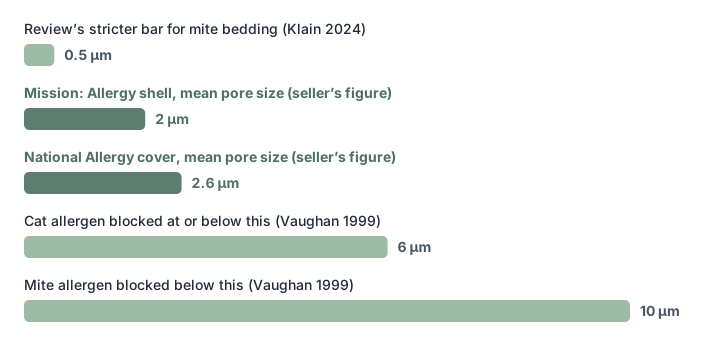
The shell is the barrier, so the listing says it needs no encasing. It claims the shell blocks 100% of dust mite and animal dander allergens and names a third-party tester, Indoor Biotechnologies. That's more than any other pillow here offers, though it's still the seller's claim and the report isn't shown. It's described as slightly firmer and gives no height, and the listing mentions no way to change the fill. Its description states a mean pore size of 2 microns and says the pillow doesn't need hot water washing. That's the seller's view, and NIEHS's general advice is a weekly hot wash.
- Type
- Pillow with built-in barrier shell
- Height
- Not stated
- Fill
- ComfortFill
- Price band
- Mid-range
#3 · Best whole-pillow wash
Beckham Hotel Collection (2-pack)
The listing says to wash each pillow on a gentle cycle and air dry it, which suits anyone who wants to clean the fill as well as the cover. It gives a plush 8-inch loft but makes no allergy claim on the listing we read: the OEKO-TEX certificate covers the cotton cover and tests for harmful substances, not allergens. No wash temperature is stated.
- Type
- Down alternative (hollow fiber)
- Height
- 8 in (plush, listed)
- Fill
- Down alternative
- Price band
- Budget
#4 · Keep this fit, add a cover
Coop Home Goods Original Adjustable
Coop's listing makes no allergy promise that we found, and its care line says cold water. It's here for one reason: its fill adjusts, so a side sleeper can dial in the height and then let a separate zip cover handle the barrier. If you already own a pillow that fits, the same logic applies and you can skip buying a new one.
- Type
- Adjustable shredded foam
- Height
- 8 in listed; adjustable
- Fill
- Cross-cut memory foam + microfiber
- Price band
- Mid-range
#5 · Zip cover with a stated pore size
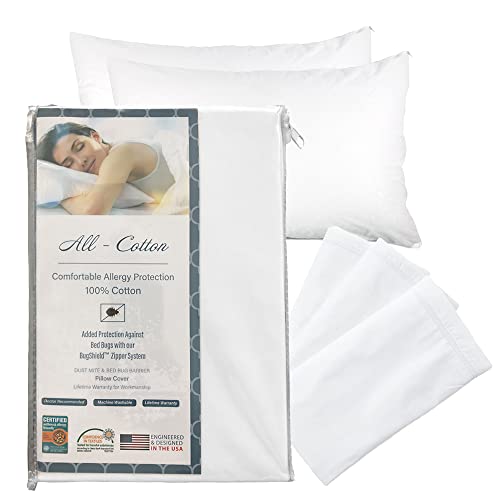
National Allergy Premium Cotton Zippered Pillow Protector (2-pack)
This is a zip cover, not a pillow. The listing gives a mean pore size of 2.6 microns, under the 10-micron mark from the Vaughan fabric test, and describes a fabric shield under the zipper. It doesn't say who measured it, and the wash temperature isn't stated.
- Type
- Zippered pillow encasement
- Height
- Not stated
- Fill
- None: a cover, not a pillow
- Price band
- Mid-range
#6 · Only hot-wash care line
AllerEase Platinum Allergy Knit Pillow Protector
Another zip cover, and the only product on this page whose care line says machine wash hot. That matches a weekly dust-mite routine better than anything else listed here. The listing's brand section says AllerEase fabrics have pore sizes “smaller than 10 microns,” with no exact figure, and hot isn't defined as a temperature, so check the tag when it arrives.
- Type
- Zippered pillow protector
- Height
- Not stated
- Fill
- None: a cover, not a pillow
- Price band
- Budget



We earn a commission if you buy through these links, at no extra cost to you. As an Amazon Associate we earn from qualifying purchases. Prices and availability are shown on Amazon and can change.
What “hypoallergenic” promises on a pillow
Very little, because no federal definition fixes what it means. The AAFA's certification page repeats the FDA's line that “There are no federal standards or definitions that govern the use of the term ‘hypoallergenic.’” The FDA statement itself dates from 2000 and is about cosmetics, so read it as the clearest official wording available and not as a pillow rule. We found no federal definition for bedding.
Three labels get confused with it:
- Asthma & Allergy Friendly: an AAFA program with Allergy Standards Limited. Products go to independent labs and “must pass every test required in the standard.” Bedding, including pillows and covers, is a listed category. This is the label closest to what most allergy shoppers want, and none of the products on this page claims it in the listing text we read. National Allergy sells some AAFA-certified items, so ask the seller whether this cover is one.
- OEKO-TEX STANDARD 100: a test for harmful substances in textiles. It says nothing about keeping dust mites out.
- CertiPUR-US: covers polyurethane foam content and emissions, also a different question.
So a pillow can carry a real certificate and still have no allergen barrier. Sleep Foundation's own list (updated April 2026, no medical reviewer listed) says a pillow “can still be hypoallergenic even if it hasn't been evaluated by a certifying organization,” which tells you how loose the word is.
Why fill alone won’t settle it
Sources disagree, so don't let a fill type decide this. NIEHS tells people with dust mite allergy to “Replace wool or feathered bedding products with synthetic materials.” A 12-month paired study went the other way, finding “Synthetic pillows accumulate Der p 1 more rapidly than feather pillows.” Harvard Health says down and feathers “repel dust mites,” while cotton, wool and synthetic cotton “make a more attractive climate for dust mites.”
Feather allergy itself looks rarer than people assume. In a Finnish clinic study of 269 adults, one had a clinically significant feather allergy, and the authors thought most positive skin tests were probably caused by mite allergens in the feathers. That's one 1998 study of feather extracts, so it can't clear down pillows, but it's a reason to get tested before assuming feathers are your problem.
Our best down alternative pillows page sets out that conflict for fiber fills in more detail. The practical reading: fill is a comfort and height choice. If mites are the concern, the barrier and the washing routine are where the sources give you something to act on.
Pore size: the number sellers rarely print
Pore size is the most useful spec on an allergy cover, and only two products here give a figure: the National Allergy cover and the Mission: Allergy shell. The AllerEase knit cover's listing has only a brand-wide “smaller than 10 microns.” In a 1999 lab study, Vaughan and colleagues pulled allergen-laden dust across fabrics and found dust mite allergens were “blocked below detectable limits by fabrics of less than 10 microm in pore size.” Cat allergen needed tighter fabric, at 6 microns or less. That test measured fabric on a rig, not people sleeping on it.
A 2024 review in *Children* sets a much stricter bar, saying effective allergy-proof bedding “requires a pore size of 0.5 microns or less.” The two figures don't agree, and the review doesn't explain the gap. The stated 2.6 microns of the National Allergy cover and 2 microns of the Mission: Allergy shell (both means, both the sellers' numbers) clear the first mark and miss the second.
The seal matters as well, since a barrier fabric can't help if the opening leaks. Look for a full zip enclosure, not an open-ended sham.
The hot-wash test: what each care line says
Only one care line here says hot, and it gives no temperature, so none clearly matches the wash NIEHS describes. Its advice is to “Wash all bedding and blankets once a week in hot water, 130 to 140 degrees Fahrenheit, to kill dust mites.” Compare that with the table on this page: one cold, one warm, three with no temperature, and one hot.
That gap is the reason to separate the two jobs. Let the pillow provide height and let a cover take the weekly hot wash. Solid foam makes this choice for you: Sleep Foundation says solid memory foam shouldn't go in a machine and latex shouldn't either. For bedding you can't wash at all, NIEHS offers another route: “Non-washable bedding can be frozen overnight.” Check that your dryer and care tag allow what you're planning, because a pillow that isn't fully dry shouldn't go back on the bed.
When to replace instead of wash
Replacing is the other lever once washing runs out. Sleep Foundation says an old pillow “can accumulate allergens like dust mites, fungus, mold, and pet dander,” and that's a reason to retire a tired pillow even if it still feels fine. No clinical body gives an allergy-specific interval that we could find, so treat the published figures as editorial guidance. Our guide on how often you should replace pillows gives the intervals by fill, and a pillow that has lost its height is due regardless, because a side sleeper feels that first.
Keep the height right for side sleeping
An allergy pillow that's too low trades one problem for another. Sleep Foundation suggests side sleepers look for at least 4 inches, and says broad shoulders may need “over 6 inches.” It's guidance, not a clinical number, and your mattress changes the answer. Our page on how high a pillow should be for side sleepers shows how to measure the gap.
The listings give you only part of what you need. The Beckham and the Coop state 8 inches, the AllerEase and the Mission: Allergy state no height, and only the AllerEase and the Coop let you change it, so those two are the safer buys if you don't know your number. See our adjustable pillow picks for more, and the Coop review for its specs. A zip cover may change the feel a little, so test height with the cover on.
A weekly routine that follows the sources
- Zip the pillow into a tight cover and put the pillowcase over it.
- Wash the cover and bedding once a week, as hot as the tag allows, aiming for NIEHS's 130 to 140°F.
- Dry fully before putting anything back.
- Keep bedroom humidity at or below 50% with a dehumidifier or air conditioning.
- Replace the pillow when it no longer holds your height.
- Review your symptoms with your allergist, and add or drop measures with their advice.
That's the whole plan.
Allergy claim and care line, product by product
| Product | What it is | Allergen wording on the listing | Stated wash | Reaches NIEHS 130–140°F? |
|---|---|---|---|---|
| AllerEase Platinum Adjustable | Pillow, polyester fiberfill | “blocks allergens from collecting in your pillow”; no test named | Machine wash warm | No: warm |
| Mission: Allergy pillow | Pillow with barrier shell | “Blocks 100% of dust mite and animal dander allergens”; names Indoor Biotechnologies; mean pore size of 2 microns | Machine wash; description says no hot water washing needed | Unknown: no temperature |
| Beckham Hotel Collection | Pillow, 2-pack | None found; OEKO-TEX certificate covers the cotton cover only | Machine wash, gentle cycle, air dry | Unknown: no temperature |
| Coop Original Adjustable | Pillow, adjustable foam | None found | Cold water, gentle cycle, tumble dry low | No: cold |
| National Allergy cotton cover | Zip cover | “mean pore size of 2.6 microns”; tester not named | Fully machine washable | Unknown: no temperature |
| AllerEase Platinum Knit cover | Zip cover | “Tightly woven construction fully protects your pillow”; brand cites third-party testing, names no lab | Machine wash hot | Closest: says hot, no figure |
Wording copied from each Amazon listing, read November 2026. The last column is our reading against NIEHS guidance (last reviewed March 2026), not a lab test. Claims are the sellers’.
Sukie's take
What stood out from reading these listings side by side is how few give the two numbers an allergy shopper needs. Only two give a pore figure and only one says hot wash, and they're different products. I'd buy for fit first and treat the cover as a separate decision.
Hypoallergenic: common questions
Are hypoallergenic pillows actually better for allergies?
There's no standard meaning for the label, so the word alone tells you little. What sources support is lowering mite exposure with tight covers and hot washing, though Cochrane found covers alone unlikely to help rhinitis symptoms.
Are hypoallergenic pillows good for side sleepers?
Only if the height fits, and the label says nothing about that. Sleep Foundation suggests at least 4 inches for side sleepers. Of the pillows here, two state 8 inches and two state no height, so an adjustable one is the safer choice when you don't know your number.
Do I need a new pillow or just a cover?
If your pillow still holds its height, a zip cover is the cheaper first step. Replace it if it has flattened. Sleep Foundation also notes old pillows can accumulate allergens.
What pore size should a dust mite cover have?
A 1999 lab test found fabrics under 10 microns blocked mite allergens, while a 2024 review says 0.5 microns or less. The sources don't agree, and few listings state a figure, so ask the seller.
Can I wash a hypoallergenic pillow in hot water?
Only if its tag says so, and of the products here only the AllerEase knit cover says hot. Coop says cold and the AllerEase pillow says warm. Follow the tag, and wash a cover instead when the pillow can't take the heat.
Sources
- FDA — Hypoallergenic Cosmetics (statement of Oct 18, 2000; content current as of Feb 25, 2022) (read November 2026)
- Asthma and Allergy Foundation of America — Asthma & Allergy Friendly Certification Program (read November 2026)
- Vaughan et al. — Evaluation of materials used for bedding encasement (J Allergy Clin Immunol 1999; abstract) (read November 2026)
- Klain et al. — The Prevention of House Dust Mite Allergies in Pediatric Asthma (Children 2024) (read November 2026)
- Sheikh et al. — House dust mite avoidance measures for perennial allergic rhinitis (Cochrane Database Syst Rev 2010; abstract) (read November 2026)
- Sleep Foundation — Best Hypoallergenic Pillows of 2026 (updated April 10, 2026; no medical reviewer listed) (read November 2026)
- NIEHS — Dust Mites and Cockroaches (last reviewed March 6, 2026) (read October 2026)
- Rains et al. — House dust mite allergen accumulation on new synthetic and feather pillows (Clin Exp Allergy 1999; abstract) (read October 2026)
- Harvard Health — Is your pillow hurting your health? (Feb 15, 2021) (read October 2026)
- Kilpiö et al. — Allergy to feathers (Allergy 1998; abstract) (read November 2026)
- Cleveland Clinic — Does Hypoallergenic Bedding Work? (Jan 3, 2023; John McDonnell, MD) (read November 2026)
- Sleep Foundation — Best Pillows for Side Sleepers in 2026 (updated October 20, 2026) (read November 2026)
- OEKO-TEX — OEKO-TEX STANDARD 100 (read October 2026)
- Cleveland Clinic — Is Your Pillow Giving You a Stiff Neck While You Sleep? (Dec 10, 2020) (read October 2026)
- Sleep Foundation — How Often Should You Replace Your Pillows? (updated May 22, 2023; no medical reviewer listed) (read October 2026)
- Sleep Foundation — How to Wash Pillows (updated Jan 31, 2023; no medical reviewer listed) (read October 2026)
- CertiPUR-US — Frequently Asked Questions (read October 2026)