Best Pillow for Side Sleepers with Sleep Apnea: Comfort and Positioning Picks, Not a Cure
The most persistent claim attached to the best pillow for side sleepers with sleep apnea is that the right pillow will treat the apnea. It won't. Harvard Health says that while adjusting your sleep position can help stave off symptoms, it “won't eliminate health problems such as restless legs syndrome or sleep apnea — even though some pillows are marketed as solutions to snoring and sleep disorders.” What a pillow can do is make the side position comfortable enough to stay in, and that position can matter: the American Academy of Sleep Medicine says a sleep doctor might recommend positional therapy when breathing is interrupted mainly on your back. So this page picks pillows for comfort and positioning, inside a plan your sleep doctor sets.

What a pillow can and can't do if you have apnea
Start with the order of things, because it decides what you should buy.
Your treatment comes first and comes from a clinician. Whether that's a CPAP machine or another approach is a decision for your sleep doctor, and nothing on this page replaces it. Harvard Health is blunt that even changing your sleep position won't eliminate sleep apnea, whatever pillows are marketed for, and the same article says the benefits of pillows “don't go much further than comfort and positioning.”
Comfort and positioning are still worth getting right. If your doctor has told you to sleep on your side, or you simply sleep better there, a pillow that fits your shoulder makes the position easier to keep. A body pillow may make rolling onto your back less likely, though no source in our register measures that. And if you use CPAP, a pillow that suits the mask makes the whole night easier.
That's the frame for the picks above. They are not apnea pillows, and none of their listings in our catalogue claims to treat apnea. They are pillows that make side sleeping comfortable, which is the part of the problem a pillow can actually help with.
Sleep apnea pillows: our 4 picks
#1 · Best head pillow for comfortable side sleeping
Coop Home Goods Original Adjustable
Listed at 8 inches with cross-cut memory foam and microfiber that you can remove until your neck sits level, plus an extra bag of fill in the box. Sleep Foundation suggests adjustable pillows when you're unsure what loft you need, and Coop's site lists a 100-night trial and a 5-year warranty while you work it out. Amazon's buyer summary praises the head and neck support, and notes that several buyers report an awful smell.
- Type
- Adjustable shredded foam
- Height
- 8 in listed; adjustable
- Fill
- Cross-cut memory foam + microfiber
- Price band
- Mid-range
#2 · Best budget curved head pillow
Sidney Sleep Adjustable Curved Pillow
A Budget-band pillow listed at 7 inches, with adjustable fill (75% foam, 25% polyester fiber) and a contoured curve the listing says is designed to fit the head, neck and shoulders. My reasoning is that a shape built around the shoulder should make the side position easier to settle into. Amazon's buyer summary says some find it too firm; the listing describes it as medium-firm out of the box, and you can remove fill to soften it.
- Type
- Curved side-sleeper, adjustable fill
- Height
- 7 in listed; adjustable
- Fill
- 75% foam / 25% polyester fiber
- Price band
- Budget
#3 · Best body pillow for holding the side position
Coop Home Goods Adjustable Body Pillow
A 20 x 54 inch body pillow with adjustable cross-cut memory foam and microfiber, CertiPUR-US foam and GREENGUARD Gold certification, and the same 100-night trial and 5-year warranty on Coop's site. It supports the top arm and knee in one piece. Amazon's buyer summary is mixed on its weight, with some finding it heavy to move from side to side.
- Type
- Body pillow (adjustable foam)
- Height
- Not stated
- Fill
- Cross-cut memory foam + microfiber
- Price band
- Mid-range
#4 · Best firm body pillow on a budget
Oubonun Adjustable Body Pillow
Listed at 54 x 21 x 10 inches with firm polyester fill; the listing says you can add or remove fill. My reasoning, not a tested finding, is that a firm pillow makes a better barrier behind your back than a soft fiber tube, which I'd expect to flatten. Amazon's buyer summary praises its side-sleeping support and is mixed on durability.
- Type
- Body pillow (adjustable fiber)
- Height
- 10 in tall
- Fill
- Polyester fiber (adjustable)
- Price band
- Budget


We earn a commission if you buy through these links, at no extra cost to you. As an Amazon Associate we earn from qualifying purchases. Prices and availability are shown on Amazon and can change.
Positional apnea: why your side comes up at all
Sleep position comes up with apnea because, for many people, breathing problems are worse on the back.
The American Academy of Sleep Medicine (AASM) describes positional therapy for exactly that pattern: “If your breathing is interrupted primarily when you are sleeping on your back, and normal when sleeping on your side or stomach, then your sleep doctor might recommend positional therapy for you.”
How common is that pattern? In a 2025 analysis of Sleep Heart Health Study data (1,870 people), positional obstructive sleep apnea was more common than non-positional apnea, 62% against 38% (Duce et al., J Clin Sleep Med 2025, abstract). Johns Hopkins sleep neurologist Rachel Salas says positioning yourself on your side or stomach “can help the airways stay open to reduce snoring and alleviate mild apnea” (Johns Hopkins Medicine).
Notice the qualifiers: “mild” apnea, breathing interrupted “primarily” on the back, and a sleep doctor who “might recommend” it. Whether position is part of your plan depends on your own results, which is why the doctor comes before the pillow. If position is part of it, our guide to using a pillow to keep you on your side covers the body-pillow setups in detail.
Will a pillow knock your CPAP mask off?
It can, and Harvard Health names the problem directly: “If you're a side sleeper, the pillow can knock the mask off.” The same article says there are pillows with cutouts “that the mask fits into so it won't get knocked off.”
Here is where I have to be honest about our catalogue. We cover pillows sold for CPAP users on a separate page: CPAP pillow for side sleeping. The Coop Cool+ Cut-Out has a notch in its lower edge, but its listing calls it a shoulder cut-out, not a mask cut-out, so I wouldn't assume it solves a mask problem.
Our source register also doesn't cover how pillow height, firmness or fill affect mask fit. If the mask is your main issue, ask your sleep doctor or the team that fitted your equipment which pillow shape they suggest, and treat anything on this page as the comfort layer around their advice. If this is your question, I'd rather say plainly where our evidence ends than guess.
The head pillow: fit still comes first
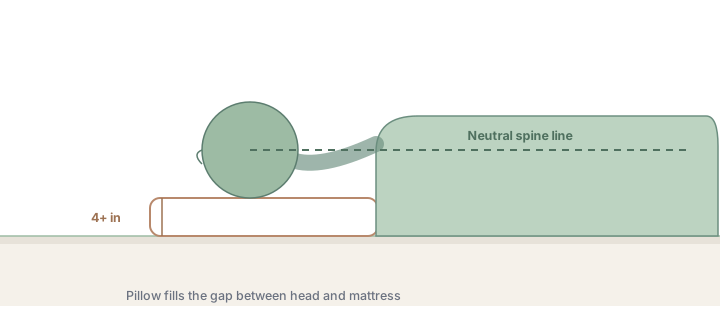
With apnea or without it, your head pillow has the same job on your side: keep your neck in line with your spine. Cleveland Clinic's rule of thumb is that the pillow “should keep your neck parallel to the mattress, rather than bent down or up” (Cleveland Clinic).
For height, Sleep Foundation's side-sleeper guide says side sleepers usually need a pillow at least 4 inches thick, while its neck-pain guide gives 3 to 5 inches for side and back sleepers. Both are starting points, and the right number depends on your shoulders and mattress: Cleveland Clinic says a firmer mattress needs a thicker pillow, and a topper or pillow-top a thinner one. Harvard Health also warns against a pillow that is “too high or stiff,” which keeps the neck flexed overnight.
That's why both head pillows I picked are adjustable. In my view, if you're still settling into a new routine, especially with equipment on your face, being able to take height out or put it back is more useful than any fixed shape. The Coop Original is the most flexible; the Sidney Sleep adds a curve for the shoulder at a lower price. Our adjustable pillow guide compares more options, and our explainer on how high a side sleeper's pillow should be sets out every source's number.
A body pillow as your positioning aid
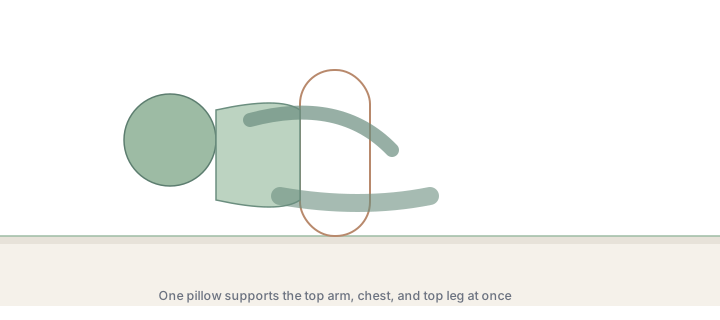
If your doctor wants you off your back, a body pillow is the simplest support for that, though no source in our register measures how well it works for apnea. What the sources do say is general: Mayo Clinic suggests side sleepers put a pillow between bent knees, adding “Use a full-length body pillow if you prefer,” and Cleveland Clinic says body and side pillows can improve sleep posture for people in the habit of sleeping on their stomach.
People change position about 1.6 times an hour on average, according to an accelerometer study of 664 adults (Skarpsno et al., 2017), so a pillow won't hold you still all night. My reasoning is that, laid firmly along your back, it should make the roll onto your back harder and the side the easier place to settle; no source has measured this.
Of the two body pillows above, the Coop is the adjustable foam option with a trial and warranty, and the Oubonun is the firmer, cheaper one. Both are 54 inches long, so check you have room, especially if a partner shares the bed. Our body pillow guide compares a third, softer option.
Questions to take to your sleep doctor
A short list makes the appointment more useful, and the answers tell you which pillows on this page are worth buying:
- Is my apnea worse on my back, and should I try to stay on my side?
- If so, which positional method do you want me to use?
- Does my mask type work with side sleeping, and is there a pillow shape you suggest?
- Should I avoid sleeping on my stomach as well?
If the answer is that position matters, the body pillows above are the low-cost place to start. If it's mainly about comfort with your equipment, start with an adjustable head pillow and set its height on your own mattress. Either way, compare every pillow we cover in the side sleeper pillow shop, check neck-specific picks in our neck pain guide, or go back to our main guide to the best pillow for side sleepers to use the fit finder.
Sukie's take
If I had apnea, I'd spend nothing on pillows until my sleep doctor had told me whether position matters for me. After that, the useful purchases are boring ones: a head pillow I can adjust to my shoulders, and a firm body pillow if I've been told to stay off my back.
Sleep apnea: common questions
Can a pillow cure sleep apnea?
No. Harvard Health says even adjusting your sleep position won't eliminate sleep apnea, though some pillows are marketed as solutions to snoring and sleep disorders. Treatment comes from your sleep doctor; a pillow only helps with comfort and positioning.
Is side sleeping good for sleep apnea?
It can help some people. Johns Hopkins sleep neurologist Rachel Salas says side or stomach positions can help the airways stay open, reducing snoring and easing mild apnea. The American Academy of Sleep Medicine says a sleep doctor might recommend positional therapy when breathing is interrupted mainly on your back.
How common is positional sleep apnea?
In a 2025 analysis of 1,870 people from the Sleep Heart Health Study, positional obstructive sleep apnea was more common than the non-positional kind, 62% against 38%. That's one study population, and only your sleep doctor can tell you which pattern you have.
What pillow is best with a CPAP mask for side sleepers?
Harvard Health notes that a side sleeper's pillow can knock a CPAP mask off, and that some pillows have cutouts the mask fits into. We haven't sourced a specific mask-cutout pillow, so ask your sleep doctor or equipment provider which shape they suggest.
Should a side sleeper with apnea use a high or low pillow?
The height should suit your body, not the apnea. Sleep Foundation suggests at least 4 inches for most side sleepers, and Cleveland Clinic says the pillow should keep your neck parallel to the mattress. An adjustable pillow lets you set that on your own bed.
Does a body pillow keep you off your back?
It can make rolling onto your back harder, but no source in our register has measured how well it works. Clinicians describe body pillows for comfort and alignment; if your doctor recommends positional therapy, ask which method they want you to use.
Does snoring mean I have sleep apnea?
Not necessarily, and a website can't tell you. The American Academy of Sleep Medicine says about 40 percent of adult men and 24 percent of adult women are habitual snorers, and that sleeping on your back may make snoring more likely. If you're worried, see a doctor.
Sources
- Harvard Health — Is your pillow hurting your health? (read October 2026)
- Harvard Health — Say “good night” to neck pain (read October 2026)
- American Academy of Sleep Medicine — Positional Therapy (Sleep Education) (read October 2026)
- American Academy of Sleep Medicine — Snoring (Sleep Education) (read October 2026)
- Duce et al. — Community prevalence of positional obstructive sleep apnea (J Clin Sleep Med 2025) (read October 2026)
- Johns Hopkins Medicine — Choosing the Best Sleep Position (read October 2026)
- Mayo Clinic — Sleeping positions that reduce back pain (read October 2026)
- Cleveland Clinic — Is Your Pillow Giving You a Stiff Neck While You Sleep? (read October 2026)
- Sleep Foundation — Best Pillows for Side Sleepers in 2026 (read October 2026)
- Sleep Foundation — Best Pillows for Neck Pain in 2026 (read October 2026)
- Skarpsno et al. — Sleep positions and nocturnal body movements (Nat Sci Sleep 2017) (read October 2026)
- Coop Home Goods Original Adjustable — Amazon listing (read October 2026)
- Coop Home Goods — Original pillow product page (read October 2026)
- Sidney Sleep Adjustable Curved Pillow — Amazon listing (read October 2026)
- Coop Home Goods Adjustable Body Pillow — Amazon listing (read October 2026)
- Coop Home Goods — body pillow product page (read October 2026)
- Oubonun Adjustable Body Pillow — Amazon listing (read October 2026)
- Coop Home Goods Cool+ Cut-Out — Amazon listing (read October 2026)