CPAP Pillow for Side Sleeping: Check the Mask First, Then Pick the Cut-Out
A CPAP pillow for side sleeping only helps once your mask fits, so check that first, then compare cut-outs and listed height. The only trial we found on these pillows followed 22 patients on cut-out foam and gel pillows, and it saw no drop in air leaks. That doesn't settle whether you need one, because a pillow can still shove a mask. Harvard Health quotes a physician saying a pillow can knock a side sleeper's mask off, and that cut-out pillows exist for this reason. But the American Academy of Sleep Medicine says the most common CPAP problems come from a mask that does not fit. So this page starts with the checks that cost nothing, then compares pillows on what their listings actually state. It does not cover whether side sleeping helps apnea.

Why your pillow moves the mask when you lie on your side
A CPAP mask only does its job while it seals. The American Academy of Sleep Medicine (AASM) puts it plainly: “The mask must make a seal in order to keep your airway open through the night.” On your back, the pillow sits behind your head and clear of the mask. On your side, the pillow sits against your face, right where the cushion, frame and hose connection are. Harvard Health quotes Dr. Lawrence Epstein on the result: “If you're a side sleeper, the pillow can knock the mask off.”
Your face changes as well. Oxford University Hospitals' sleep service warns that “A mask that fits well when you're sitting up might not fit so well when you're lying down,” because facial muscles shift when you lie down and relax further once you are asleep. So two things are moving at once: the pillow is pressing on the hardware, and the seal itself is sitting on a different face from the one that was fitted upright.
How much trouble the pillow causes depends on the mask you wear. The Sleep Foundation's mask guide, an editorial page that names no medical reviewer, ranks them by size. A full-face mask “takes up the most surface area of all the mask types.” A nasal mask “has more volume than a nasal pillow but less than a full-face mask.” With nasal pillows, “the entire unit is fairly small and unobtrusive.” The same guide calls nasal pillows, nasal masks and prongs “great picks for side sleepers, due to their lower-profile designs,” and adds that “some side sleepers may still find that their mask shifts when it hits their pillow.”
That order gives you a rough buying rule. Full-face wearers have the most hardware against the pillow, so a cut-out's size matters most to them. Nasal mask wearers sit in the middle. Nasal pillow wearers may find an ordinary adjustable pillow does the job.
Do not change mask type just to suit a pillow. AASM says a full-face mask may help if you have air leaks on a nasal mask, and that nasal pillows may help too, so the right move can run in either direction. That makes it a decision for your clinician or equipment supplier.
This page covers the mask and the pillow, nothing else. If your question is whether side sleeping helps your apnea, read our page on the best pillow for side sleepers with sleep apnea. No pillow treats apnea. Harvard Health says adjusting your sleep position “won't eliminate health problems such as restless legs syndrome or sleep apnea,” even though “some pillows are marketed as solutions to snoring and sleep disorders.”
CPAP pillows: our 4 picks
#1 · Most height settings stated
Elviros Elviros CPAP Pillow
The listing gives four heights, 4.14, 4.33, 4.92 and 5.12 inches, all of which clear Sleep Foundation's 4-inch starting point for most side sleepers, plus two foam inserts that change the feel. It names nasal masks and “other types” without naming full-face masks, so full-face wearers should check the cut-outs on arrival. The listing says your neck may take 2-4 weeks to adjust and advises caution with severe neck problems.
- Type
- CPAP pillow with side cut-outs
- Height
- 4.14 to 5.12 in, four listed heights
- Fill
- Memory foam with two interchangeable inserts
- Price band
- Budget
#2 · Tallest stated height
IKSTAR IKSTAR CPAP Pillow
Listed at 5.5 or 4.7 inches with a 2 cm insert, this is the taller choice for wider shoulders or a firm mattress, though it stops short of the “over 6 inches” Sleep Foundation mentions for broad shoulders. It names nasal, full-face and pillow masks. The size line and the dimensions field disagree on length and width, so confirm it fits your pillowcase.
- Type
- CPAP pillow with side cut-outs
- Height
- 5.5 in or 4.7 in (listed)
- Fill
- Slow-rebound memory foam with a 2 cm insert
- Price band
- Budget
#3 · Longest named mask list
Lunderg Lunderg CPAP Pillow
The listing names nasal, nasal pillow, full-face, hybrid and face or mouth masks, and includes a second washable case. It has a removable 1.1-inch layer but no overall height, so you cannot match it to your measured gap before buying. It warns the foam will feel firm if you are used to standard or down pillows.
- Type
- CPAP pillow with side cut-outs
- Height
- Not stated; 1.1 in layer removes
- Fill
- Slow-rebound memory foam with a removable 1.1 in layer
- Price band
- Mid-range
#4 · Choice of softer surface
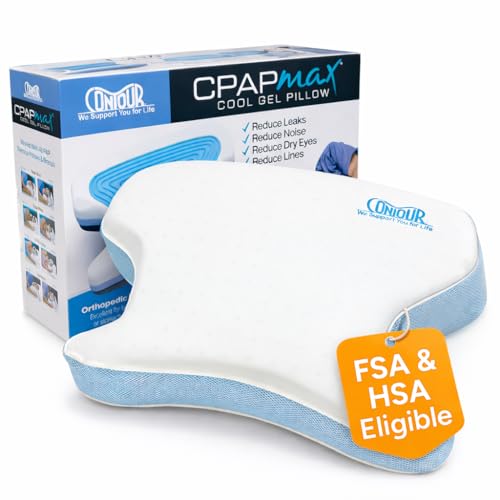
Contour Contour CPAPMax Cooling Gel
The listing describes a 2-in-1 design with a plush, fiber fill or memory foam surface, which suits readers who dislike solid foam. It gives no height and no dimensions, so buy it knowing you will find out the fit at home. The “stay cool all night” and “pressure-free zone” lines are seller claims with no measurement behind them.
- Type
- CPAP pillow with side cut-outs
- Height
- Not stated; 2-in-1 design adjusts loft
- Fill
- Adjustable memory foam and fiber fill with a cool gel layer
- Price band
- Mid-range


We earn a commission if you buy through these links, at no extra cost to you. As an Amazon Associate we earn from qualifying purchases. Prices and availability are shown on Amazon and can change.
5 mask checks to run before you buy a pillow
AASM says “The most common problems with CPAP occur when the mask does not fit properly.” A cut-out cannot correct a mask that is the wrong size, so run these five checks first. None of them costs anything, and a CPAP pillow for side sleeping only makes sense once they are done.
- Fit it on your side. Oxford's advice is to “lie in your usual sleeping position” when you fit the mask, and it names “curled up on your side” as one of those positions. Lie down on the pillow you use now, with the mask on. A fit that holds only while you sit on the edge of the bed tells you little.
- Check the size. AASM explains the two ways size goes wrong. Too big, and “the straps holding it to your face will need to be pulled tightly.” Too small, and it “will not seal properly and air will leak out through the edges.” Oxford adds: “If you can only get a good seal by tightening the mask until it's uncomfortable, you may have the wrong size.” Use your mask's own fitting guide, because Oxford notes that sizing can differ between mask designs.
- Ease the straps before you tighten them. This is the check side sleepers skip. Oxford warns that “Over-tightening your straps can also result in mask leaks.” Stanford Health Care says the mask “should be snug, but not so tight that it feels glued to your face,” with “some give so that, as you move during the night, the mask will shift with you to maintain the seal.” For most nasal mask styles, Stanford says the headgear should have enough slack to pull the mask about an inch from your skin.
- Reseat it, then balance the straps. Stanford says “Most mask leaks can be fixed by pulling the mask away from the face and "reseating" the mask.” If a nasal mask still leaks, the usual cause it gives is that the strap diagonally opposite the leak is too tight, or the strap closest to it is too loose.
- Look for worn parts. Oxford says “An old mask is more likely to leak, while old headgear may lose its elasticity, leading to over-tightening and discomfort.” One of its signs that replacement is due is “you're having to tighten the straps very frequently.” It also asks you not to tinker with a forehead dial, since your clinician set it.
Then look at what is left. Sleep Foundation says temporary red marks that fade within an hour are normal after removing a mask, while lingering indentations or soreness point to straps that are too tight or a mask that does not fit. AASM agrees that strap marks are often due to a poor mask fit. If the marks go once the straps ease, the straps were the likely cause.
The case left for a CPAP pillow is narrower and easy to recognize: the mask fits and the straps are comfortable on your back, but on your side you can feel the pillow pushing the cushion or frame. That is mechanical interference, and giving the mask room is a sensible thing to try.
The one CPAP pillow trial, and its limits
We searched PubMed on November 4, 2026 for “CPAP pillow” and got 52 records. Most are about mask types, including nasal pillow masks, or about newborn CPAP, which are different things. One trial tested a bed pillow made for CPAP users, and we could not find another.
Salvaggio and colleagues (Jornal Brasileiro de Pneumologia, 2016) enrolled 23 people with obstructive sleep apnea who were new to CPAP, and 22 finished. Each slept on their own pillow for nights 1 to 5, then on a foam pillow and a gel pillow for 5 nights each in random order. Both test pillows had side cut-outs. Pressures, residual apnea-hypopnea index, air leaks and hours of use “did not differ among the periods during which each pillow was used.” The authors write that the cut-outs “neither reduced air leaks nor improved respiratory disturbances, as well as having had no impact on patient comfort.” Patients did rate the gel pillow higher than their own pillow and the foam one, but the foam pillow had the same cut-outs, so that preference doesn't point to the cut-outs.
That result is weaker than it first sounds, in both directions. All but one participant wore a nasal mask, which the authors say “allowed them to turn on their sides easily with no increase in air leak,” and most had minimal air leak during the night. So the trial says little about someone whose full-face mask is visibly being pushed. The single oronasal mask user had the highest leak on their own pillow (21.6 L/min), falling to 6.0 L/min on gel and 7.2 L/min on foam, and the authors say further studies are warranted. One person proves nothing either way. Each pillow also got only 5 nights, the own-pillow nights always came first, and the paper reports no count of who slept on their side. The pillows came from one manufacturer, Technogel, and the paper we read carries no funding statement. Neither test pillow is on our list, so any result would not transfer directly.
Now compare that with the sales copy. Each of the four CPAP listings here makes a leak claim: Elviros says “minimize air leaks,” IKSTAR says “helping reduce mask pressure & air leaks,” Lunderg says “help prevent shifting or leaks,” and Contour says “help eliminate leaks.” None of that listing text cites a study. Read those lines as what the seller hopes for. We make no such claim for any pillow on this page, and the same goes for claims about using CPAP more.
CPAP pillows still have support as a comfort step. AASM suggests that “You also can try using a special bed pillow that is shaped for a CPAP mask and tubing,” and Harvard's Dr. Epstein describes pillows with “cutouts that the mask fits into.” So the fair summary of a CPAP pillow for side sleeping is a reasonable thing to try for mask room, as AASM suggests, with no good evidence that it lowers leaks and no trial evidence that cut-outs add comfort.
Cut-outs, height and hose: reading a CPAP pillow listing
Listings for a CPAP pillow for side sleeping give you three things to check, and they disclose them unevenly.
Cut-outs. None of the four listings publishes a cut-out measurement. “Larger cutouts” on the IKSTAR has no number behind it, and the claims that a pillow fits “all” or “most” masks are the seller's own. A cut-out helps only if your face lands over it, which you can only judge at home. Before buying, lie on your side in your mask and note how far the mask sits from the point where your head rests. After it arrives, do the same on the new pillow with the machine on, and check that the frame and hose connection sit in the gap with nothing pressing on them. The return terms matter here, so read them on the listing first.
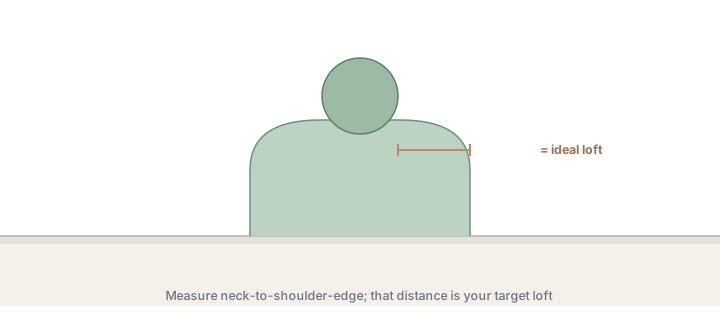
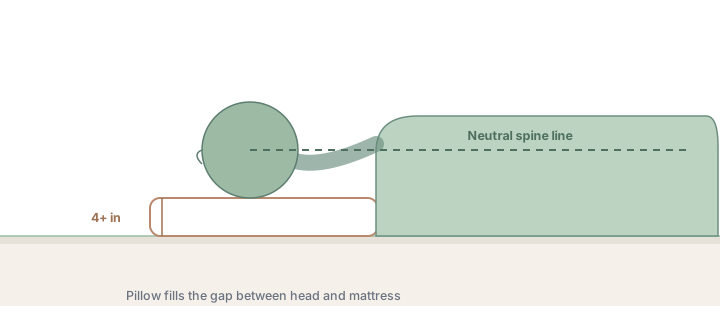
Height. A mask does not change what your neck needs. Sleep Foundation suggests at least 4 inches for most side sleepers, says broad shoulders may need “over 6 inches,” and warns that if you sink deeply into your bed, you “might find that even a 4-inch loft is too high.” Set the listings against that. The Elviros lists 4.14, 4.33, 4.92 and 5.12 inches. The IKSTAR lists 5.5 and 4.7 inches. The Lunderg gives only a removable 1.1-inch layer, and the Contour gives no height at all. So no listed height here reaches the “over 6 inches” some broad-shouldered readers may need. The Elviros listing offers an extra 0.8-inch insert on request, but does not say what total height that gives. None of the listings says which part of the contour its figure measures. Our guide to how high a pillow should be shows how to measure your own gap first.
Your mattress moves the number too. Cleveland Clinic says a firmer mattress needs a thicker pillow, and a topper or pillow-top needs a thinner one. All four picks use memory foam in some form, and Lunderg warns its pillow will feel firm if you are used to standard or down pillows. Our memory foam pillow guide covers that trade-off.
Hose. AASM says “The tubing is long enough to allow you to move around or turn over in your bed.” We found no clinical source that sets out how to route a hose for side sleeping, and we will not invent a method. Elviros says its cut-outs help manage tubing and IKSTAR mentions “hose tug,” but neither explains how, and none of the four listings describes a clip or tether. What you can check yourself is simple: note whether the hose runs under the pillow or under your body when you wake, and whether it pulls from the left or the right. If it keeps tugging the mask, tell your equipment supplier what you saw.
Still leaking on a CPAP pillow?
Stop buying pillows and call your equipment supplier or sleep clinician. Oxford tells patients to “get in touch with your equipment supplier or sleep specialist to request a mask re-fit session,” and AASM says that with fit problems “you may need a different mask or headgear.” A pillow is not a replacement for that appointment.
Make the call useful by bringing specifics:
- your mask's make, model and cushion size, and how old the cushion and headgear are
- which side you sleep on, and whether the leak happens only on that side
- where you feel the air, since AASM notes it may blow into your eyes
- any marks that last, as Sleep Foundation says those signal tight straps or a poor fit
- any leak reading your machine shows you
Raise it soon rather than living with it. Sleep Foundation says “Leaks reduce the effectiveness of your therapy,” and “If leaks persist, you may need a different mask size or style.” Please do not stop using the machine while you wait: AASM says “Using CPAP less often reduces its health benefits and makes it harder for your body to adjust to the therapy.” Leave your pressure settings alone too, because AASM says your sleep doctor determines the air pressure you need.
If the supplier sorts out the mask and you turn out not to need a CPAP-shaped pillow at all, the rest of the site still applies. A side sleeper's pillow has to fill the shoulder gap and keep the neck level, as our main guide to pillows for side sleepers explains. If your arm is what ends up under the pillow, see our arm-under-pillow picks.
CPAP pillow: common questions
Do I need a CPAP pillow if I wear a nasal pillow mask?
Possibly not. Sleep Foundation describes nasal pillows as small and low-profile and a good match for side sleepers, though it says some side sleepers still find the mask shifts when it hits the pillow. Try the five checks above on an adjustable pillow first, and buy a cut-out pillow only if you can feel your pillow pushing the mask.
Will a CPAP pillow stop my mask leaking?
Nobody can promise that. The only trial we found compared cut-out pillows with people's own pillows and saw no difference in air leaks, although nearly everyone in it wore a nasal mask and most had minimal air leak. Leak claims on listings are seller claims. If leaks persist, take them to your sleep clinician or equipment supplier, because a re-fit or a different mask may be what you need.
How high should a CPAP pillow be for a side sleeper?
Use the same height you would without a mask: enough to keep your neck level. Sleep Foundation suggests at least 4 inches for most side sleepers and says broad shoulders may need over 6, while a soft mattress can make 4 too high. No listing on this page reaches 6 inches, so measure your own gap first. A second Sleep Foundation page gives 3 to 5 inches for side and back sleepers with neck pain, so treat every figure as a starting point.
Sources
- Harvard Health — Is your pillow hurting your health? (read October 2026)
- Salvaggio et al., Gel pillow designed specifically for obstructive sleep apnea treatment with continuous positive airway pressure (J Bras Pneumol 2016) (read November 2026)
- American Academy of Sleep Medicine — Continuous Positive Airway Pressure (Sleep Education) (read November 2026)
- Oxford University Hospitals, OxSVS — Information and guidance (read November 2026)
- Stanford Health Care — Mask Fitting Tips for PAP Therapy (read November 2026)
- Sleep Foundation — CPAP Mask Types (read November 2026)
- Sleep Foundation — Best Pillows for Side Sleepers in 2026 (read October 2026)
- Sleep Foundation — Best Sleeping Positions (read October 2026)
- Sleep Foundation — Best Pillows for Neck Pain in 2026 (read October 2026)
- Cleveland Clinic — Is Your Pillow Giving You a Stiff Neck While You Sleep? (read October 2026)