Travel Pillows for Side Sleepers: What Works When You Can Only Lean
The best travel pillows for side sleepers depend on your seat, so this page goes seat by seat. Can travel pillows for side sleepers let you sleep on your side in a seat? No, because you can't lie on your side in a normal upright seat. You sit up and lean. So the shopping job is different from your bed pillow: stop your head rolling or dropping, fill the gap between head and shoulder on the side you lean toward, and pack small. Harvard Health says a horseshoe-shaped pillow can stop your head “dropping to one side if you doze” on a plane, train or car, and warns that one too large behind the neck “will force your head forward.” That warning shapes most of what follows.

Why your head is the weak point in a seat
At home a mattress carries your whole body. In a seat your neck carries your head, and that stops working well once you fall asleep.
The clearest study I found is small. A 2018 study in Chronobiology International gave six healthy adults 4-hour daytime sleep opportunities in a seat at three back angles, with sleep recorded by polysomnography. Compared with the flat seat (90° from vertical):
- The upright seat (20°) gave 29% less total sleep, 30% less slow-wave sleep and 79% less REM sleep.
- The reclined seat (40°) gave similar total sleep and slow-wave sleep, but 37% less REM sleep.
The authors suggest two mechanisms. The first is the one a pillow can touch: “it is difficult to maintain the head in a comfortable position for sleep when sitting upright, and this is likely exacerbated during REM sleep, when muscle tone is very low.” The second is out of a pillow's reach: an upright posture raises physiological arousal.
Keep the limits in view. Six people is a tiny sample, the seats modelled crew rest facilities rather than passenger cabin seats, and the abstract, which is all I could read, doesn't mention a travel pillow. It shows where the problem sits. It does not show which product fixes it.
Sleep Foundation describes the same problem in plain terms: “The head is likely to tilt or slump over, potentially straining the neck.” Side sleepers lose something else too. In an accelerometer study of 664 working adults, people shifted position about 1.6 times per hour in bed. A buckled seat leaves far less room for that, so my reasoning is that the position you start in matters more than it does at home.
If you came here for your bed, start with the best pillow for side sleepers instead. Everything below is about the seat.
Travel pillows: our 7 picks
#1 · Most listed head holds: straps, clasp and wings
Cabeau Evolution S3
The listing gives it three separate holds: straps that attach to the seat, an adjustable chin clasp and raised foam wings, with a stated neck fit of 12 to 18 inches. No other pillow here lists that many, which suits someone whose head drops forward and rolls. It says it compresses to 1/3 size in its case. Nobody has published a measurement of how well these parts work, so treat them as features rather than results.
- Type
- Travel neck pillow with seat straps
- Height
- Not stated
- Fill
- Dual-density memory foam
- Price band
- Mid-range
#2 · For forward drop without a strap
J-Pillow Chin Support Travel Pillow
The listing says its chin support keeps the head from falling forward and that it fills the gap between head and shoulders, which is the leaning-side job in one shape. At 7.5 oz it is the lightest here. No packed size is given, and Sleep Foundation warns that J shapes are often bulkier to pack. The fill isn't stated, but the listing's 6-month return policy gives you time to run the chair test.
- Type
- J-shaped travel pillow
- Height
- Not stated
- Fill
- Not stated on the listing
- Price band
- Mid-range
#3 · Middle and aisle seats, where there's no wall
Travelrest All-in-One Travel Pillow
The strap goes around the seat, a car headrest or your shoulder, and the listing suggests hugging it to your chest or leaning on it at the window. It is the only pillow here with a stated rolled size, 8 x 3.5 x 3.5 inches at 8.6 oz. You set the firmness with your breath. The foam disc isn't washable, though the cover is.
- Type
- Inflatable travel pillow with strap
- Height
- Not stated
- Fill
- Air, with a round memory foam disc at the head end
- Price band
- Mid-range
#4 · Bend-it-yourself roll for window seats and cars
Dot&Dot Twist Memory Foam Roll
A 26-inch memory foam roll that you shape into a wedge against the wall, or snap around your neck or a headrest. That makes it useful when you don't know which side you'll lean to, since nothing fixes it to one shoulder. It is the heaviest seat pillow here at a listed 1 lb, with no packed size.
- Type
- Bendable memory foam roll
- Height
- Not stated
- Fill
- Memory foam
- Price band
- Budget
#5 · Budget neck wrap for short trips
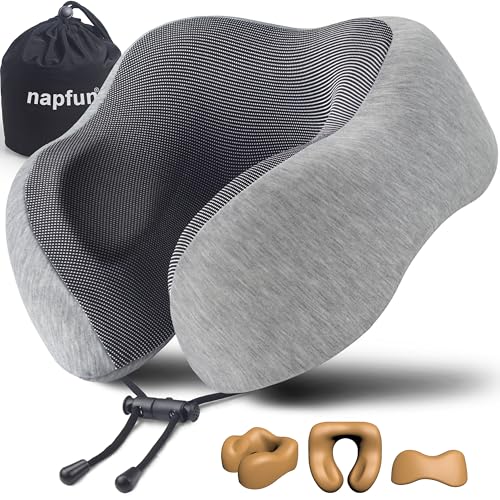
napfun Memory Foam Neck Pillow
A Budget-band memory foam wrap with a compression bag. The listing says it wraps the neck and frees the chin, and lists no seat strap. Listed at 4.72 inches, it is worth checking for the too-thick-behind-the-neck problem Harvard Health describes, since the listing doesn't say how that figure relates to the back of the pillow.
- Type
- Memory foam neck wrap
- Height
- Not stated
- Fill
- Memory foam
- Price band
- Budget
#6 · Hotels and camping when you don't know the mattress
fulocean Small Adjustable Memory Foam Pillow
Not a seat pillow. It is an 18 x 13 inch pillow (size M) with shredded memory foam you add or remove by zipper, plus a travel bag and a machine-washable case. No height is stated, which the adjustable fill offsets. The listing names CertiPUR-US and OEKO-TEX. At 28.1 oz it is better suited to a car than a backpack.
- Type
- Small bed pillow for travel
- Height
- Not stated
- Fill
- Shredded memory foam, adjustable by zipper
- Price band
- Budget
#7 · Small flat pillow with a stated height
alkamto Travel & Camping Memory Foam Pillow
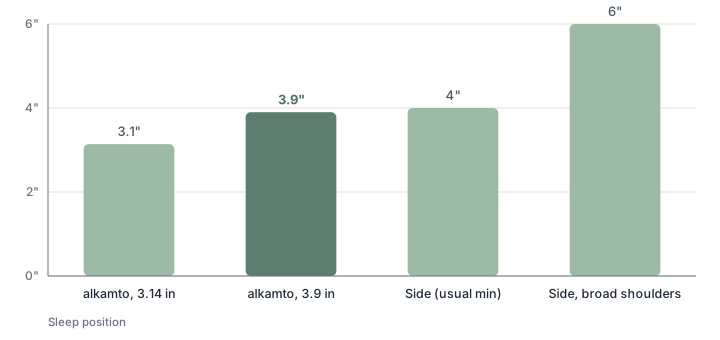
Also a lying-down pillow. It lists 3.9 / 3.14 inches, one of the few travel pillows that tells you its height, which is under Sleep Foundation's 4-inch side-sleeper guide, though inside its neck-pain guide's 3 to 5 inch range. It compresses into a small bag and expands on its own. It is a better match for a softer hotel bed or a narrower build than for a firm camp mat.
- Type
- Small flat bed pillow for travel
- Height
- 3.9 / 3.14 in (listed size)
- Fill
- Viscoelastic memory foam
- Price band
- Mid-range




We earn a commission if you buy through these links, at no extra cost to you. As an Amazon Associate we earn from qualifying purchases. Prices and availability are shown on Amazon and can change.
The three jobs, and the gap you're actually filling
Rank travel pillows for side sleepers on three jobs, in this order.
- Stop the head dropping or rolling. This is the job the study above points at. Forward drop and sideways roll are different failures, and they need different hardware: a chin support or seat strap for the first, something solid beside the head for the second.
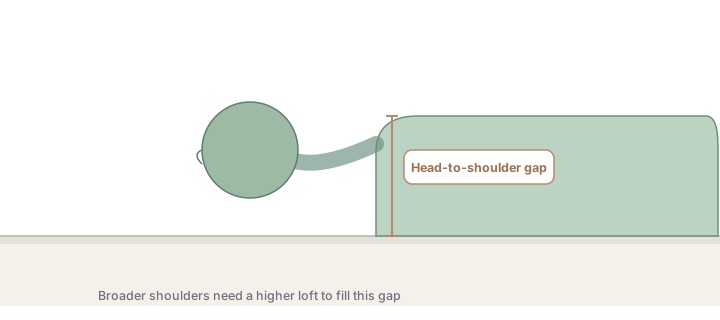
- Fill the gap on the leaning side. You will probably tip toward one shoulder. I'm assuming that's the side you sleep on at home, though no study I found tests that. The space between that ear and that shoulder is the upright version of the gap your bed pillow fills.
- Pack small. A pillow left at home does nothing, and Sleep Foundation notes that “Small or compressible pillows tend to be easier to pack.”
The second job borrows its logic from bed research. A side-sleeper trial describes a pillow's main role as supporting the neck “in a neutral position,” and Sleep Foundation's bed-pillow advice is to match loft to the distance between neck and shoulder. That is the reason I care about the gap upright. It is reasoning rather than a finding: no study I found measures this gap in a seat, and no listing gives a number for it. For the bed version, see how high a pillow should be.
Now the warning that matters most for buying. Harvard Health (Feb 2022) says a horseshoe-shaped pillow “can support your neck and prevent your head from dropping to one side if you doze,” and adds: “If the pillow is too large behind the neck, however, it will force your head forward.” So a thick U shape can cause the drop it was bought to stop. Listings do not give the thickness behind the neck, so test it when it arrives:
- Sit in a straight dining chair with your back and head against something firm, as in a seat.
- Put the pillow on and let your head settle.
- If your chin is pushed toward your chest, it is too thick behind the neck for you. Send it back, or deflate it if it is inflatable.
- Then lean toward your usual side. If your ear still hangs in the air above the pillow, it will not do the second job.
Seat by seat: window, middle, aisle, car, train
Your seat decides more than your sleeping habit does. These are my readings of the listings and the sources, since no study compares shapes by seat.
Window seat
Sleep Foundation says some sleep experts suggest a window seat “because it provides a surface to rest your head.” You can also pick your side. Sit on the left of a forward-facing cabin and you lean left against the wall; sit on the right and you lean right. That is the one booking choice that respects your home side.
The wall handles the sideways roll, so you only need padding and something for forward drop. A rolled Dot&Dot Twist wedges between shoulder and wall. The Cabeau S3 covers forward drop as well.
Middle seat
Nothing sits beside your head, and leaning means leaning on a stranger. Go forward instead: Sleep Foundation says a J-shaped pillow “goes across the front of the body and loops over one shoulder,” and the Travelrest listing says to hug it to your chest. Either gives the head something in front.
Aisle seat
You lean out into the aisle, or into your neighbour, so a pillow that stays put matters most. The Travelrest strap goes around the seat, and the Cabeau straps attach to it. The Travelrest listing names the aisle and middle seats specifically.
Car passenger
Passengers only, obviously. In a US car the front passenger leans right against the door, and the rear left seat leans left. The Dot&Dot listing says its snap closure secures around a headrest, and the Travelrest strap goes around a car headrest.
Train or bus
Treat it as window or aisle according to where you sit. Strap-on pillows need a seatback the strap can go around, so check the seat before relying on one. The Cabeau listing says its straps attach to any seat, and I'd take that as a claim to test.
What the listings promise, and what anyone has shown
Read travel pillow listings as a description of the parts, and be skeptical of the health language. Several listings here claim to prevent neck pain or carry award headlines. Those are seller statements, and I've left them out of the table. This page uses listings for shape, size, weight, straps and care only.
The independent evidence is thin, and it fits on one hand:
- Harvard Health says a horseshoe pillow can support the neck in transit, with the too-large caveat above. It names no product.
- Sleep Foundation lists shapes for upright sleep. It says travelers wanting neck support “may want to go with a u-shaped, wrap, or j-shaped pillow.” That page and its plane-sleep page list no medical reviewer, so I treat them as editorial guidance.
- One seat study comes close. In a 2019 Applied Ergonomics study of a reclined business class seat, researchers found “No significant differences in muscle activity” in the neck muscles they measured, with or without a headrest, though subjects expected more comfort with one. Those people were awake watching a screen, in a headrest rather than a pillow. It suggests comfort is the honest thing to buy.
A November 2026 search of PubMed and Europe PMC found no peer-reviewed trial comparing travel pillow shapes for sleep. So when choosing among travel pillows for side sleepers, nothing here is evidence-based in the strict sense. The picks are a match between a job and a listed feature.
Two details are worth reading closely. Sleep Foundation says “most manufacturers do not indicate the firmness of their travel pillows, so customers are left to guess,” and none of the five seat pillows here gives a firmness rating. Also, a CertiPUR-US line covers polyurethane foam only, and that applies to the foam rather than the whole product.
Inflatables carry one extra note. The Travelrest listing warns that cabin pressure can make it feel softer in flight and tells you to add a breath. Sleep Foundation adds that inflatable pillows “can be deflated so that they take up very little room,” while non-inflatable ones “are usually bulkier.”
Other travel lists often name the Trtl. It isn't in the Amazon listing data we read for this page, so we have no specs to compare and no verdict to give.
Hotels and camping need a small bed pillow, not a neck wrap
Once you can lie down, you are a side sleeper again and neck hardware stops helping. Sleep Foundation says backpackers and campers sleeping lying down “will typically prefer a rectangular or an hourglass pillow.” So the fulocean and alkamto pillows in the table solve a different problem from the five seat pillows, and neither one has any hold for upright sleep.
The usual bed rules apply. Sleep Foundation says side sleepers usually need “at least 4 inches,” that broad shoulders may need more than 6, and that sinking deeply into the bed can make even 4 inches too high. Cleveland Clinic's Dr. Bang adds the mattress half of it: a firmer mattress needs a thicker pillow, and a topper or pillow-top needs a thinner one.
Applied to these two:
- alkamto lists 3.9 / 3.14 inches. That is under Sleep Foundation's 4-inch side-sleeper guide, though its neck-pain guide's 3 to 5 inch range includes both. On a soft hotel mattress that may suit you. On a firm camp mat, by the rule above, it may sit low, especially with broad shoulders.
- fulocean states no height, but the zipper lets you add or remove shredded foam, and Sleep Foundation says adjustable pillows “can be a good choice if you are unsure what pillow loft you need.” That makes it the safer buy when you don't know the mattress. It is also the heaviest item here at 28.1 oz, which counts against it in a backpack.
If you have broad shoulders and a car trip, your home pillow may beat both. Weight stops mattering when the trunk carries it.
Recline first, fix what fails, then get up
A pillow is the third step. Set the seat up first.
- Recline. Sleep Foundation's advice is to “Recline your chair as much as possible,” and the 40° seat in the 2018 study beat the 20° seat. If you can't recline, the head-hold features matter more.
- Sit well back so the seat and any strap take the weight of your head, then fasten the strap or clasp.
- Lean to your usual side and adjust until your ear rests on something.
When it still goes wrong, the failure usually tells you what to change:
- Chin pushed down at the start: too thick behind the neck (the Harvard warning). Let air out of an inflatable, or bend a roll thinner.
- Head falls forward once asleep: you need a chin support or seat strap, as the J-Pillow and Cabeau list. Side wings alone may not be enough.
- Head rolls off the side: add height on the leaning side, or move the pillow to the wall in a window seat.
- Pillow slides away: use a strap, or wrap the roll around the headrest.
- Neck sore for days after: stop using that pillow and raise it with your clinician if it doesn't settle. Nothing on this page treats neck pain. Our neck pain page covers the bed side of that.
Then the part no pillow handles. The CDC says “anyone traveling more than 4 hours, whether by air, car, bus, or train, can be at risk for blood clots,” and most people affected have other risk factors too. Its advice: “Move your legs frequently when on long trips and exercise your calf muscles to improve the flow of blood.” A CDC travel graphic on the page says to walk around every 1 – 2 hours. If you've been sitting a long time, it suggests a break to stretch your legs: “Extend your legs straight out and flex your ankles (pulling your toes toward you).”
A good setup for travel pillows for side sleepers can work against this. A strapped-in window passenger has the longest way out to the aisle. If you have clot risk factors, such as a previous clot, recent surgery or pregnancy, the CDC says to talk with your doctor, and you may prefer the aisle over the wall.
Seat pillows and small bed pillows: listing specs side by side
| Pillow | Shape | Head hold (as listed) | Listed size | Weight | Packing | Cover care | Seat or use (my reading) |
|---|---|---|---|---|---|---|---|
| Cabeau Evolution S3 | U-style wrap with raised wings | Seat straps, adjustable chin clasp, wings | 10 x 9.5 in; neck 12-18 in | 11.6 oz | To 1/3 size in case; luggage clip | Washable cover | Window, aisle, train |
| J-Pillow Chin Support | J-shape | Chin support; no strap listed | 12 x 12 x 7 in | 7.5 oz | No packed size; snap loop for luggage | Machine washable | Any seat, forward drop |
| Travelrest All-in-One | Inflatable with foam disc | Strap around seat, headrest or shoulder | Inflated size not stated | 8.6 oz | Rolls to 8 x 3.5 x 3.5 in | Machine wash cover, line dry; foam not washable | Middle, aisle, car passenger |
| Dot&Dot Twist | Bendable 26-inch roll | Snap closure around neck or headrest | 26 x 3.8 in | 16 oz | No packed size; snaps to luggage | Cotton cover machine washable | Window, car passenger |
| napfun Neck Pillow | Neck wrap with chin room | Listing claims chin support; no strap listed | 11.02 x 11.02 x 4.72 in | 10.9 oz | Compresses in bag; no packed size | Not stated | Short trips |
| fulocean Small Adjustable (M) | Small rectangle, zip-adjustable fill | None: bed pillow | 18 x 13 in | 28.1 oz | Compresses in travel bag | Pillowcase machine washable | Hotel, camping, lying down |
| alkamto Travel & Camping | Small flat rectangle | None: bed pillow | 13.7 x 11.8 x 3.9 / 3.14 in | 23.5 oz | Compresses into small bag | Not stated | Hotel, camping, lying down |
Specs as each Amazon listing states them, read November 2026. Ounces are converted from listed pounds, except Travelrest, which states 8.6 oz. Listing text is the seller's statement, not a measurement by this site; the last column is my reading.
Sukie's take
On this evidence I'd book the window on my usual side, recline as far as the seat allows, and choose by how my head falls: a chin hold if it drops forward, a roll or wall wedge if it tips sideways. I'd ignore the neck pain claims on travel pillow listings, including some of the picks here, because no source I read supports them.
Travel: common questions
Can you sleep on your side on a plane?
Not in a normal seat. You can only lean toward one shoulder, so the aim is to stop your head dropping or rolling and to fill the gap on that side. In a lie-flat seat you can lie on your side, and then ordinary bed-pillow rules apply.
Are U-shaped neck pillows bad for side sleepers?
No source says so. Harvard Health says a horseshoe-shaped pillow can stop your head dropping to one side if you doze, but also that one too large behind the neck will force your head forward. Fit is the deciding factor, so check for that push before you travel.
Do travel pillows actually improve sleep?
Nobody has shown that for the pillows here. I found no peer-reviewed trial comparing travel pillow shapes for sleep. Sleep Foundation says they can help support your neck, and a 2018 study suggests head position is one reason upright sleep is poor. Recline matters too: that study changed only the seat angle, and sleep changed a lot.
Which travel pillow packs smallest?
Of the seven here, only the Travelrest All-in-One states a packed size: it rolls to 8 x 3.5 x 3.5 inches. The Cabeau S3 says it compresses to 1/3 size in its case, and the napfun comes with a compression bag, but neither gives packed dimensions. The J-Pillow and Dot&Dot list none.
Sources
- Roach et al. — Flat-out napping: sleep obtained in a seat increases with angle of recline (Chronobiol Int 2018) (read November 2026)
- Smulders et al. — Neck posture and muscle activity in a reclined business class aircraft seat (Appl Ergon 2019) (read November 2026)
- Sleep Foundation — How to Sleep on a Plane (read November 2026)
- Sleep Foundation — Best Travel Pillows of 2026 (read November 2026)
- CDC — Understanding Your Risk for Blood Clots with Travel (read November 2026)
- Harvard Health — Say “good night” to neck pain (read October 2026)
- Sleep Foundation — Best Pillows for Side Sleepers in 2026 (read October 2026)
- Sleep Foundation — Best Sleeping Positions (read October 2026)
- Cleveland Clinic — Is Your Pillow Giving You a Stiff Neck While You Sleep? (read October 2026)
- Gordon et al. — Pillow use: cervical stiffness, headache and scapular/arm pain (J Pain Res 2010) (read October 2026)
- Skarpsno et al. — Sleep positions and nocturnal body movements (Nat Sci Sleep 2017) (read October 2026)
- CertiPUR-US — Frequently Asked Questions (read October 2026)
- Amazon listings for the seven products above (Creators API listing data) (read November 2026)
- Sleep Foundation — Best Pillows for Neck Pain (read November 2026)