Types of Pillows: The Main Fills and Shapes, With a Verdict for Side Sleepers
The types of pillows on sale are defined by two things: the fill inside the cover and the shape of the pillow itself. Fill covers materials such as memory foam, latex, down, feather, polyester and buckwheat. Shape covers the standard rectangle, contour and cervical pillows, cut-outs, and the specialist forms: body, knee, wedge, travel and CPAP. This page maps both axes, says who each type suits, gives a verdict for side sleepers, and marks where the research stops and where seller claims begin.

The main pillow types at a glance, with a side-sleeper verdict
| Type | Feel and behaviour | Adjustable? | Side-sleeper verdict | Source |
|---|---|---|---|---|
| Block memory foam | Contours evenly, slow to regain shape, prone to holding heat | No, one solid piece | Workable if the height fits; you can’t change it | Sleep Foundation types guide |
| Shredded memory foam | Scrunchable, generally more breathable than block | Some models, by removing fill | Strong starting point when you don’t know your height | Sleep Foundation types guide |
| Latex | Responsive contouring; breathable and durable | Shredded versions sometimes; block no | Best trial record, though the evidence is thin | Sleep Foundation types guide; Chun-Yiu 2021; Gordon 2009, 2010 |
| Down | Light, plush, compresses under the head | Not covered by the sources | Often too soft unless very full; no side-sleeper trial in our register | Sleep Foundation types guide |
| Feather | More support than down; needs regular fluffing | Not covered by the sources | Weakest in the one side-sleeper field trial | Gordon 2009, 2010, 2011 |
| Down alternative and polyester | Soft, light, moldable; wide range of lofts | Only some models | Fine if it is tall enough; check it keeps that height | Sleep Foundation types and replacement guides |
| Buckwheat | Firm, heavy, airy; hulls rustle | Often, by removing hulls | For those who want firm support and don’t mind noise; no side-sleeper trial found | Sleep Foundation types guide; Cleveland Clinic |
| Standard shape | Plain rectangle in any fill, size or loft | Depends on the fill | Default choice; buy by height, not by shape | Sleep Foundation types guide |
| Contour or cervical | Raised neck area with a dip for the head; often firm foam | Some: certain models rotate to change height | Optional: experts disagree and trials show no clear advantage | Gordon 2009, 2011; Cleveland Clinic |
| Cut-out or curved | A notch or curve for the shoulder or arm | Depends on the model | Plausible for arm-under sleepers, but unstudied in our register | Amazon listings, Oct 2026 |
| Body | Extra long, typically 20 by 54 inches | Some, by removing fill | Good add-on for leg and hip alignment, and for pregnancy | Sleep Foundation types guide; Mayo Clinic; ACOG |
| Knee | Small pillow held between the knees | Not covered by the sources | Good add-on; any small pillow can do the job | Mayo Clinic; Cleveland Clinic |
| Wedge | Solid triangular foam block that holds you at an incline | No, one solid block | For a medical reason only; medium-firm may be more comfortable for side sleepers | Sleep Foundation wedge guide; American College of Gastroenterology |
| Travel | J, U or bendable forms for sitting up | Some bendable forms | Not a bed pillow; Harvard Health supports horseshoe shapes for dozing upright, no trial found | Harvard Health; Amazon listings, Nov 2026 |
| CPAP | Cut-outs at the edges to give a mask room | Some, per their listings | Ask your sleep doctor or equipment provider first | Harvard Health; Amazon listings, Nov 2026 |
Compiled from the named sources, read October and November 2026. Feel and adjustability restate those sources or the listings; the verdict column is our editorial reading of them, not a test result or a score.
Two ways to sort a pillow: fill and shape
Fill is what's inside, and it decides feel, heat, noise, care and lifespan. Shape is the outline, and it decides what the pillow supports: your head, your neck, your legs or your whole upper body. Sleep Foundation's types guide sorts the market the same way, which is why this page keeps the two axes apart. Most types of pillows are one choice from each column: a shredded-foam contour pillow, a down-alternative standard pillow, and so on.
For side sleepers, the two axes don't carry equal weight. A 2021 meta-analysis said there may be no change in side-lying neck alignment “regardless of the use of rubber or feather pillows,” adding: “Rather, the cervical alignment may be significantly impacted by the shape and height of the pillow.” A 2025 review of pillows for chronic neck pain found “no particular type (latex, foam or standard) demonstrating clear superiority.”
So treat fill as a question of comfort, upkeep and whether the pillow holds its height. The types guide gives side sleepers “a medium to high loft (3 to 5+ inches) and a mid-range firmness,” and our pillow height guide sets that figure against every other source's number. If you want a decision walk-through rather than a map, use what kind of pillow a side sleeper should use.
The table above is the short version. Its verdict column is our reading of the sources, and “no trial” means none in our source register, which is a statement about what we found.
Memory foam, block or shredded
Memory foam, as Sleep Foundation describes it, “changes shape in response to heat and pressure.” It comes in two forms that behave almost like different products.
- Block (solid) memory foam is one piece. It contours evenly, but block pillows are “slow to regain their shape when the sleeper moves” and “more prone to heat retention.” You get whatever height the mold set.
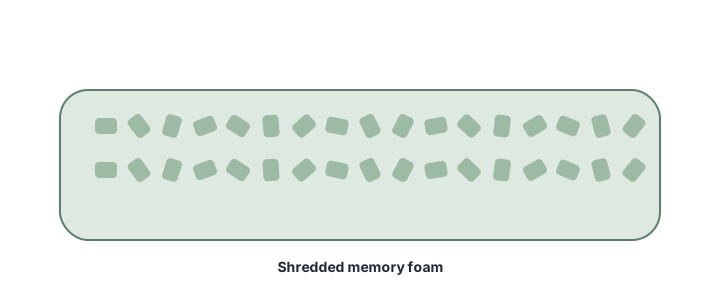
- Shredded memory foam is loose pieces in a cover. Sleep Foundation says it lets you “scrunch and mold the pillow as needed,” is generally more breathable, and that some models have “a zippered cover with removable fill for customizable loft and firmness.”
Who each suits: block foam suits someone who already knows their height and likes a steady, slow feel. Shredded foam suits anyone still working out their height, and a bed-sharing household where two people want different lofts from the same model.
Side-sleeper verdict: shredded is the stronger default for finding your height. Cleveland Clinic adds a caution: “Shredded foam can cool you but loses its stability over time if you sleep on your side,” so recheck the height as it settles. Sleep Foundation's side-sleeper guide says adjustable pillows “can be a good choice if you are unsure what pillow loft you need.” That advice concerns adjustability, and no trial compares block with shredded foam, so the case rests on fit. See our adjustable pillow picks and the memory foam pillow picks.
Life and care: Sleep Foundation's replacement guide says memory foam should be replaced every 2 to 3 years. Its washing guide says solid memory foam should not be machine washed. New foam can smell at first; the types guide says the odor “should air out within a few days as long as you leave the pillow in a well-ventilated room.”
Why latex keeps coming up in side-sleeper trials
Latex has the strongest positive results of any fill in the side-sleeper research we hold. Sleep Foundation calls latex pillows “known for their responsive contouring,” and says they come in block and shredded forms: shredded is “more moldable,” block “excels in shape retention,” and some shredded versions have removable fill. It also separates natural, synthetic and blended latex, noting that synthetic is more affordable but less durable.
The trial record, in brief, is one field trial reported in two papers. Its 106 side sleepers tried five pillows for a week each. One paper supports rubber (latex) pillows for waking neck pain, based on its abstract (Gordon et al., 2009). The other reports that “The feather trial pillow performed least well, producing the highest frequency of waking symptoms, while the latex pillow performed best” (Gordon et al., 2010). The 2021 meta-analysis also favored rubber pillows for neck pain, with a small effect (SMD -0.263), while the 2025 review found no clear winner. Those results point the same way without settling the matter, and they tell you nothing about one latex brand against another.
Side-sleeper verdict: the best-supported fill, if you can find one at the right height and you don't have a latex allergy. Cleveland Clinic chiropractor Andrew Bang says that if you're allergic to latex, you'll want memory foam. Our head-to-head on memory foam vs latex goes through the studies, the Dunlop and Talalay processes, and heat.
Life and care: Sleep Foundation suggests replacing latex every 2 to 4 years, and says to avoid machine washing it.
Down and feather are different pillows
Shops often group these two, but the evidence separates them sharply.
Down is, in Sleep Foundation's words, “quilless feather clusters,” and it makes “light, plush pillows that compress beneath the head.” Feather uses the outer plumage, and its structure “often lends more support than down,” though feather pillows “need regular fluffing.” Many pillows blend the two. A testing lab's sorting step shows how loose the word can be: before testing, IDFL treats a sample with “a declared down content of over 30%” as down, and one up to 30% as feather. That isn't a labeling rule, but a “down” sample can still contain feather. Fill power measures loft, and IDFL says that under the US standard, “extremely high quality down will have a fill power of 700+ in3.” Standards differ by country, so don't compare numbers across them.
Feather verdict for side sleepers: the weakest type here. The 2009 study concluded “Feather pillows should not be recommended.” A lab trial found spinal slope “alters significantly” when people switch between a feather pillow and a foam, latex or polyester one (Gordon et al., 2011). That sits awkwardly with the 2021 meta-analysis quoted earlier, which said alignment may not change between rubber and feather pillows. Cleveland Clinic's Bang says feather pillows cause the most neck pain. Harvard Health disagrees. Its tips for side and back sleepers say to “Try using a feather pillow, which easily conforms to the shape of the neck,” while warning that feather pillows collapse and should be replaced “every year or so.”
Down verdict for side sleepers: unproven and often too soft, on our reading. The trials in our register tested feather, and none tested pure down, so feather's results shouldn't simply be transferred. The practical concern comes from Harvard Health: a soft pillow without enough neck support makes a side sleeper's head “extend sideways to meet the pillow.” A pillow that compresses beneath the head has to start out very full to avoid that. Our soft pillow guide covers the plush options.
Life and care: Sleep Foundation gives 1 to 3 years for down and feather. Check the care label: Sleep Foundation's guides differ on down, one saying some should be dry cleaned and the other that many can only be dry cleaned.

What is down alternative, really?
Down alternative is usually polyester. Sleep Foundation says it imitates down and is “typically made of vegan-friendly polyester microfiber,” sometimes with cotton or rayon, and that it's “generally more affordable and easier to care for than traditional down.” It comes in a wide range of firmness levels and lofts. That range is the point: “down alternative” tells you nothing about how tall or supportive a given pillow is.
Its weakness is staying power. Sleep Foundation's replacement guide puts down alternative at approximately 1 to 2 years and calls polyester “among the least durable,” at 6 months to 2 years. On the plus side, both can be machine washed on a gentle cycle, every 3 to 6 months.
Allergies are less simple than the label suggests. Sleep Foundation says the fill avoids down's “associated allergens,” and NIEHS advises replacing feathered bedding with synthetic. Yet a 12-month paired study found “Synthetic pillows accumulate Der p 1 more rapidly than feather pillows.” Harvard Health reflects the same split. Treat this as unsettled, and use NIEHS's advice on encasing pillows and washing bedding whichever fill you choose.
Side-sleeper verdict: acceptable when the pillow is tall enough and you'll replace it on time. The risk is buying a soft-feeling pillow that sinks below your shoulder gap. Taller, gusseted designs may help here, and the Beckham Hotel Collection review shows what to check on an overfilled set. For tight budgets, see our affordable pillow picks.
Buckwheat and the less common fills
Buckwheat is a fill where the sources give real numbers and still leave questions. Sleep Foundation describes hull pillows as “typically firm, heavy, and supportive,” with fill you can often adjust and gaps in the shells that “allow exceptional airflow.” It also warns of “rustling noises with movement,” and Cleveland Clinic's Bang says “Buckwheat pillows are noisy” and that their support “can slip away,” though they do “support your neck when you sleep on your side.”
Lifespan needs careful reading. The types guide says buckwheat pillows “can last 10 to 20 years with proper care,” while Sleep Foundation's replacement guide suggests replacing the hulls “about once every 3 years.” These fit together if the shell lasts and the fill gets renewed, so budget for refills.
We searched for clinical research and found no side-sleeper trial. What exists concerns allergens. A 2004 study of synthetic and buckwheat pillows (abstract read) found much higher endotoxin on new buckwheat pillows: geometric means of 60,950 EU/g against 4,887 EU/g. After three months, levels of a dust mite allergen were similar on both, at 1.16 and 1.08 microg/g. The authors said the buckwheat levels “may be of relevance to asthma severity of atopic asthmatics.” So be wary of seller claims that buckwheat keeps mites away, and if you have asthma, ask your doctor before buying one.
Side-sleeper verdict: a niche pick. Adjustable hulls can reach a side sleeper's height, but the firmness “isn't ideal for everyone,” and noise rules it out for light sleepers.
Sleep Foundation's guide also covers these, none with side-sleeper evidence in our register:
- Wool: breathable, but alone “often flat and dense with little conforming.”
- Cotton: plush at first, then “flattens over time.”
- Kapok: soft and down-like, but needs regular fluffing.
- Microbeads: moldable, yet they “tend to lose their shape over time.”
Flat or flattening fills work against a side sleeper's need for height, so we'd leave them out unless a specific model states a tall loft.

Shape: standard, gusseted, contour and cut-out
Standard is the plain rectangle, and Sleep Foundation says it “accommodates any sleep position.” Common sizes run from standard (20 by 26 inches) through queen (20 by 30) to king (20 by 36). Those figures are width and length, and they say nothing about height, so check the loft separately.
Gusseted rectangles have side panels. Harvard Health says “Rectangular pillows with panels on the side may help; they're taller than standard pillows.” This is the simplest shape upgrade for side sleepers, and our firm pillow guide covers firmer structured options.
Contour and cervical pillows are close relatives. Contour pillows are “usually made of firm memory foam with a curved surface,” and cervical pillows have “a raised area to support the neck's natural curvature and a dip to cradle the head.” Here the experts disagree:
- For: Cleveland Clinic's Bang says cervical contour pillows “work best for most people,” and Harvard Health tells side sleepers to use a pillow “higher under your neck than your head.”
- Against: the 2009 study found “no evidence that the use of a foam contour pillow has advantages over the regular shaped pillows,” and the 2011 lab trial found shape “does not significantly alter cervico-thoracic spinal segment slope.”
Verdict: optional. Try one if a plain pillow leaves a gap under your neck, but no pillow shape is proven better. Our cervical pillow picks list the height of each model, which matters more than the curve.
Cut-out and curved pillows put a notch or crescent where your shoulder or arm goes. The Coop Cool+ Cut-Out listing calls its notch a shoulder cut-out, and the Coop Crescent curves the same way. We found no study of either design. Verdict: a reasonable thing to try if you sleep with an arm under the pillow, on logic alone. Our arm-under-pillow page goes further.
Roll or bolster pillows are long cylinders. Sleep Foundation says they are usually firm and “often used for decorative purposes.”
Body and knee pillows do a different job
These two don't replace a head pillow. They sit lower down and deal with your hips and spine, and they have the clearest clinical backing of any shape on this page, because the advice concerns the position rather than a product.
Mayo Clinic tells side sleepers with back pain to draw the legs up slightly and put a pillow between them, saying this “can help align your spine, pelvis and hips,” and adds “Use a full-length body pillow if you prefer.” Cleveland Clinic says a leg pillow can stop your upper leg “pulling forward and twisting your torso.”
Body pillows are, per Sleep Foundation, “extra long, typically measuring 20 by 54 inches,” and popular with side sleepers and expecting mothers. In pregnancy, ACOG says it may help to put a pillow between your knees and another under your belly, or “try a full-length body pillow for support.”
Knee pillows are small, and some are sold as contour pillows, shaped to sit between the knees. Sleep Foundation says these models “promote hip alignment.” Note what the clinical sources describe: a pillow, not a special one. Sleep Foundation's side-sleeping page says even a rolled-up towel can work, so start with what you own.
Side-sleeper verdict: both are worthwhile add-ons, and the choice between them comes down to how much you want to hold. Compare them in body pillow vs knee pillow, or go to the body pillow picks and knee pillow picks.
Wedge, travel and CPAP pillows
These three types of pillows solve one specific problem each, and the evidence differs for each.
Wedge pillows are triangular and, per Sleep Foundation's wedge guide, “typically constructed with a solid block of foam, so most are medium firm to firm.” It adds: “Most wedge pillows have a height of 6 to 12 inches, or 30 to 45 degrees.” The main medical use is nighttime reflux, and the best source there is the American College of Gastroenterology, which says: “Use an under-mattress foam wedge to elevate the head about 6-10 inches. Pillows are not an effective alternative for elevating the head in preventing reflux.” Notice that it means a wedge under the mattress, which raises your bed, and that its warning covers pillows in general without carving out foam wedge pillows. Harvard Health quotes a sleep lab director who differs: “I've had success with patients using a wedge pillow.” Ask your clinician which setup to use.
The evidence is modest. A 2021 systematic review (abstract read) found five trials with 228 patients, all “at high-risk of performance bias.” One used a wedge pillow, two used bed blocks and two used both. Four reported symptom improvement. The authors wrote that the limitations “preclude definitive recommendations,” but that head-of-bed elevation “could be still considered as a cheap and safe alternative to drug interventions with unfavourable safety profiles.”
Wedge verdict for side sleepers: buy one for a reason a clinician has given you, and not as a comfort upgrade. Sleep Foundation says medium firm wedges “may be more comfortable for side sleepers,” and we found no study of neck alignment for side sleepers on a wedge. Wedges are also sold for snoring and apnea, but Harvard Health says adjusting your sleep position won't eliminate sleep apnea.
Travel pillows are made for sitting upright. Amazon listings read in November 2026 include J-shaped, U-shaped and bendable forms, and the J-Pillow listing says its chin support keeps your head from falling forward. Those are seller claims. Harvard Health says a horseshoe-shaped pillow can “prevent your head from dropping to one side if you doze,” and that one too large behind the neck “will force your head forward.” We found no trial of any travel pillow, so we offer no verdict beyond this: they aren't substitutes for a bed pillow.
CPAP pillows have cut-outs for a mask. Harvard Health says “If you're a side sleeper, the pillow can knock the mask off,” and that cut-out pillows give the mask somewhere to fit. Listings such as IKSTAR's describe mask cutouts. Harvard's Dr. Epstein says such pillows can help keep masks on, but we found no study measuring how well they work. Ask your sleep doctor or equipment provider, and read our sleep apnea pillow page for what a pillow can't do.
What the evidence does not tell you
Reading all these types of pillows side by side, the sources support four points and leave a lot open.
What they support:
- Height and shape may matter more for side-lying alignment than fill (2021 meta-analysis).
- Feather was the weakest performer in the one side-sleeper field trial we hold.
- Latex has the best trial record, with small effects and small studies.
- A pillow between the knees is common clinical advice for side sleepers with back pain.
What they don't show:
- That any single type suits everyone. Cleveland Clinic's Bang says “There isn't one type of pillow that will satisfy everyone's needs.”
- That contour pillows beat regular ones. The evidence is mixed.
- That down, buckwheat, wool, cut-out or travel pillows help or harm side sleepers. We found no side-sleeper trial of any of them.
- That “cooling” fills lower your temperature. Our register has no peer-reviewed source for this.
- That pillows do more than position you. Harvard Health says their benefits “don't go much further than comfort and positioning.”
Some of the research above is small and we read several papers as abstracts only, so treat each verdict as a starting point. If a pillow leaves you with waking pain, believe your neck over the table.
To turn this map into a purchase, pick your height first, choose a fill you can live with, then add a shape only if you have a reason. The side sleeper pillow shop filters every pillow we cover by type, and our main guide to the best pillow for side sleepers has the fit finder. For pain-led decisions, start from the neck pain picks or the shoulder pain picks.
Sukie's take
Lining up every type made the market look simpler than the shelves suggest. If I were starting from nothing, I’d skip feather, choose a fill that can hold my height, and spend no extra on a special shape until a plain pillow had given me a specific reason to.
Pillow types: common questions
What are the main types of pillows?
The main types of pillows are grouped by fill (memory foam, shredded foam, latex, down, feather, down alternative or polyester, buckwheat) and by shape (standard, contour or cervical, cut-out, body, knee, wedge, travel, CPAP). Most products combine one fill with one shape.
Which type of pillow is best for side sleepers?
No type wins outright. Adjustable shredded foam is the easiest starting point if you don’t know your height, and latex has the best trial record. Feather performed worst. A 2021 meta-analysis suggests shape and height may affect neck alignment more than fill does, so match the height to your shoulder first.
What type of pillow lasts longest?
Going by Sleep Foundation’s figures, latex lasts 2 to 4 years and memory foam 2 to 3 years, against 6 months to 2 years for polyester. Buckwheat pillows can last 10 to 20 years with proper care, but the same publisher suggests replacing the hulls about every 3 years.
Are cervical pillows better than regular pillows?
The evidence doesn’t show that. A study of 106 side sleepers found no advantage for a foam contour pillow over regular shapes, and a lab trial found similar spinal slopes. A Cleveland Clinic chiropractor still favors them, so treat the shape as optional and judge by the height.
Can side sleepers use a wedge pillow?
Yes, and Sleep Foundation says medium firm wedges may be more comfortable for them, but we found no study of side-sleeper alignment on a wedge. For nighttime reflux, the American College of Gastroenterology advises an under-mattress foam wedge, raising the head about 6 to 10 inches.
Sources
- Sleep Foundation — Types of Pillows (updated May 22, 2023; no medical reviewer listed) (read November 2026)
- Sleep Foundation — Best Wedge Pillows of 2026 (updated April 10, 2026; no named medical reviewer) (read November 2026)
- American College of Gastroenterology — Acid Reflux / GERD (updated April 2025) (read November 2026)
- Albarqouni et al. — Head of bed elevation to relieve gastroesophageal reflux symptoms: a systematic review (BMC Fam Pract 2021) (read November 2026)
- Nam et al. — Endotoxin and house dust mite allergen levels on synthetic and buckwheat pillows (J Korean Med Sci 2004) (read November 2026)
- Chun-Yiu et al. — The effects of pillow designs on neck pain (Clin Biomech 2021) (read October 2026)
- Ghosh et al. — Effect of pillow on pain, disability and sleep quality in chronic neck pain (Rehabilitación 2025) (read October 2026)
- Gordon et al. — Pillow use: cervical pain, sleep quality and pillow comfort in side sleepers (Man Ther 2009) (read October 2026)
- Gordon et al. — Pillow use: cervical stiffness, headache and scapular/arm pain (J Pain Res 2010) (read October 2026)
- Gordon et al. — Does pillow type alter cervico-thoracic spinal posture when side lying? (J Multidiscip Healthc 2011) (read October 2026)
- Cleveland Clinic — Is Your Pillow Giving You a Stiff Neck While You Sleep? (read October 2026)
- Cleveland Clinic — Best Sleeping Positions for Pain (read October 2026)
- Harvard Health — Is your pillow hurting your health? (read October 2026)
- Harvard Health — Say “good night” to neck pain (read October 2026)
- Mayo Clinic — Sleeping positions that reduce back pain (read October 2026)
- ACOG — Can I sleep on my back when I’m pregnant? (read October 2026)
- NIEHS — Dust Mites and Cockroaches (read October 2026)
- Rains et al. — House dust mite allergen accumulation on new synthetic and feather pillows (Clin Exp Allergy 1999) (read October 2026)
- IDFL — Explanation of Down and Feather Tests (read October 2026)
- Sleep Foundation — Best Pillows for Side Sleepers in 2026 (read October 2026)
- Sleep Foundation — Side Sleeping: Which Side Should You Sleep On? (read October 2026)
- Sleep Foundation — How Often Should You Replace Your Pillows? (read October 2026)
- Sleep Foundation — How to Wash Pillows (read October 2026)
- Coop Home Goods Cool+ Cut-Out — Amazon listing (read October 2026)
- J-Pillow travel pillow — Amazon listing (read November 2026)
- MROUEN U-shaped travel pillow — Amazon listing (read November 2026)
- Dot&Dot Twist bendable travel pillow — Amazon listing (read November 2026)
- IKSTAR CPAP pillow — Amazon listing (read November 2026)