Best Pillow for Petite Side Sleepers: Lower Lofts for Narrow Shoulders
I'll admit that most advice behind the best pillow for petite side sleepers starts from a number written for someone else. One widely cited figure is Sleep Foundation's “at least 4 inches,” and the tall adjustable pillows on this site's own lists, such as the Coop Original and Sidney Sleep, are listed at 7 or 8 inches. If your shoulders are narrow, the gap between your ear and the mattress is smaller, and a pillow sized for an average frame can push your head up toward the ceiling. So I went back through our catalogue looking for the opposite of the usual brief: pillows that state a low height, or step down to one, without leaving you so low that your head drops.

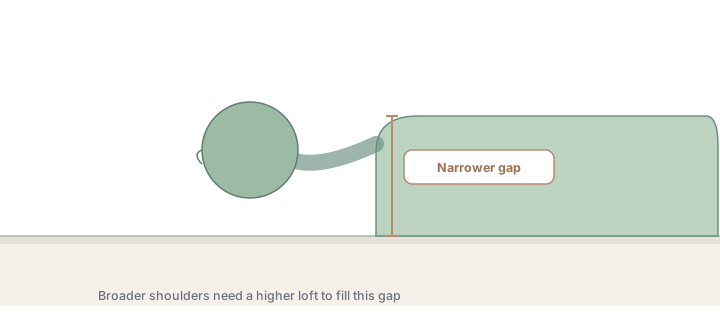
What petite changes: a narrower gap to fill
When you lie on your side, your shoulder props your head off the mattress, and the pillow fills the space that's left. Sleep Foundation's medically reviewed side-sleeping page explains that because the shoulders raise the head further from the bed, side sleepers usually do best with a thicker pillow (Sleep Foundation). The flip side follows directly: narrower shoulders raise it less, so the space to fill is smaller.
Sleep Foundation's measuring principle puts it in one line: “Choose a pillow with a loft, or thickness, that matches the distance between your neck and your shoulder” (Sleep Foundation). There is a little research behind the idea that shoulder width matters. In a 2025 study of nine side sleepers, a measure “calculated by the subject's shoulder width and absolute pillow height” predicted the curve of the neck and the individual optimal pillow height (Tian et al., 2025, abstract). The same study found comfort ratings were not sensitive to that measure, which suggests comfort alone may not be a reliable guide to height.
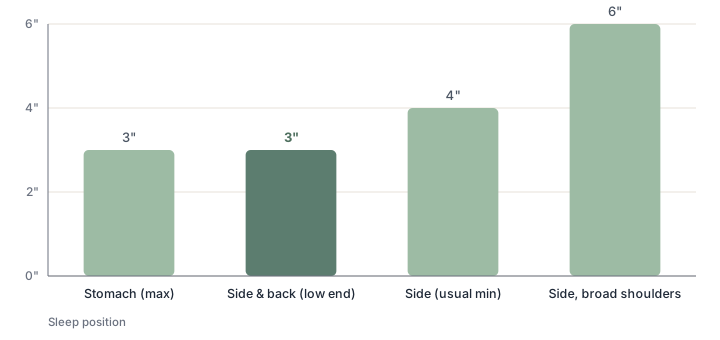
Now the numbers, which don't agree. Sleep Foundation's side-sleeper guide says side sleepers usually need a pillow at least 4 inches thick, and that broad shoulders may need over 6. Its neck-pain guide suggests 3 to 5 inches for side and back sleepers. Neither page gives a figure for petite frames. And a 2021 review of pillow-height research concluded there remain “no firm conclusions about the optimal pillow height for the supine and lateral positions” (Lei et al., Healthcare 2021).
So I can't give you a proven petite number, and I'd be wary of anyone who does. What the sources support is a direction: if your shoulders are narrow, start at the low end of the side-sleeper range, around 3 to 5 inches, and adjust from there on your own bed. Every pick on this page can be set inside that window, which is why the tall adjustable pillows that lead our broad-shoulder guide appear here only for comparison. If you're not sure where you sit, our explainer on how high a side sleeper's pillow should be lines up every source's figure.
One more note on the word petite. People use it for height, weight and build, but the variable the sources tie to pillow height is the width of your shoulders and how far they sink. A tall person with narrow shoulders may need the same low pillow as a short one.
Petite frames pillows: our 4 picks
#1 · Best overall for petite side sleepers
UTTU Sandwich Cervical Pillow
A contour memory foam pillow listed at 5.2 and 4.5 inches on its two edges, dropping to 4.0 and 3.2 inches when you take out the middle layer. That gives you four heights at or near the low end of Sleep Foundation's side-sleeper ranges, each with a high and a low contour. Amazon's buyer summary mentions neck support and choosing two or three layers. My one reservation is warmth: solid foam leaves less room for air than shredded fill, though no source in our register measures pillow temperature.
- Type
- Contour cervical (removable layer)
- Height
- 5.2/4.5 in; 4.0/3.2 in with layer removed
- Fill
- Memory foam
- Price band
- Mid-range
#2 · Best fixed low pillow
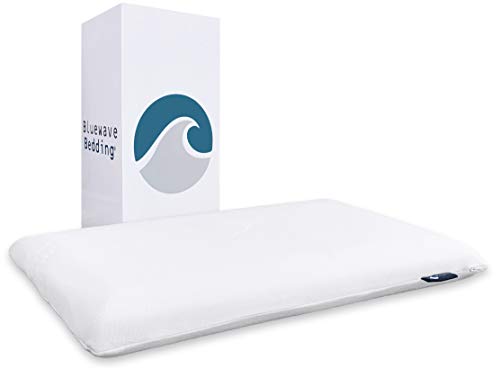
Bluewave Bedding Ultra Slim Gel Memory Foam
Bluewave sells this gel memory foam pillow in heights from 1.75 to 4 inches, so you choose your number when you order. For most petite side sleepers that means the 4-inch or 3.25-inch size; the thinner ones suit stomach sleeping better, and Amazon's buyer summary notes some find them too thin. It's Budget-band, with CertiPUR-US foam and a 3-year warranty on the listing.
- Type
- Slim memory foam
- Height
- 2.75 in (1.75–4 in offered)
- Fill
- Gel memory foam
- Price band
- Budget
#3 · Best two-height contour
VYLEE Cervical Neck Pillow
Two neck-roll edges at 3.9 and 4.9 inches, so you can turn the pillow to the side that fits. The listing calls it soft but supportive, and Amazon's buyer summary singles out support for side sleepers, with some mentions of lumpiness. It isn't adjustable beyond those two edges, and the listing states a 12-month warranty.
- Type
- Contour cervical (dual height)
- Height
- 3.9 in / 4.9 in (two edges)
- Fill
- Memory foam
- Price band
- Mid-range
#4 · Best adjustable for a softer feel
Coop Home Goods Eden Adjustable
Listed at 8 inches when full, which is too tall for most small frames, but you can remove its gel-infused memory foam and microfiber fill, and it is sold as medium-soft, where the Coop Original is listed as medium. Coop's site lists a 100-night trial and a 5-year warranty, useful while you find your setting. Amazon's buyer summary, which this listing shares word for word with Coop's Cool+ Cut-Out, praises how easy it is to adjust and is mixed on cooling.
- Type
- Adjustable shredded foam
- Height
- 8 in listed; adjustable
- Fill
- Gel-infused memory foam + microfiber
- Price band
- Premium



We earn a commission if you buy through these links, at no extra cost to you. As an Amazon Associate we earn from qualifying purchases. Prices and availability are shown on Amazon and can change.
Too low is a risk too: the drooping head
Going low is the right instinct for a narrow frame, but it's easy to overshoot, especially with the thinnest slim pillows.
A side-lying lab study in our register illustrates why. Twenty-one adults without symptoms tried foam pillows 5, 10 and 14 cm high while lying on their side. The 10 cm pillow (about 3.9 inches) was rated most comfortable compared with both the lower and the higher one, and the lowest, 5 cm (about 2 inches), produced the highest activity in the down-side middle trapezius, a muscle of the mid-upper back (Sacco et al., JMPT 2015, abstract). It's a small study, and the participants' frames aren't described in the abstract, so I wouldn't treat 10 cm as a petite target. But it's a reminder that the lowest option didn't win.
Clinical sources describe both failure modes. Cleveland Clinic says a pillow should be thick enough to support your head and neck “without letting it droop down” (Cleveland Clinic), and its rule of thumb is a neck kept “parallel to the mattress, rather than bent down or up” (Cleveland Clinic). Harvard Health adds that with a soft pillow that doesn't support the neck, a side sleeper's “head has to extend sideways to meet the pillow” (Harvard Health), and, at the other end, a second Harvard article warns against “too high or stiff a pillow, which keeps the neck flexed overnight” (Harvard Health).
For a petite side sleeper that rules out two kinds of pillow. A soft, tall fiber pillow can look right in photos and then sink until your head drops. And a slim pillow under 3 inches, made for stomach sleeping, is likely too low for side sleeping all night. That's why I pointed you to the Bluewave's 4-inch and 3.25-inch sizes rather than its thinnest ones. If you also spend time on your stomach, though, the lower sizes come back into play; our guide to the best pillow for side and stomach sleepers covers that mix.
Firmness matters here too. Sleep Foundation says mid-level firmness is usually best for side sleepers, and Harvard Health says side sleepers need a firm pillow for support. A low pillow that's also very soft gives you the least height of all once your head settles, so in this range I'd favor foam that holds its shape over plush fiber. If you do prefer a softer feel, our soft pillow guide explains how to get it without losing height.
Your mattress, your fill, your number
Two petite sleepers with the same shoulders can still need different pillows, because the mattress changes the gap. Cleveland Clinic's Dr. Andrew Bang explains that a firmer mattress needs a thicker pillow, because your shoulder won't sink into it very much, while a memory foam topper or pillow-top needs a thinner pillow, because your shoulder sinks into the bed. Sleep Foundation adds that if you sink deeply into your mattress, you might find that “even a 4-inch loft is too high,” and that loft depends on both your body shape and how much you sink.
For a narrow frame on a soft or topped mattress, that can push the right height below 4 inches. On a firm mattress, the same person may be comfortable near 5. That range is why adjustable and step-down pillows lead this list, and why Sleep Foundation suggests an adjustable pillow if you're unsure what loft you need. The UTTU's removable layer and the Vylee's two edges give you fixed steps; the Coop Eden lets you set a wide range by removing fill.
Here's how I'd find your setting at home:
- Have someone measure from the side of your neck to the outer edge of your shoulder while you stand relaxed. That's a rough starting point, not a medical measurement; no clinical source in our register publishes a measuring protocol.
- Set the pillow near that number: pick the closer UTTU edge, or remove fill from the Eden until it's close.
- Lie on your side on your own mattress and have someone check from behind that your neck continues the line of your spine.
- Wait before judging. In a lab study of 24 women lying on their side, 70.8% had stabilised on the pillow by 15 minutes (Hodkinson et al., Ergonomics 2013, abstract).
- Adjust in small steps over a few nights, and keep any fill you remove in case you want it back.
Remember that listed heights describe the pillow before your head compresses it. I'd expect a solid foam pillow like the Bluewave or Vylee to stay closer to its listing than shredded fill, so with the Eden you may end up keeping more fill than the number suggests; no source in our register measures compression. Our adjustable pillow guide has more on how shredded fill settles.
Neck pain on a small frame: what the evidence supports
If neck pain is why you're looking for a petite pillow, it's worth being straight about what the research shows.
Shape gets the most attention, and the evidence on it is mixed. In a randomized lab trial in side sleepers, contour and regular foam pillows produced similar spinal slopes (Gordon et al., 2011), and a field trial of 106 side sleepers found no evidence that a foam contour pillow had advantages over regular shapes. A 2025 review of five studies found limited evidence for specific pillows in chronic neck pain, with “no particular type (latex, foam or standard) demonstrating clear superiority” (Ghosh et al., 2025, abstract). On the other side, Cleveland Clinic's chiropractor says cervical contour pillows work best for most people, and Johns Hopkins says that if you have neck or shoulder pain, a supportive pillow designed to cradle the neck could be helpful.
What the sources agree on more is height and shape together. A 2021 meta-analysis concluded that in side lying, cervical alignment “may be significantly impacted by the shape and height of the pillow” (Chun-Yiu et al., 2021, abstract). For a narrow frame, that's the strongest argument for the UTTU and Vylee: they are the only contour pillows in our catalogue with a listed height below 5 inches; the other two cervical pillows we cover are listed at 5 and 5.1 inches. If you'd rather avoid a contour shape, the Bluewave's 4-inch size is a plain alternative.
A pillow is a comfort and positioning tool, and Harvard Health says its benefits don't go much further than that. If neck pain lasts despite a pillow that fits, see a doctor or physical therapist rather than buying another pillow. For more on neck-specific choices, see our neck pain picks and the cervical pillow guide. You can compare every pillow we cover in the side sleeper pillow shop, or go back to our main guide to the best pillow for side sleepers and use the fit finder, which has a narrow / petite shoulder option.
Low and step-down pillows for narrow shoulders: listed heights
| Pillow | Listed height(s) | How you change it | Fill | Price band |
|---|---|---|---|---|
| UTTU Sandwich Cervical | 5.2 / 4.5 in; 4.0 / 3.2 in with the middle layer out | Remove the layer, then pick an edge | Memory foam | Mid-range |
| Bluewave Ultra Slim | 1.75, 2.25, 2.75, 3.25 or 4 in (Standard); 2.75 or 3.25 in (King) | Choose the size when ordering; fixed after that | Gel memory foam | Budget |
| Vylee Cervical | 3.9 in / 4.9 in (two edges) | Turn it to use the other edge | Memory foam | Mid-range |
| Coop Eden | 8 in listed, full | Remove fill (extra bag included) | Gel-infused memory foam + microfiber | Premium |
| For comparison: Royal Therapy Contour | 5 in (Queen); 6.5 in Extra sizes | Removable layer (lower height not stated) | Memory foam | Mid-range |
| For comparison: Coop Original | 8 in listed, full | Remove fill (extra bag included) | Cross-cut memory foam + microfiber | Mid-range |
Heights as each Amazon listing or brand page states them, read October 2026. Listed heights are measured before your head compresses the pillow.
Petite frames: common questions
What pillow height should a petite side sleeper start with?
No source gives a petite-specific number. Sleep Foundation's neck-pain guide suggests 3 to 5 inches for side and back sleepers, and its side-sleeper guide says at least 4 for most side sleepers, so a narrow frame usually starts at the low end of that overlap and adjusts on its own mattress.
Is a 3-inch pillow too low for side sleeping?
It can be. In one small lab study, the lowest pillow (5 cm, about 2 inches) produced the highest activity in one mid-back muscle, the down-side middle trapezius, and the 10 cm pillow was rated most comfortable. On a soft mattress or with very narrow shoulders, 3 inches may work, so check that your head doesn't droop.
Are contour pillows too tall for small frames?
Some are. Two of the four contour pillows in our catalogue are listed at about 5 inches, but the UTTU Sandwich drops to 4.0 and 3.2 inches with its middle layer out, and the Vylee has a 3.9-inch edge. Evidence on contour shapes is mixed, so choose one for fit, not a promised benefit.
Sources
- Sleep Foundation — Best Pillows for Side Sleepers in 2026 (read October 2026)
- Sleep Foundation — Best Pillows for Neck Pain in 2026 (read October 2026)
- Sleep Foundation — Best Sleeping Positions (read October 2026)
- Sleep Foundation — Side Sleeping: Which Side Should You Sleep On? (read October 2026)
- Cleveland Clinic — Is Your Pillow Giving You a Stiff Neck While You Sleep? (read October 2026)
- Cleveland Clinic — Best Sleeping Positions for Pain (read October 2026)
- Harvard Health — Say “good night” to neck pain (read October 2026)
- Harvard Health — Is your pillow hurting your health? (read October 2026)
- Johns Hopkins Medicine — Choosing the Best Sleep Position (read October 2026)
- Tian et al. — The individualized optimal pillow height and neck support design for side sleepers (Med Biol Eng Comput 2025) (read October 2026)
- Lei et al. — Ergonomic Consideration in Pillow Height Determinants and Evaluation (Healthcare 2021) (read October 2026)
- Sacco et al. — The effect of pillow height on muscle activity (JMPT 2015) (read October 2026)
- Hodkinson et al. — Time to stabilisation of the cervical spine in side lying (Ergonomics 2013) (read October 2026)
- Gordon et al. — Does pillow type alter cervico-thoracic spinal posture when side lying? (J Multidiscip Healthc 2011) (read October 2026)
- Gordon et al. — Pillow use: cervical pain, sleep quality and pillow comfort in side sleepers (Man Ther 2009) (read October 2026)
- Ghosh et al. — Effect of pillow on pain, disability and sleep quality in chronic neck pain (Rehabilitación 2025) (read October 2026)
- Chun-Yiu et al. — The effects of pillow designs on neck pain: systematic review and meta-analysis (Clin Biomech 2021) (read October 2026)
- UTTU Sandwich Cervical Pillow — Amazon listing (read October 2026)
- Bluewave Ultra Slim Gel Memory Foam Pillow — Amazon listing (read October 2026)
- Vylee Cervical Neck Pillow — Amazon listing (read October 2026)
- Coop Home Goods Eden Adjustable — Amazon listing (read October 2026)
- Coop Home Goods — Eden pillow product page (read October 2026)
- Royal Therapy Memory Foam Contour Pillow — Amazon listing (read October 2026)
- Coop Home Goods Original Adjustable — Amazon listing (read October 2026)